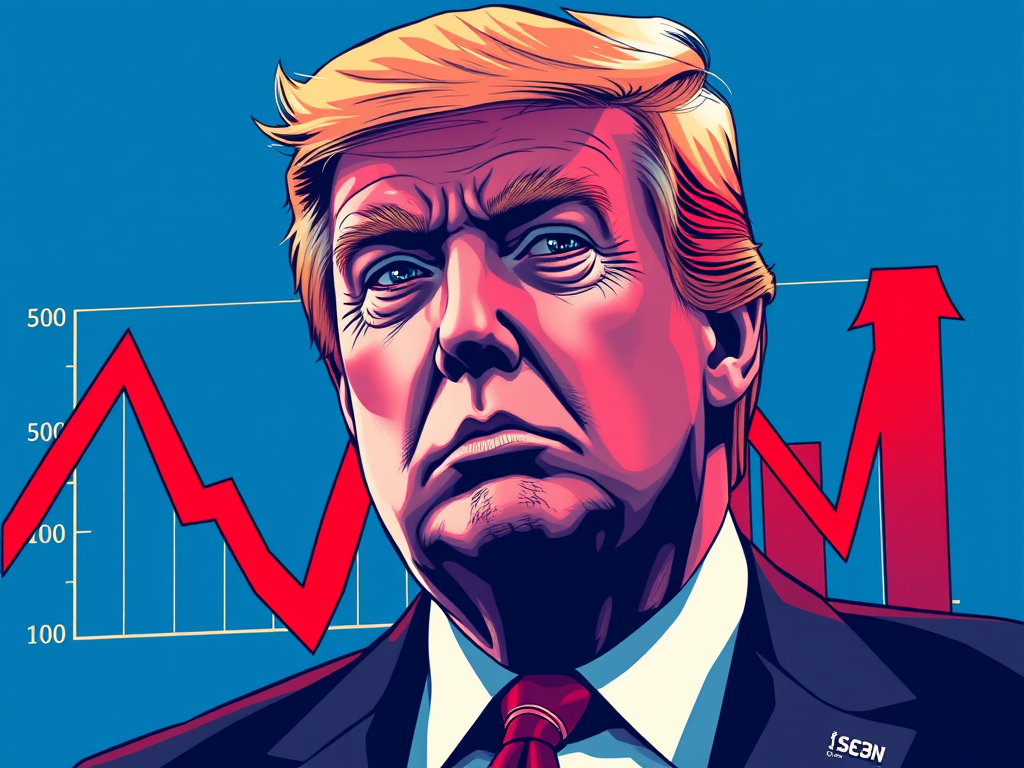
President Trump’s approval ratings are at or near historic lows, with declining support on the economy, immigration, and foreign policy.
Blue Press Journal – As President Donald Trump concludes the first year of his second term, a series of new national polls reveal a sharp decline in public approval, underscoring deepening political divisions and waning confidence in his leadership.
Public Sentiment Turns Negative
A CNN poll released Friday found that nearly 60% of Americans view Trump’s first year back in office as a failure. Even on the economy—historically one of his strongest areas—55% say conditions have worsenedunder his leadership, with only 36% believing he is focused on the right priorities, a nine-point drop since last year. Trump’s overall job approval now sits at 39%, down from 48% in February 2024.
The same survey reports that a majority believe he has overstepped his presidential authority, reflecting growing concerns about the use of executive power.
Erosion in Party Support
The Associated Press–NORC poll also reveals troubling signs for Trump within his own party. Only 16% of Republicans believe he has significantly helped with the cost of living—down from 49% in April 2024. Approval of his immigration policies among Republicans has slipped from 88% in March to 76% now, with overall national approval on immigration at 38%.
These numbers mark some of the lowest economic ratings recorded for Trump during both his presidencies.
Foreign Policy Opposition
Other surveys echo similar concerns. A Reuters/Ipsos poll shows 58% disapproval of Trump’s job performance, with just 36% approving of his economic handling. Notably, 71% oppose military action against Greenland, and a Marist poll finds 56% against intervention in Venezuela—highlighting widespread discomfort with his foreign policy approach.
BLUE PRESS JOURNAL – In a stark sign of his dwindling popularity, President Donald Trump has hit a record high in disapproval ratings in the crucial swing state of North Carolina, according to a recent poll. With only 35% of respondents in the key state expressing approval, the 2026 midterm elections are poised to become a major test for Trump and his GOP allies.
The Elon University and YouGov survey, conducted from November 19 to December 1, paints a bleak picture for Trump, with 51% of North Carolinians voicing disapproval of his job performance. This alarming number is compounded by an additional 14% of undecided voters, a demographic that often proves decisive in close elections. The data suggests Trump’s toxic approval ratings are not only damaging his own re-election prospects but also posing significant challenges for Republicans looking to retain control of Congress.
North Carolina’s status as a traditional swing state makes these findings particularly concerning for the GOP. Recent voter registration figures from the North Carolina State Board of Elections show a razor-thin margin between the two major parties, with Democrats holding a mere 1,200 voter advantage. This slim margin underscores the state’s impact on national electoral outcomes and underscores the importance of Trump’s performance in the region.
Trump’s struggles in North Carolina are reflective of his broader national decline in popularity. As the President’s controversial policies and persona continue to polarize the country, many Americans are growing increasingly disaffected with his leadership. His inability to appeal to a broader cross-section of voters in key battleground states like North Carolina raises serious questions about his ability to lead a unified country and effectively represent the diverse interests of the American people.
With the 2026 midterms fast approaching, the implications of Trump’s plummeting approval ratings in North Carolina are far-reaching and potentially disastrous for the Republican Party. If the President’s unfavorable ratings continue to soar, it could lead to a significant erosion of Republican support among key voter demographics, creating an uphill battle for the party to retain control of Congress.
Trump’s staggering disapproval ratings in North Carolina act as a glaring alarm bell for the GOP as they gear up for the 2026 midterms. With his divisive presence continuing to redefine the political terrain, his inability to charm swing state voters like those in North Carolina could spell disaster for the Republican Party’s electoral prospects. Time is running out for Trump and his allies to reverse the tide of public sentiment, or they might just find themselves staring down the barrel of a humiliating defeat at the polls.
60 percent of Americans disapprove of the job Trump’s doing
Blue Press Journal – A new Gallup poll released on Friday has revealed a dismal picture for President Donald Trump, with his approval rating sinking to 36 percent, just one point higher than its lowest point since taking office. The poll, which comes as Trump nears the midpoint of his term, shows that 60 percent of Americans disapprove of the job he’s doing, a stark reminder that his policies and actions are facing intense scrutiny from the public.
Trump’s numbers have been underwhelming since his return to the Oval Office in January, with his approval rating stuck between 40 percent and 41 percent in the intervening months. The latest poll suggests that his policies on immigration and the economy, two key areas he’s focused on, are not resonating with voters. His approval rating on these issues stands at 37 percent and 36 percent, respectively, while his handling of healthcare policy has earned a meager 30 percent approval rating.
The pollsters noted that Trump’s standing with the American people has been damaged by the longest shutdown of the federal government, Republican Party losses in the 2025 elections, and concerns about affordability. The combined effect of these factors “could be a sign of trouble for Republicans in next year’s midterm elections,” Gallup warned, as the GOP tries to maintain control of the federal government.
Trump’s response to criticism has been to lash out at the press, exemplified by his bizarre outburst earlier this month when he told an ABC News reporter to “Quiet, piggy” while she asked about the Justice Department’s release of files related to convicted sex offender Jeffrey Epstein. This behavior only adds to the perception that Trump is out of touch with the concerns of ordinary Americans.
As the midterm elections draw near, Trump’s plummeting approval rating and the GOP’s mounting electoral defeats are transforming into an undeniable burden for the party. The signs are unmistakable: Trump’s policies and outrageous behavior are failing to connect with the electorate, and it is high time for Republicans to engage in a serious introspection about their path forward.
A recent NPR/PBS News/Marist survey has shown that Democrats hold a significant 14-point advantage over Republicans going into the midterm elections next year. The poll, conducted from November 10-13, found that 55% of voters said they would choose a Democratic candidate in their district if the election were held today, compared to 41% who said they would opt for a Republican candidate.
This is the largest lead Democrats have had in a Marist poll since 2017, a period marked by the tumultuous start of President Trump’s first term in office. During this time, voters were grappling with the numerous actions taken by the Trump administration on issues such as immigration, climate change, and tax policy. The following year, Democrats saw a significant surge in support, gaining approximately 40 seats in the House of Representatives as voters rallied behind the party’s focus on healthcare and their opposition to Trump.
The latest poll also reveals that independents are leaning heavily towards Democratic candidates, with 61% stating they would choose a Democrat compared to just 28% who said they would choose a Republican. This significant lead among independents is a key factor in the overall 14-point advantage held by Democrats.
The survey’s findings are a positive indicator for Democrats in the midterms, suggesting the party is positioned to gain in the House. However, it’s important to note that the poll reflects only a snapshot of voter sentiment, which can shift significantly in the coming months.
The NPR/PBS News/Marist survey offers insight into the midterm elections, showing the significant lead of Democrats. It will be intriguing to see if this lead holds or if Republicans can close the gap.
When Donald Trump won the 2024 presidential election, he did so on a wave of voter frustration—a deep dissatisfaction with the state of the U.S. economy, persistent inflation, and a soaring cost of living that plagued Kamala Harris’s campaign. His bold promise to “bring prices down” resonated across political lines, especially in key battleground states where families felt the financial squeeze more than ever.
Yet, one year into his second presidency, Trump’s economic promises appear more illusion than reality. Far from delivering relief, the latest data show inflation rising, household expenses climbing, and public confidence in his economic leadership sinking fast.
The Core Promise: Lowering Costs for Ordinary Americans
On the campaign trail, Trump’s rhetoric was clear: “We will bring grocery prices down. We will make energy affordable again. And we will end the economic pain caused by the Harris-Biden administration.” That clarity, coupled with aggressive attacks on his opponent’s record, helped him secure victory.
A year later, however, the picture looks grim. Grocery prices—already high—have surged to historic levels. Beef, coffee, and bananas have hit record highs, and the cost of electricity is biting deeply into household budgets.
Economic Snapshot – November 2025
Category
Price Change (YoY)
Notable Factors
Beef
+18%
Tariffs on South American imports, increased feed costs
Coffee
+22%
Tariffs on Brazil, supply chain disruptions
Bananas
+25%
Import restrictions, climate impacts
Electricity
+15%
Reduced renewable subsidies, fuel cost increases
Overall Inflation
+6.1%
Tariff-induced price pressures, labor shortages
Tariffs, Immigration Crackdowns, and Rising Prices
The administration’s economic strategy has heavily focused on aggressive global tariffs—meant to protect U.S. industries but instead often raising costs for U.S. consumers. Combined with strict immigration crackdowns that have reduced the labor force in agriculture and manufacturing, supply chains have been squeezed from multiple directions.
Economists warn that such policies can backfire. As economist Dr. Laura Benton told The Washington Post:
“Tariffs can protect certain domestic industries in the short term, but when applied so broadly and amid labor shortages, they almost inevitably raise consumer prices. In this case, the everyday American shopper is paying the price for political posturing.”
The Energy Gap: Another Broken Promise
Energy affordability was another cornerstone of Trump’s campaign platform. He accused the previous administration of “killing U.S. energy independence” and promised a resurgence in domestic oil, gas, and coal production to slash prices.
Yet, electricity prices have risen sharply—up 15% in just a year—due partly to reduced subsidies for renewable energy projects and volatile fossil fuel markets. Utility companies have passed higher costs on to consumers, further squeezing household budgets.
Trump’s “energy-first” rhetoric hasn’t translated into meaningful savings for Americans. In fact, higher energy costs disproportionately hurt lower-income households who spend a larger portion of their earnings on utilities.
Public Opinion: Approval in Decline
The political cost has been significant. According to a recent Washington Post-ABC News poll:
59% of Americans assign Trump either “a great deal” or “a good amount” of blame for current inflation.
His approval rating on handling the economy sits at 37%, versus 62% disapproval.
These numbers reflect a sharp decline from his post-election honeymoon period when many voters were willing to give him time to fulfill his promises.
During a recent interview on CBS’ “60 Minutes”, Trump was asked directly about his message to Americans struggling financially. Rather than addressing inflation or energy costs, he pivoted to discussing crime and immigration—issues where polling shows he performs better with the public. The dodge was glaring, and to many observers, telling.
Tax Cuts for the Wealthy – Paid for by Cuts to Medicaid
In a move that has drawn intense criticism, Trump signed his “Big Beautiful Bill” into law—a sweeping measure that extended his 2017 tax cuts primarily benefiting the wealthy, costing the U.S. government nearly $4 trillion over the next decade.
To help fund these cuts, his administration slashed Medicaid by $800 billion, a decision that has alarmed healthcare advocates and left millions vulnerable. For Americans facing rising costs on all fronts, the policy has reinforced a perception that Trump’s economic priorities favor the affluent over the working class.
Advocacy group spokesperson Maria Alvarez told reporters:
“These policies are not designed to help the average American family. Cutting vital healthcare programs while lavishing tax breaks on billionaires sends a clear message: you are on your own.”
The Danger of Political Promises Untethered from Policy Reality
Trump’s inability—or unwillingness—to deliver on his core economic promises raises broader questions about the nature of political campaigning. In retrospect, his vow to bring down grocery and energy prices may have been less an achievable policy goal than an effective electoral talking point.
Political analyst Greg Stanton argues:
“Campaign promises are often aspirational, but when they’re made in absolute terms—like pledging to lower prices ‘fast’—they set expectations that can implode if reality doesn’t cooperate. That’s when broken promises become political liabilities.”
The Cost of Distrust
Broken promises don’t just harm an administration’s approval ratings; they erode trust in the political process itself. For Americans who voted in 2024 hoping for economic relief, the past year has been a painful reminder that campaign rhetoric and governing reality can be miles apart.
This distrust carries consequences beyond Trump’s presidency—it deepens political polarization, discourages voter engagement, and fuels cynicism.
The Price of Broken Promises
The story of Trump’s second term thus far is one of unmet expectations. The promises to lower everyday costs have not materialized. Instead, tariffs, energy price hikes, and cuts to social programs have compounded the financial strain on millions.
For the voters who propelled him back into office, the disappointment is palpable. As inflation edges upward and household budgets tighten, the gap between campaign promises and lived reality grows ever wider.
In politics, promises can win elections—but failing to keep them can define a presidency. One year in, Donald Trump’s economic record is not one of triumph, but of trust broken.
Blue Press Journal – President Trump and his allies continue to tout a “mandate” for his far-right policies. But a closer examination of the election results and recent polling data reveals a different story. Despite winning the popular vote by a slim 1.5 percent margin, Trump’s claims of a sweeping mandate are baseless.
Polling Agency
Approval Rating
Leger
38%
YouGov
40%
Pew Research Center
40%
Marist College
41%
These weak approval ratings, averaging around 40 percent, are a far cry from the overwhelming support Trump claims to have. As Senator Bernie Sanders noted, “When you win an election by 1.5 percent, that’s not a mandate. That’s a narrow victory.” Moreover, the policies Trump is pushing, such as firing federal workers, deploying the military to cities, and slashing funding for medical research, are not supported by a majority of Americans.
In fact, a recent survey by the Pew Research Center found that 60 percent of Americans oppose reducing funding for medical research, while 55 percent oppose deploying the military to cities to address protests. These numbers suggest that Trump’s policies are out of touch with the values and priorities of the American people.
As Representative Alexandria Ocasio-Cortez pointed out, “The idea that Trump has a mandate to push through these extreme policies is a myth. The American people did not give him a blank check to pursue his agenda.” Instead, the election results and polling data suggest that Americans are looking for bipartisan solutions and pragmatic leadership, not divisive rhetoric and radical policy shifts.
The notion of a Trump mandate is a myth that needs debunking; the numbers do not support claims of broad endorsement for his policies. We must prioritize democracy, inclusivity, and pragmatism over a partisan agenda. As Barack Obama said, “We are the change that we seek.” It’s time for Americans to unite for a more equitable future for all.
The poll also highlights the deep divisions within the country, with nearly half of Democrats (49%) reporting that they are “furious” about the actions of the Trump administration. In contrast, 27% of Republicans say they are “thrilled” with the administration’s actions, while 18% report being “happy” and 28% say they are “satisfied”. These results demonstrate the intense polarization that has come to characterize American politics under Trump’s presidency.
One area where Trump’s ratings are particularly weak is on economic matters. Only 39% of Americans approve of his handling of inflation, while 41% approve of his handling of trade and tariffs. These numbers are concerning, given the significant impact that economic policy can have on the lives of everyday Americans.
On the other hand, there is one issue where Americans are largely united: the use of vaccines to prevent diseases. A whopping 78% of respondents strongly or somewhat support the use of vaccines, with 49% strongly supporting it. This overwhelming majority demonstrates that, despite their differences, Americans can come together on issues that affect the health and well-being of their communities.
Recent claims by Donald Trump regarding widespread support for his agenda and a supposed “historic win” are demonstrably false. Public opinion polls paint a starkly different picture, revealing a nation divided and increasingly concerned about the direction of the country.
A recent Emerson College Polling survey indicates that Trump’s approval rating is “underwater,” with 45% of respondents approving of his performance and 46% disapproving. Furthermore, a significant majority (53%) of those surveyed believe the country is on the wrong track, compared to 48% who feel it is headed in the right direction. These figures directly contradict any assertion of overwhelming support for the current administration.
The same survey also suggests a potential shift in the political landscape. On a generic congressional ballot, Democrats hold a slight lead over Republicans, receiving approximately 43% of the vote compared to 40% for the Republicans.
The implications of these findings are nothing short of monumental. As concerns swell about the future of our nation, the very real possibility of a transformation in congressional control ignites hope to return to sanity.
Perhaps Trump should stick to playing golf in Florida, where his ratings might be a bit better. After all, it seems like the less he does, the more people like him. But hey, who needs a mandate when you’ve got a golf club.
It’s absolutely shocking (not really) that Trump’s job approval is already in the toilet just over two weeks into his presidency. Usually, this is the time when presidents are basking in the glow of public adoration, but not Trump. His poll numbers are plummeting faster than a lead balloon.
According to a new poll from Civiqs conducted for Daily Kos, only 45% of registered voters approve of the job Trump is doing, while a whopping 52% are opposed. Even independent voters, who usually swing both ways, are turning their backs on him. Fifty-three percent disapprove of his performance, while a measly 43% approve.
And let’s not forget about the cherry on top – blaming a plane crash on diversity programs in aviation. Classic Trump move. 68% of voters agree that disaster relief shouldn’t be withheld over policy disagreements with the president.
Let’s not forget Elon Musk and his poll numbers. The percentage of Republicans who support Elon Musk having a significant influence has decreased significantly to 26%. Conversely, 43% of Republican respondents prefer Musk to have a minor influence, while 17% believe he should have no influence at all. These findings are based on the most recent poll conducted by The Economist/YouGov, which was released on Wednesday.
So, while Trump may have narrowly won, yes narrowly … no mandate, the 2024 election, it looks like he’s not immune to political gravity. If he keeps pushing his unpopular agenda, Republicans might be in for a rude awakening come the 2026 midterm elections.





 Blue Press Journal