Unethical, Illegal, and Unacceptable Misuse of Public Funds
by Winston Wendell
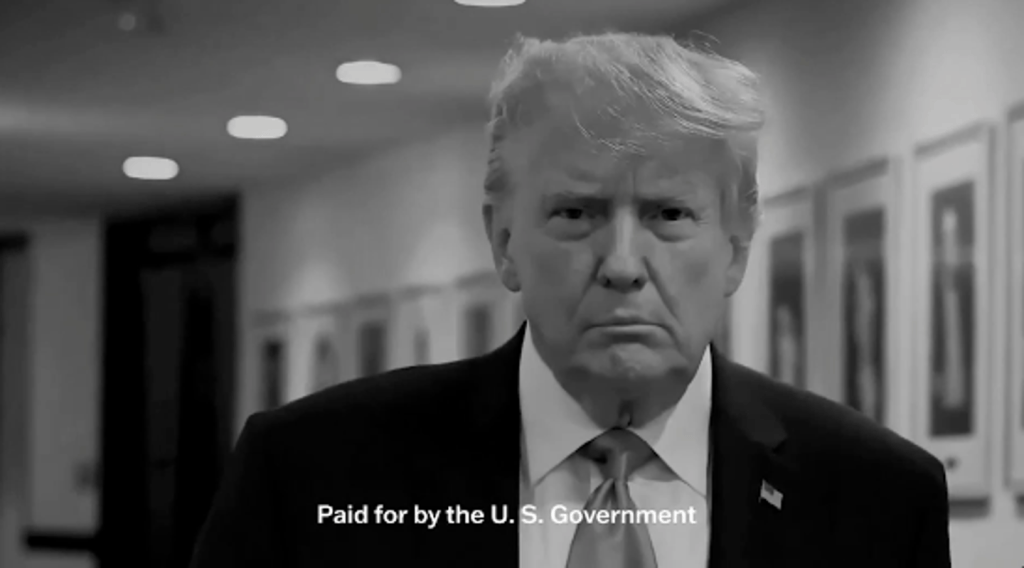
The Trump administration has crossed another bridge on its way to complete disaster by publicly displaying a campaign ad that utilizes taxpayer funds. The video, taken from Trump’s 2024 campaign, includes his usual insults at “villains” and “institutions.” This is not only shameful but illegal and ethically wrong.
According to the Hatch Act, federal employees cannot engage in any politics while on duty and misusing federal resources. Additionally, the Anti-Lobbying Act and appropriations acts state that it is illegal to use federal funds for “publicity or propaganda” for a candidate. In other words, Trump has officially been purchasing attack ads with taxpayer’s money.
This is an utterly unethical and completely corrupt practice, fueled by Trump’s vindictiveness and thirst for attention. The money paid by citizens for defense, roads, or public healthcare gets wasted on ad campaigns for political purposes. This public relations operation will damage the reputation of the government and the office of the president.
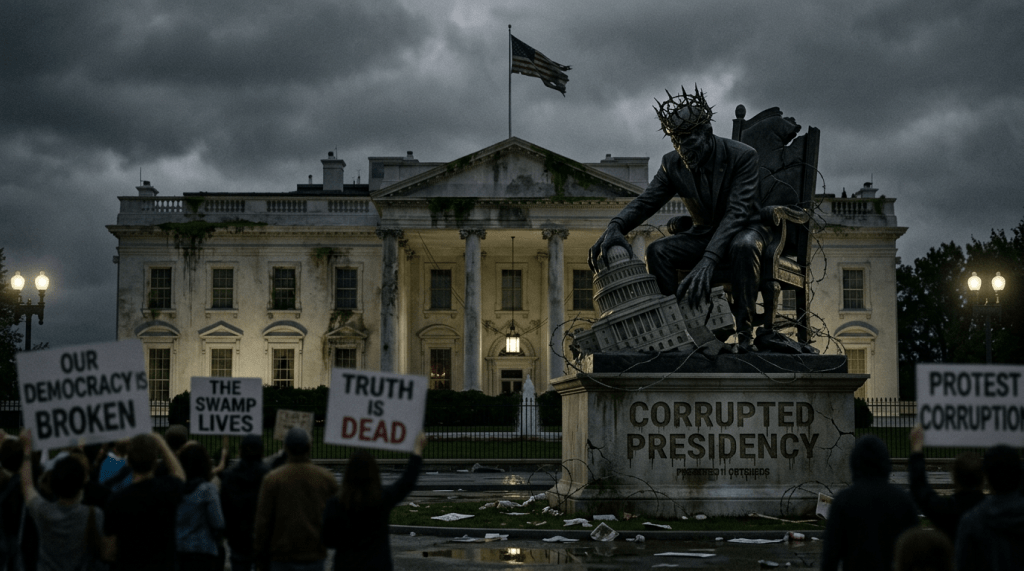
Such an unethical and corrupt action demonstrates Trump’s contempt for the rule of law and democratic norms in general. According to CREW, this latest scandal further illustrates the harm that can be done when the government engages in the kind of behavior. The Government Accountability Office already warned about the illegality of these actions. The President of the United States is not an executive for a private company. They should not turn their apparatus into a propaganda machine for their own electoral gain.
Donald Trump has pursued one scandalous policy after another in his second term. One of the latest initiatives that perfectly represents the president’s disregard for the public interest in favor of big business. In essence, the policy allows big tech companies to score a decade-long billion-dollar tax break by building AI data centers on public lands.
One commentator has summarized the issue by noting that tax breaks are nothing more than a “windfall” given to big tech companies. Indeed, a separate fiscal analysis report noted that thanks to new Trump administration rules, major technology companies, including Amazon, Microsoft, and Google, would benefit enormously from being able to “accelerate the depreciation of data center equipment.”Amazon, Meta, Alphabet, Netflix, Apple, and Microsoft collectively pay an average effective tax rate of 18.8%, far below what the average American pays in taxes.
Environmentalists have pointed out that the policy is short-sighted because it will fuel the American west’s newest land-use fights. For example, ranchers, farmers, conservationists, and indigenous peoples’ representatives from a significant number of western states, including Utah, Nevada, and Montana, have raised concerns about the environmental impact of technology giants building their data centers in the region. The companies would use huge amounts of water to cool the data centers and would have to build new power lines and roads, disrupting local wildlife.
Trump’s initiative on AI is counterproductive because it fails to acknowledge the fact that cutting big tech companies’ taxes will reduce the resources for critical social programs that support the American middle class. Furthermore, the technology companies have more than enough money to research and develop innovative AI technologies without taxing the public.
The Trump administration and Donald Trump has pursued a policy that hurts the public, benefits corporations, and will destroy the environment.
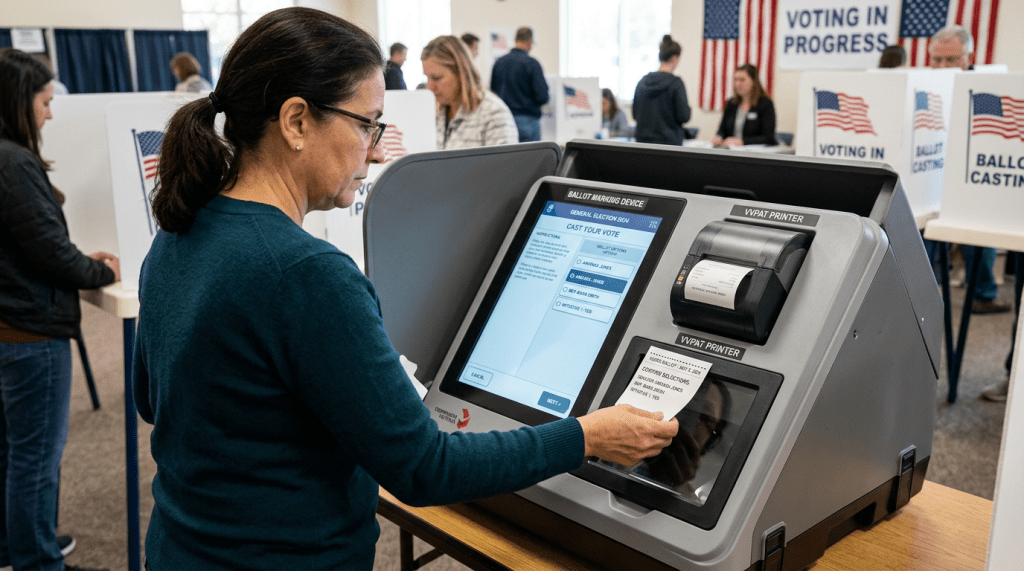
Watching election security evolve has been a strange ride, especially when high-profile politicians start making claims that shake people’s confidence in the whole system. Lately, Donald Trump has been all over the idea that America’s electronic voting machines are just waiting to be hacked. That’s got a lot of election officials and cybersecurity pros on edge. But if you really dig into what he’s saying, his claims do more damage than they highlight any real problem.
Trump went on TV and basically told Americans that everything they’ve heard about secure elections is a lie, and that electronic machines are easy targets for anyone wanting to mess with results. It’s true, researchers have found weak spots—DEFCON’s Voting Village loves demonstrating just that. But here’s the part everyone keeps missing: nobody’s shown real evidence of these flaws getting used to change an election’s outcome. That’s what matters.
Remember when Russian hackers went after our elections in 2016? That was a wake-up call. Now, we’re seeing way more states using paper ballots or machines that spit out a paper record. Most voters today leave behind something you can physically check. Plus, elections aren’t managed from a single office—they’re split across every state and county. That makes a giant, coordinated hack pretty far-fetched.
Election experts keep saying that these kinds of claims just eat away at trust. Colorado Secretary of State Jena Griswold put it simply: Trump’s story isn’t new, and it’s not about some overlooked threat. Yeah, there’s probably an audience for this stuff, but spinning these tales just pushes people away from voting or sets them up to question any results they don’t like.
Government records released Thursday didn’t back up Trump’s claims of widespread voting machine hacking. The National Intelligence Council checked for proof of foreign tampering as recently as 2020 and came up empty. Cybersecurity and Infrastructure Security Agency—CISA—admitted there are always risks, but said they haven’t seen any evidence of actual votes being changed.
That doesn’t mean the job’s done. Local officials are still squeezed for cash and can’t always upgrade equipment or boost cybersecurity training. Congress has dropped about $1 billion since 2018, but just $45 million was set aside last year—barely enough to keep things running.
Benjamin Hovland, former commissioner at the Election Assistance Commission, keeps calling for more funding. He’s not shy about it: if we’re serious about protecting elections, we need to pay for better tools and train the people who use them. States hear a lot of talk, but the actual resources just aren’t reaching them.
So where does that leave us? Election security is messy, but it’s getting better, not worse. The people running our elections and the experts backing them up are working on real fixes, not just trading in outrage.
Instead of fanning the flames, it’s time for everyone—politicians, tech companies, and regular voters—to sit down and talk about how to keep improving things. That’s going to mean real investment, honesty, and showing our work so everyone can see the system doing its job.
The future of our democracy depends on facts and clear policy-making, not scare tactics. Let’s argue about solutions, not sow distrust.
As I look at the current administration’s recent direction, something troubling stands out: the line between running the country and personal financial gain keeps getting harder to see. This isn’t just ordinary governing, it looks like President Tump is linking his decisions to his own investments.
It’s hard to ignore the evidence. Again and again, Donald Trump’s stock moves seem to either predict or closely follow moves by his administration that help those same holdings. There’s the Nvidia stock purchase right before the Department of Commerce green-lit chip exports to China, buying Dell shares just ahead of public praise for the brand, and glowing statements about Apple soon after investing in the company, these moments keep lining up almost too well.
When you put it all together, it looks like the presidency itself is being used to grow personal wealth. Maybe it’s no surprise that Forbes recently pointed out a $1 billion jump in the president’s net worth in the last year. If this happened when Biden or Obama were president, congress would be having nonstop investigators over it. Yet, inside this administration, it’s just accepted as business as usual. Main Street media’s response, second page news.
However, the financial controversy extends beyond the realm of stocks. There exists a new $1.7 billion “anti-weaponization fund” allocated within the Department of Justice, established following a settlement from a $10 billion lawsuit the president’s own litigation against his own government a legal strategy that detractors deem devoid of merit.
Here’s the real worry: what happens with that money? A lot of people are concerned those taxpayer dollars will support individuals convicted for their roles in the January 6 Capitol riot. Using public funds to help people who tried to disrupt democracy isn’t just a budget issue, it’s a serious ethical breach. For many, this turns the U.S. treasury into a reward of cash for a group of convicted criminals. That’s before the president pardoned them, but the ethics and legality of that is for another article.
This isn’t just partisan drama. It cuts right into the heart of what the presidency is supposed to mean. When public trust becomes just another asset and government policy gets treated like a tool for personal profit, the foundations of government start crumbling and we are seeing it now. Voters are noticing: New York Times/Siena College polls now show the president’s approval rating slipping to new lows for his second term. People aren’t just worried about gas prices or groceries, they’re anxious about the future of the country itself.
A president’s job is to look out for the public, not cash in on power. When personal gain and shielding friends take priority over the common good, it’s Americans who end up paying the price, 1.7 billion to be exact. We all have to ask, is this what we want from our leaders, or is it time to demand better ethics and transparency? No matter where you stand politically, the signs of deep corruption should make anyone who cares about democracy sit up and take notice.
Blue Press Journal – The political landscape is reeling as newly unearthed documents detailing ties to convicted sex offender Jeffrey Epstein have ignited a firestorm around the current Commerce Secretary Howard Lutnick. Figures from across the political spectrum are now vocally demanding the Secretary’s immediate resignation, questioning the integrity of his past statements and his suitability for high office.
Recent disclosures from court documents related to Epstein’s network have revealed previously undisclosed interactions involving the Secretary. Among the most damaging are records of an invitation for the Secretary and his family to visit Epstein’s private island in 2012, as well as evidence of a private meeting between them for drinks in 2011. These revelations contradict the Secretary’s earlier claims of having ceased contact with Epstein around 2005 and asserting he “spent zero time with him socially, for business or even philanthropy.” (Source: The Guardian on Epstein document releases)
The profound discrepancy between these emerging facts and the Secretary’s earlier pronouncements has eroded confidence. Republican Congressman Thomas Massie, speaking on a national news program, unequivocally stated the Secretary “should just resign.” He drew stark parallels to high-profile resignations in British politics, emphasizing the seriousness of the alleged misrepresentations. (Source: CNN interview archives)
Echoing this sentiment, Democratic Senator Adam Schiff took to social media, asserting that the Secretary is unfit for his position. The bipartisan nature of these calls underscores the gravity of the situation and the perceived breach of public trust.
This development is not an isolated incident but forms part of the continuing fallout from the extensive Epstein revelations, which have implicated numerous prominent individuals. The ongoing exposure of powerful figures connected to Epstein’s sex trafficking operation continues to challenge institutional integrity and demand accountability from those in positions of power. (Source: New York Times reporting on Epstein fallout)
As the spotlight intensifies, the core question remains: Can a public official serve credibly when their past statements about a notorious figure contradict verified facts? The calls for the Commerce Secretary’s resignation highlight a growing demand for transparency and ethical standards from national leaders. The nation watches this critical episode unfold, with implications for government ethics and the Epstein scandal’s legacy.