Tag: Strait of Hormuz

  • Trump’s Iran Conflict Fuels Highest Wholesale Inflation in Three Years

    Grocery store shelves showing price increases on milk, bread, eggs, and cereal

    Blue Press Journal (DC) – The escalating military engagement with Iran has propelled American producer inflation to its highest level in over three years, with the Labor Department confirming that the Producer Price Index surged 0.5% in March 2026 and climbed 4% annually. According to Bloomberg, the spike stems primarily from an 8.5% monthly explosion in energy costs as regional hostilities disrupt critical supply chains, while the Washington Post reports that retail gasoline prices have pushed consumer inflation to 3.3% over the past year.

    In spite of this growing pressure, President Trump continues to insist on reducing interest rates further, an action that the Financial Times observes runs counter to the emerging agreement between policymakers that there is a need to adopt stricter measures to avoid the economy from overheating. Even though inflation growth was only 0.1% when volatile industries were stripped off, Reuters points out that the International Energy Agency has recently made its first reduction of global oil demand forecasts since the COVID-19 period due to infrastructure sabotage and the closing of the Strait of Hormuz.

    Given that food costs offer little in terms of relief following the volatility seen in February, the potential disconnect between the government’s military and economic policies suggests that market uncertainty may persist even after the mid-term elections.

  • The High Cost of Chaos: Questioning the Trump Administration’s Iran Strategy

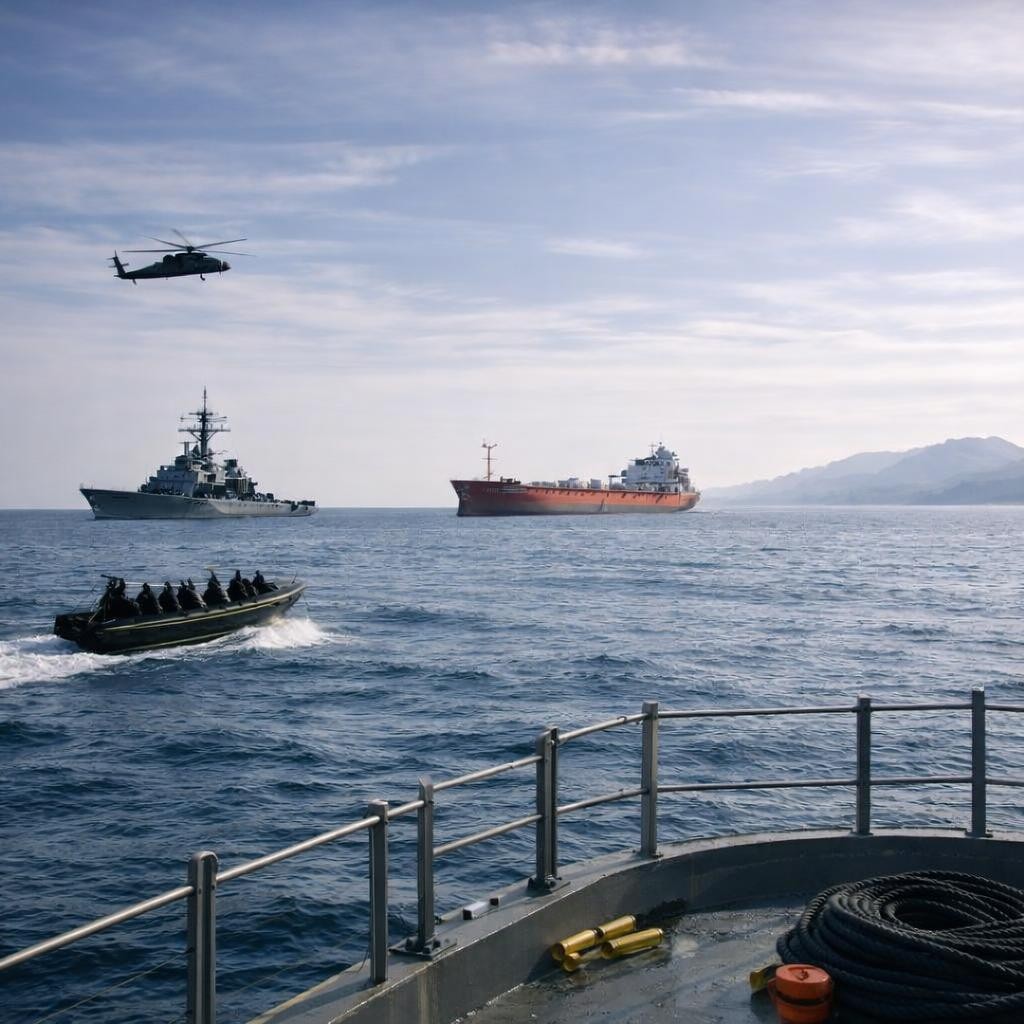
    Naval combat scene with burning ships, missiles, helicopters, and a soldier operating a gun on a boat

    Blue Press Journal – The escalation of conflict between the United States and Iran has pushed the global economy to the brink, fostering an environment of instability that many experts argue was entirely preventable. By initiating a campaign of military aggression without congressional authorization, the Trump administration has by passed legislative oversight, leaving the American public to bear the brunt of surging inflation and a precarious geopolitical landscape.

    Current negotiations center on a fragile two-week ceasefire, yet this “peace” effort remains deeply troubling. Critics argue that using the threat of mass civilian casualties as a bargaining chip to reopen the Strait of Hormuz is not only reprehensible but strategically bankrupt. Data from Lloyd’s List Intelligence confirms that shipping volumes plummeted 90% at the height of the conflict, while reports from the Financial Times indicate that Iran intends to levy hefty cryptocurrency tolls on vessels—effectively turning a vital international waterway into a proprietary toll road.

    The administration’s shifting narrative and erratic policy goals have created what many characterize as a “credibility gap.” While the White House touts progress, the Associated Press notes that claims of regional stability are contradicted by continued missile fire reported across Kuwait, the UAE, and Qatar. Furthermore, as the New York Times reports, the imposition of $2 million fees per ship suggests a significant concession that threatens the status of the Strait as an international waterway.

    Many military analysts have a scathing assessment of the presidents war describing his current posture as a “total fold.” After weeks of reckless bluster, the U.S. now finds itself negotiating on terms dictated by an Iranian 10-point proposal. We are left asking: What has actually been gained? With Iranian nuclear capabilities degraded, by how much? Now we face the potential for Russian or Chinese rearmament of Iran looming, the administration’s strategy appears to be a reactive, uncoordinated mess.

    If an American president cannot maintain a coherent policy, ignores the potential for long-term strategic catastrophe, and accelerates the financial hardship of working families, we must critically evaluate their fitness for office. This unnecessary war, characterized by its lack of transparency and disregard for international norms, remains a defining failure of the Trump administration.


  • Trump Dismisses Iran War Economic Costs as “Short-Term” While Americans Face Surging Oil Prices

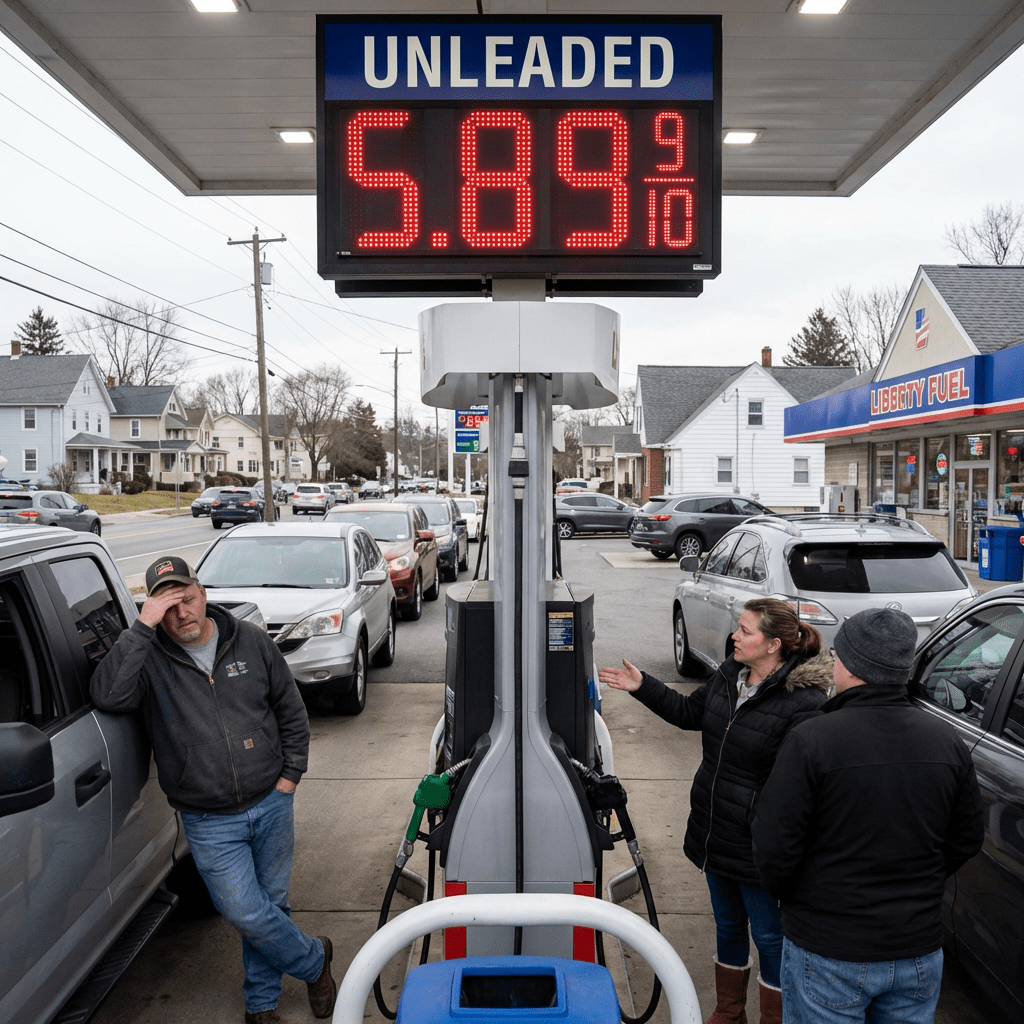
    Digital gas price sign showing Unleaded 5.89 9/10 with concerned customers nearby.

    Blue Press Journal – President Donald Trump openly acknowledged this week that military confrontation with Iran would trigger severe economic consequences, stating the potential for skyrocketing energy costs and stock market declines “didn’t matter to me” during a Republican fundraising address (Associated Press).

    The admission comes as crude oil prices hit $99.75 per barrel and national gas prices jumped roughly 30%, driven by Iranian retaliation and the blockade of the Strait of Hormuz (Forbes). While the billionaire president—whose net worth recently exceeded $6 billion through cryptocurrency investments—calls these disruptions temporary, working families face hardship. Seattle commuters report abandoning personal vehicles for lengthy public transit routes as operating costs become unsustainable (HuffPost).

    Trump’s justification that previous presidents “lacked the guts” to strike Iran has collapsed under scrutiny. Bill Clinton, Barack Obama, Joe Biden, and George W. Bush all denied the alleged private conversations where they supposedly expressed regret for not initiating conflict (The Wall Street Journal).

  • Trump’s Shadow War: Are U.S. Boots on the Ground in Iran Inevitable?

    7% AMERICANS SUPPORT TROOPS IN IRAN WAR. Source: Public Opinion Poll Data (Stylized).

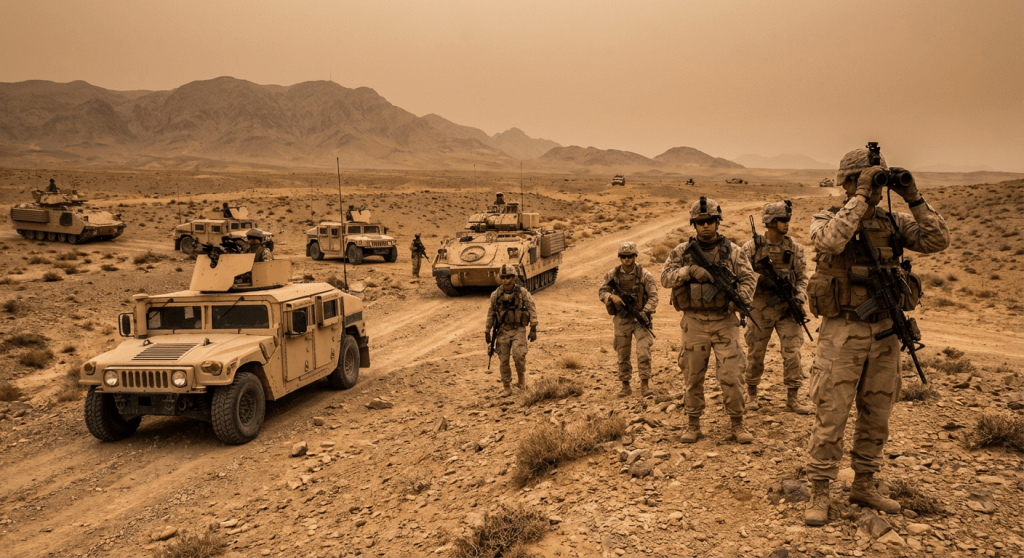
    Blue Press Journal – Despite President Trump’s insistence that he is “not putting troops anywhere,” The Hill reports the Pentagon is rapidly deploying thousands of Marines to the Middle East, fueling speculation that ground forces will soon enter Iran. Military sources confirm the 11th Marine Expeditionary Unit, comprising over 2,200 personnel, is heading to U.S. Central Command aboard the USS Boxer, even as the administration publicly denies escalation plans.

    The contradiction highlights growing Republican anxiety over the conflict’s third week. GOP lawmakers now engage in semantic contortions, with Rep. Haridopolos suggesting to C-SPAN that occupying Kharg Island—handling 90% of Iranian oil exports—would not constitute “boots on the ground.” Meanwhile, Reuters reports that 65% of Americans believe Trump will order a large-scale ground war, yet only 7% support such action. With casualty counts rising to 232 wounded and 13 killed, according to defense officials, the administration’s refusal to pursue ceasefires while accelerating troop deployments reveals a dangerous disconnect between military reality and political deception.

  • Geopolitical Turbulence: How the Iran Conflict, Ignited Under Trump, Threatens Global Economic Stability

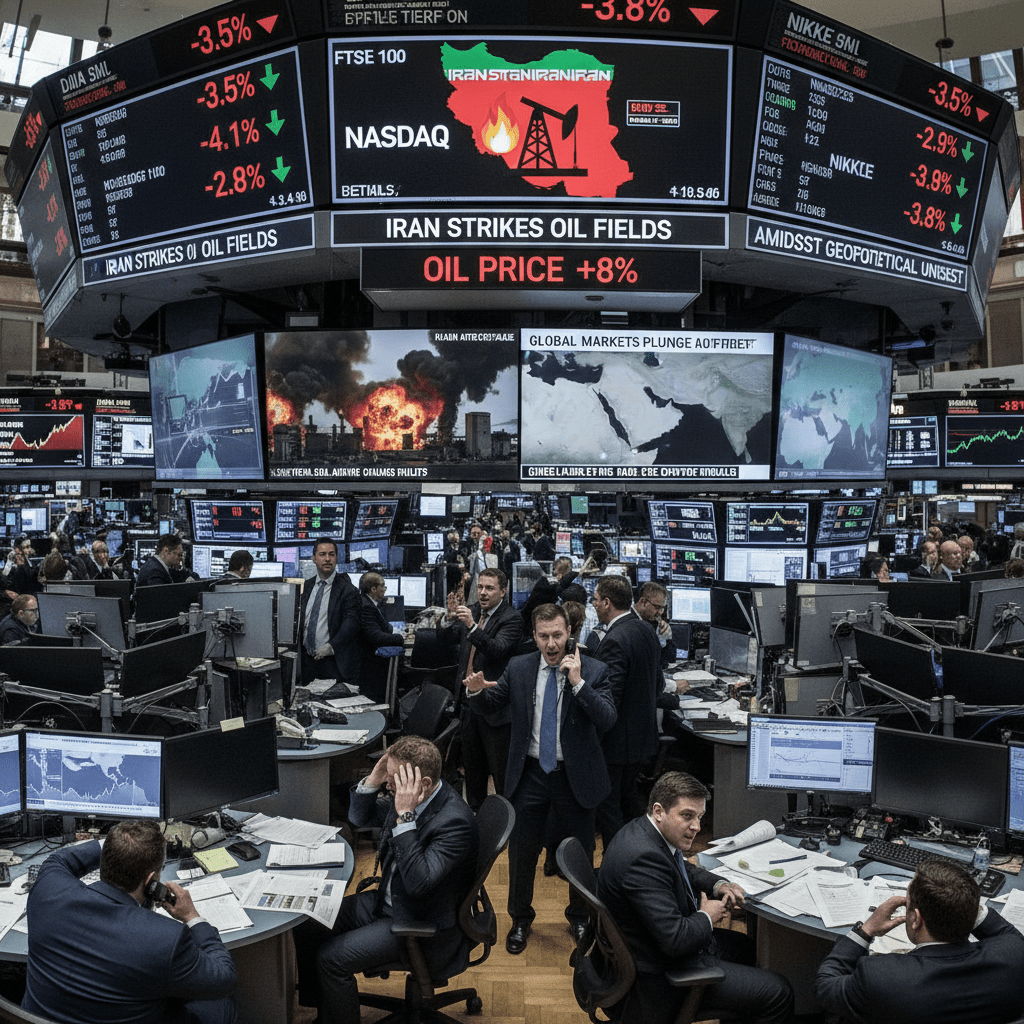
    Trading floor with screens showing IRAN STRIKES OIL FIELDS and falling stock indices.

    The Economic Fallout of Trump’s Iran Conflict

    Blue Press Journal – The global energy landscape is currently facing a catastrophic destabilization. Following targeted Iranian strikes on critical energy infrastructure in the Gulf—specifically two major refineries in Kuwait and Qatar’s vital Ras Laffan natural gas terminal—Brent crude has surged toward the $115 mark. As Tehran’s offensive disrupts the flow of approximately 20% of the world’s liquefied natural gas (LNG), the specter of a “macro wrecking ball” hanging over the global economy has become a grim reality.

    A Manufactured Crisis and the Trump Administration

    While the physical damage to the Strait of Hormuz and surrounding facilities is undeniable, financial analysts and geopolitical experts are increasingly pointing the finger at the White House. Critics argue that the Trump administration’s decision to initiate this conflict was a strategic blunder of historic proportions. According to reports from The New York Times, high-level security officials previously indicated there was no immediate or imminent security threat from Iran that warranted a full-scale kinetic engagement. 

    By prioritizing a hawkish foreign policy over regional stability, the administration has arguably invited the very energy crisis it claimed to prevent. This “war of choice” has now pushed the national average price of gas to a staggering $3.88 per gallon as of March 19, 2026, placing an immense burden on American households.

    Global Market Contagion

    The economic repercussions are being felt far beyond U.S. borders. On Thursday, Brent crude jumped 6% to $113.77 per barrel, a massive leap from the sub-$73 levels seen prior to the commencement of hostilities. The Financial Times reports that European natural gas benchmarks have doubled in just thirty days, threatening a wave of “debilitating inflation” across the continent.

    Global indices are reflecting this instability:

    • Japan’s Nikkei 225 plummeted 3.4% as the Bank of Japan froze interest rates.
    • Germany’s DAX and London’s FTSE 100 both saw losses exceeding 2%.
    • Wall Street futures remain in the red as the Federal Reserve warns that persistent inflation, fueled by the war, limits their ability to provide further interest rate relief.

    As the Strait of Hormuz remains effectively shuttered to tanker traffic, the question remains: was the pursuit of this conflict worth the systematic dismantling of global economic stability? For now, the world pays the price at the pump and in the markets for a war that many intelligence experts claim was entirely avoidable.

  • The White House had a war plan but no economic plan—and American drivers paid the price

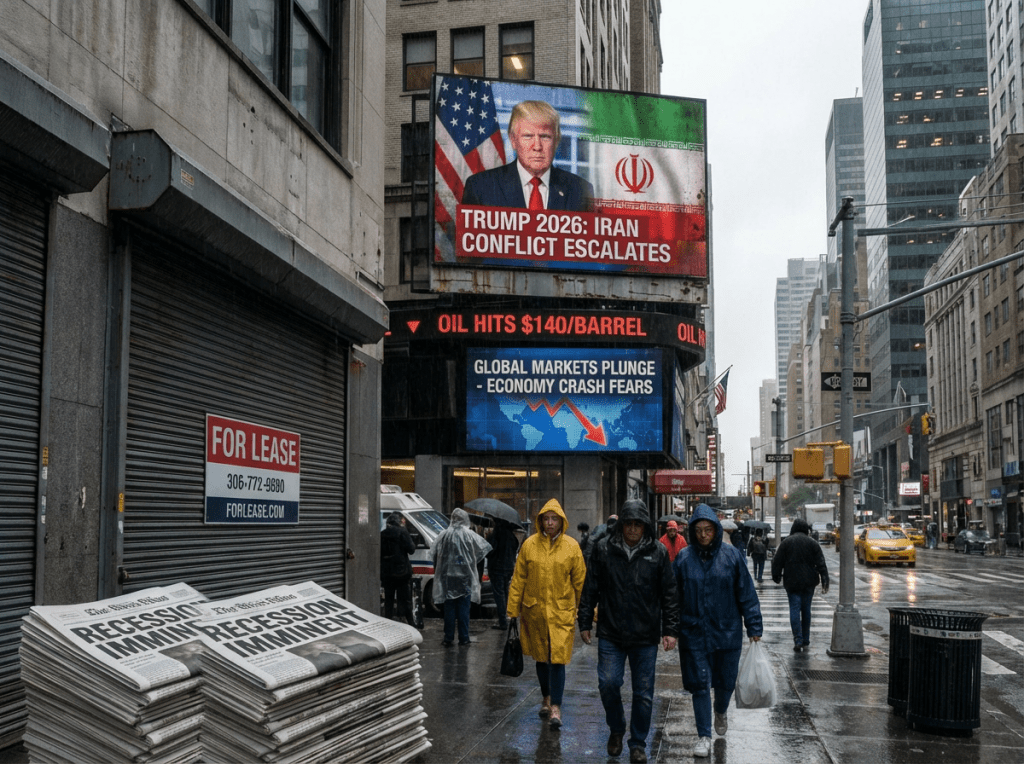
    Trump’s 2026 Iran War: How $140 Oil Tanked the American Economy

    Billboards display headlines about Trump 2026 Iran conflict, oil prices, and market crashes.

    Blue Press Journal – When President Trump ordered strikes on Iran, administration officials promised a “short, decisive conflict.” What Donald Trump failed to calculatecatastrophically—was the immediate collapse of energy markets and the devastating ripple effect across the American economy.

    West Texas Intermediate (WTI) Crude vs. Retail Gasoline Prices – Jan 2026 → Apr 2026based on estimates

    MonthWTI Crude (USD / bbl)Retail Gas (USD / gal)
    Jan$86.0$2.98
    Feb$100.0$3.48
    Mar$114.0 +$3.86
    Apr projected$140.0 +$6.80

    The economic impact was immediate and brutal. As Iranian mines and missile threats choked the Strait of Hormuz, global supply chains seized. American consumers can face $6+ per gallon gasoline within weeks, triggering which will cause inflationary pressure that will erase wage gains, stock market prices and crush discretionary spending. The transportation sector will hemorrhaged profits while manufacturing faced energy costs not seen since 2008.

    The administration’s war planning contained no credible energy contingency strategy. Despite Pentagon warnings that Hormuz closure would disrupt 20% of global oil shipments, Trump dismissed price concerns as “temporary fluctuations” and failed to coordinate with allies on alternative supply routes. Strategic Petroleum Reserve releases will provide insufficient against sustained disruption.

    The result: can be a stagflationary spiral that pushes the economy into recession by Q3 2026, with middle-class families bearing the burden of strategic miscalculation.

    DateS&P 500 Index
    Feb 1, 20264500
    Feb 15, 20264200
    Feb 28, 20264000
    Mar 1, 20263800
  • Trump’s Russia Sanctions Relief Exposes Iran War Fallout

    Trump’s gift to Vladimir Putin

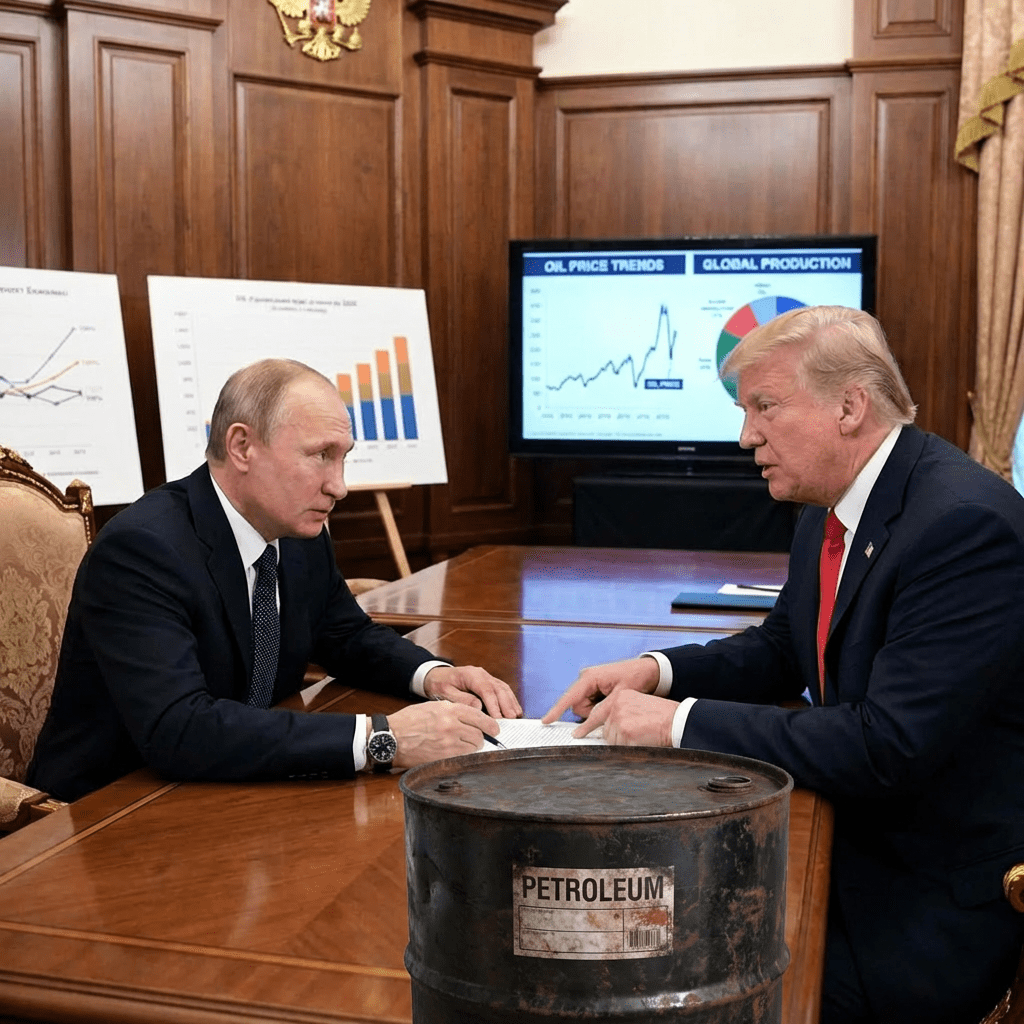
    Donald Trump and Vladimir Putin reviewing documents and economic charts during a formal meeting.

    Blue Press Journal – The Trump administration’s temporary lifting of Russian oil sanctions represents a stark admission that its Iran military campaign is backfiring economically. In a move rich with geopolitical irony, the White House is easing restrictions on Moscow—a direct concession to Vladimir Putin—to counteract crude price spikes triggered by the President’s own Persian Gulf escalation (The Guardian).

    The decision undermines years of bipartisan measures designed to punish Russia’s Ukraine invasion while revealing acute strategic shortsightedness. According to CNN, officials failed to contingency-plan for Iran’s threatened Strait of Hormuz closure despite this scenario being “a bedrock principle of US national security policy for decades” (CNN). By treating Putin’s regime as an economic “pressure relief valve,” Trump prioritizes electoral survival over principled opposition to Russian aggression, deepening scrutiny of the administration’s crisis planning and longstanding Kremlin entanglements.

  • Trump’s Iran Attack: Economic Fallout Threatens US Recovery and Global Trade Stability

    Gears labeled USA and IRAN over a chasm swallowing falling charts and GLOBAL MARKETS coins.

    BLUE PRESS JOURNAL – Trump’s reckless military escalation against Iran today poses an existential threat to American economic stability and global commerce. Far from projecting strength, these strikes risk catalyzing a catastrophic financial crisis that will burden working families while destabilizing international markets.

    The immediate consequence centers on energy markets. Iran’s geographic dominance over the Strait of Hormuz—a chokepoint handling roughly 20% of global oil shipments—means even limited conflict triggers catastrophic price spikes. Analysts predict Brent crude could surge past $130 per barrel, translating to $5+ gasoline for American consumers already battered by persistent inflation. This shockwave ripples through every sector, from transportation to agriculture, effectively imposing a regressive tax on households least equipped to absorb it.

    Global trade faces imminent paralysis. Military activity in the Persian Gulf threatens container shipping routes vital for Asian-European commerce, potentially replicating the supply chain disruptions that fueled 2021’s inflationary spiral. Insurance premiums for maritime freight have already spiked 40%, costs ultimately borne by American consumers through higher retail prices.

    Financial markets reflect this anxiety, with defense stocks soaring while broad indices plummet. The dollar’s safe-haven status offers minimal protection against the stagflationary pressures of simultaneous energy shortages and slowing growth. Moreover, diverting billions toward military operations steals resources from infrastructure and domestic manufacturing initiatives essential for long-term competitiveness.

    This economic warfare against American pocketbooks serves no strategic purpose beyond political theater. Diplomatic alternatives remain unexplored while the administration gambles with global recession. History demonstrates that Middle East military adventures consistently deliver economic devastation—higher deficits, volatile currencies, and diminished purchasing power—while failing to achieve sustainable security outcomes.