Blue Press Journal – January 26, 2026 – The ongoing clash between Minnesota state officials and the federal government over Immigration and Customs Enforcement (ICE) operations reached a critical juncture this week, as U.S. District Judge Kate Menendez weighed whether the Trump administration’s deployment of nearly 4,000 ICE agents to the state violates constitutional principles.
At the heart of the case is the Tenth Amendment, which reserves to the states or the people any powers not explicitly granted to the federal government. Minnesota’s legal team, led by Assistant Attorney General Brian Carter, argues that “Operation Metro Surge” — the mass influx of federal immigration agents — represents a coercive overreach that undermines state sovereignty and erodes public trust in the republic.
A Constitutional Flashpoint
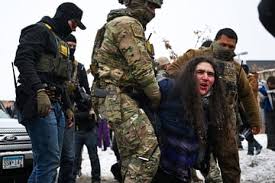
Judge Menendez acknowledged the “enormous evidentiary record” detailing the fallout from ICE’s aggressive tactics in Minnesota. This includes the fatal shootings of Renee Good and Alex Pretti, incidents that have intensified public outrage and raised urgent questions about accountability.
Carter underscored the gravity of the situation:
“If this is not stopped right here, right now, I don’t think anybody who is seriously looking at this problem can have much faith in how our republic is going to go in the future.”
According to the American Civil Liberties Union (ACLU) and investigative reports from ProPublica, ICE under the Trump administration frequently targeted individuals without serious criminal records, contradicting claims that enforcement is focused on “the worst of the worst.”
Accountability Gaps and Body Cameras
The White House has refused to commit to releasing body camera footage from the federal agent killing of Alex Pretti. Press Secretary Karoline Leavitt sidestepped questions about whether ICE agents should be required to wear body cameras — a standard increasingly adopted by local police departments nationwide for transparency and public trust.
The Government Accountability Office (GAO) has repeatedly reported that ICE’s internal oversight mechanisms are inadequate, with insufficient transparency in use-of-force incidents.
Local Leaders Sound the Alarm
Minneapolis City Attorney Sara Lathrop stressed that before the Trump administration’s escalation, Minnesota had just 80 ICE agents — who still managed thousands of arrests. The new surge, she argued, is unnecessary and producing “toxic and lifelong harms” to immigrant communities, where fear of detention now dictates daily life.
Lathrop urged Menendez to impose an immediate pause on ICE’s expanded operations, warning that without judicial intervention, constitutional rights will continue to be “trampled on.”
What’s at Stake
This case is more than a dispute over immigration enforcement numbers — it’s a test of how far a presidential administration can push federal power into state jurisdictions without consent. If Judge Menendez sides with Minnesota, it could set a precedent limiting future federal overreach in immigration matters.
For now, the decision rests with the court. But one thing is clear: unchecked federal enforcement, lacking transparency and accountability, risks deepening mistrust between communities and the government — a danger to both constitutional balance and public safety.
 Blue Press Journal