Tag: trump

  • The White House had a war plan but no economic plan—and American drivers paid the price

    Trump’s 2026 Iran War: How $140 Oil Tanked the American Economy

    Billboards display headlines about Trump 2026 Iran conflict, oil prices, and market crashes.

    Blue Press Journal – When President Trump ordered strikes on Iran, administration officials promised a “short, decisive conflict.” What Donald Trump failed to calculatecatastrophically—was the immediate collapse of energy markets and the devastating ripple effect across the American economy.

    West Texas Intermediate (WTI) Crude vs. Retail Gasoline Prices – Jan 2026 → Apr 2026based on estimates

    MonthWTI Crude (USD / bbl)Retail Gas (USD / gal)
    Jan$86.0$2.98
    Feb$100.0$3.48
    Mar$114.0 +$3.86
    Apr projected$140.0 +$6.80

    The economic impact was immediate and brutal. As Iranian mines and missile threats choked the Strait of Hormuz, global supply chains seized. American consumers can face $6+ per gallon gasoline within weeks, triggering which will cause inflationary pressure that will erase wage gains, stock market prices and crush discretionary spending. The transportation sector will hemorrhaged profits while manufacturing faced energy costs not seen since 2008.

    The administration’s war planning contained no credible energy contingency strategy. Despite Pentagon warnings that Hormuz closure would disrupt 20% of global oil shipments, Trump dismissed price concerns as “temporary fluctuations” and failed to coordinate with allies on alternative supply routes. Strategic Petroleum Reserve releases will provide insufficient against sustained disruption.

    The result: can be a stagflationary spiral that pushes the economy into recession by Q3 2026, with middle-class families bearing the burden of strategic miscalculation.

    DateS&P 500 Index
    Feb 1, 20264500
    Feb 15, 20264200
    Feb 28, 20264000
    Mar 1, 20263800
  • Trump’s Tariff Legacy: American Families Face Staggering $330 Billion Burden While Businesses Get Refunds

    Family carrying a heavy crate labeled TARIFFS and PRICE HIKES uphill past stacks of money.

    Blue Press Journal (DC) – American households are on track to endure an unprecedented financial hit this year, with combined costs from import duties totaling an estimated $330 billion. This colossal sum, translating to over $2,500 for the average family, underscores the severe economic strain inflicted by President Donald Trump’s aggressive trade policies. A recent report from the Democratic minority on the Joint Economic Committee (JEC) as reported by news outlets like Reuters, paints a stark picture of these escalating expenses, a considerable jump from the $1,700 Americans reportedly paid in 2025.

    Despite a Supreme Court ruling last month that invalidated Trump’s use of emergency powers for imposing widespread tariffs, the administration appears undeterred. US Treasury Secretary Scott Bessent has projected “virtually unchanged tariff revenue in 2026,” suggesting a continued reliance on these trade taxes through different legal avenues to circumvent the high court’s decision. This persistent strategy means continued pressure on consumer wallets.

    The burden of these customs charges falls disproportionately on everyday Americans. Independent analysis from the nonpartisan Congressional Budget Office (CBO) detailed in reports by organizations like the Associated Press, revealed that foreign entities bear only about 5% of tariff expenses. Domestic companies absorb roughly 30%, but a staggering 65% is ultimately shouldered by consumers through higher prices on goods and services.

    A Tale of Two Refunds: Businesses Get Relief, Families Don’t

    While American families grapple with surging costs, businesses impacted by what were deemed unlawful duties are poised for substantial relief. The US Court of International Trade (CIT) recently mandated that the Treasury Department and Customs and Border Protection must reimburse approximately 330,000 importers a staggering $166 billion for duties collected under the invalidated tariffs a development covered by outlets such as The Wall Street Journal. Customs officials indicate that a system for processing these refund requests for over 53 million entries could be operational as early as mid-April.

    However, a stark disparity remains for ordinary citizens. Senator Maggie Hassan (D-NH), a ranking member of the Joint Economic Committee, sharply criticized this imbalance. She lamented that while businesses are set to receive reimbursements with interest, “the Trump administration refuses to provide relief for families” and is instead “choosing to institute new tariffs that will push prices even higher.”

    Legislative Efforts to Aid Struggling Households

    In response to this growing economic strain, Senator Martin Heinrich (D-NM), also a committee member, has introduced a legislative proposal to directly assist those most affected. His “Working Families Refund” bill aims to provide a $600 tax rebate to individuals earning up to $90,000 annually, and to head-of-household filers making $120,000 or less. Joint filers under $180,000 would receive $1,200, with an additional $600 for each dependent child.

    Senator Heinrich emphasized the measure’s intent: “This is money that belongs to working families—not to CEOs of big corporations.” He criticized the administration’s rhetoric, stating, “The president may call the affordability crisis a ‘hoax,’ but working people feel it every time they pay for essentials. This bill will return the money lost to Trump’s tariffs back to those who paid the price.”

    Public sentiment reflects growing dissatisfaction with economic policies. An NBC News poll showed that 55% of voters believe trade taxes have harmed the economy, while only 33% view them as beneficial. With 62% disapproving of the administration’s handling of inflation and living costs, the financial strain on American families is clear. Heinrich’s bill includes a provision to prevent the president from labeling rebate checks with his name, acknowledging previous political optics around stimulus payments.

  • Trump’s Russia Sanctions Relief Exposes Iran War Fallout

    Trump’s gift to Vladimir Putin

    Donald Trump and Vladimir Putin reviewing documents and economic charts during a formal meeting.

    Blue Press Journal – The Trump administration’s temporary lifting of Russian oil sanctions represents a stark admission that its Iran military campaign is backfiring economically. In a move rich with geopolitical irony, the White House is easing restrictions on Moscow—a direct concession to Vladimir Putin—to counteract crude price spikes triggered by the President’s own Persian Gulf escalation (The Guardian).

    The decision undermines years of bipartisan measures designed to punish Russia’s Ukraine invasion while revealing acute strategic shortsightedness. According to CNN, officials failed to contingency-plan for Iran’s threatened Strait of Hormuz closure despite this scenario being “a bedrock principle of US national security policy for decades” (CNN). By treating Putin’s regime as an economic “pressure relief valve,” Trump prioritizes electoral survival over principled opposition to Russian aggression, deepening scrutiny of the administration’s crisis planning and longstanding Kremlin entanglements.

  • The Unrecoverable Losses: Understanding the True Impact of Trump’s Iran War on the Stock Market

    Financial monitor showing 'IRAN WAR COST' and 'MARKET CRASH' with a plummeting line graph.

    “Time is Money”

    Blue Press Journal – The recent deep decline in the stock market, triggered by Trump’s Iran war, has left investors reeling. Financial advisers are quick to reassure their clients that the losses will be recouped, and the market will bounce back. However, they often fail to mention a crucial aspect of market volatility: the lost time.

    When the market is down, the clock keeps ticking, and the time lost is not recoverable. The gains made prior to the decline are not just put on hold; the opportunity to make new gains during that time is also lost. To illustrate this point, let’s consider a hypothetical example.

    MonthMarket PerformanceCumulative Gains
    January10% gain$10,000 to $11,000
    February15% loss$11,000 to $9,350

    In this example, an initial investment of $10,000 in January yields a 10% gain, bringing the total to $11,000. However, in February, a 15% loss wipes out the gains, leaving the investor with $9,350. While the financial advisers might say that the market will recover, the reality is that the two months of lost time cannot be regained. The investor missed out on potential gains that could have been made during those two months.

    The tone of the article is cautionary, highlighting the often-overlooked consequence of market volatility. By using hypothetical numbers, we can see that the lost time can have a significant impact on an investor’s overall returns. As investors, it’s essential to be aware of this hidden cost and not solely rely on the promise of a market rebound.

  • Trump’s Iran War Threatens Catastrophic Oil Crisis as Aramco Warns of Global Market Collapse

    Trump’s Iran Escalation Threatens Catastrophic Oil Crisis for American Consumers

    Poster TRUMP v. IRAN GLOBAL OIL CRISIS showing Trump gesturing towards a burning map of Iran.

    Blue Press Journal – As working Americans face mounting costs at the pump, Saudi Aramco’s CEO has issued a stark warning that President Donald Trump’s escalating conflict with Iran could trigger “catastrophic consequences” for global oil markets. Amin Nasser told reporters Tuesday that blocking the Strait of Hormuz—through which roughly 20% of global oil shipments flow—represents “the biggest crisis the region’s oil and gas industry has faced” (Reuters). 

    The Iranian Revolutionary Guards have vowed to halt “one litre of oil” from passing if U.S. attacks persist, already choking shipments through the vital artery. Despite Brent crude surging to three-year highs near $120 per barrel, Trump has doubled down on aggression, threatening “much harder” strikes while proposing an unrealistic naval escort plan that energy officials dismiss as insufficient (Bloomberg). 

    With global inventories at five-year lows and Aramco suspending Gulf exports entirely—removing 350 million barrels from the market—Trump’s brinkmanship directly threatens American consumers with sustained price spikes across aviation, agriculture, and transportation sectors. As one Gulf energy official noted to CNBC (2026), only stopping the war—not escalating it—can reopen these critical shipping lanes.

    Chart: Brent Crude Price Surge During Iran Crisis

    DatePrice (USD)Event
    Pre-Escalation$70Baseline pricing
    Week 1$85Initial Hormuz tensions
    Current Peak$118-120Iran blocks shipping threats

    Source: Market data via Bloomberg/New York Mercantile Exchange

  • Trump’s Iran War Triggers Gas Price Spike, Threatening GOP Midterm Strategy Just Days After ‘$1.99’ Boast

    BLUE PRESS JOURNAL – In a striking reversal that threatens to undermine Republican economic messaging ahead of the 2026 midterms, President Donald Trump’s military strikes against Iran have sent domestic fuel costs climbing—barely one week after the administration heralded falling gas prices as a signature achievement.

    During his recent State of the Union address, Trump claimed victory over fuel costs, declaring that gasoline had fallen “below $2.30 a gallon in most states, and in some places, $1.99 a gallon”—a characterization that already strained credulity compared to national averages tracked by AAA and the Energy Information Administration. According to Bloomberg energy analysts, those rosy figures collapsed almost immediately following U.S. military intervention in the Middle East, with the average price per gallon jumping 16 cents to nearly $3.11 in just seven days.

    The volatility stems from Trump’s decision to launch strikes against Iranian targets, a move that has destabilized a region responsible for more than 25% of global oil production. As Reuters reports, renewed conflict near the Strait of Hormuz—where nearly one-fifth of the world’s petroleum shipments pass—has triggered immediate risk premiums in futures markets. Secretary of State Marco Rubio acknowledged the economic trade-off Tuesday, admitting the administration “knew that going in would be a factor” when asked about the surge.

    The political calculus grows increasingly precarious for Republican strategists heading into November’s congressional elections. One veteran GOP operative, speaking anonymously to avoid White House retaliation, warned The Hill that sustained increases could prove “devastating” for candidates already struggling with voter dissatisfaction over persistent inflation in housing and groceries. “If it sustains at all, it’s really bad,” the strategist noted. “Where does that end?”

    Democratic critics have seized on the disconnect between Trump’s “America First” branding and the economic fallout. Representative Ro Khanna (D-Calif.), a potential 2028 presidential contender, wrote in a Tuesday op-ed that Americans “don’t want higher gas prices, which will spike at the pump because of this stupid conflict.” Senator Chris Murphy (D-Conn.) echoed these concerns to NBC News, emphasizing that “nobody in America is asking for their gas prices, their grocery prices, their construction prices to go through the roof.”

    Price Outlook: If hostilities continue through the summer driving season, industry analysts project national averages could climb to $3.40–$3.65 per gallon by late July, potentially erasing the administration’s limited inflation gains and complicating GOP efforts to maintain congressional majorities.

    Trump administration officials insist the spike represents “short-term” turbulence, with the President claiming Tuesday that prices will drop “lower than even before” once conflict ceases. However, with Pentagon officials offering conflicting timelines for operations and Iran vowing continued retaliation against American assets, energy markets remain jittery—leaving American consumers to bear the cost of a war few voters requested.

  • Trump’s Iran War Triggers Global Market Crash: Dow Plunges 1,000 Points as Gas Prices Soar and Oil Nears Crisis Levels

    The Cost of Forever War: Trump’s Iran Escalation Triggers Global Market Meltdown and Gas Price Shock

    BLUE PRESS JOURNAL ( 3/3/2026) – Global financial markets plunged into chaos Tuesday as the economic realities of President Donald Trump’s widening war with Iran came crashing down on Wall Street, sending the Dow Jones Industrial Average plummeting over 1,000 points and driving crude oil prices toward the psychologically devastating $100-per-barrel threshold.

    The sell-off—echoing across trading floors from Seoul to Frankfurt—reflects growing panic that the administration’s decision to assassinate Iranian Supreme Leader Ayatollah Ali Khamenei and subsequent strikes on the U.S. Embassy in Riyadh have triggered a conflict with no clear exit strategy, one that threatens to choke global energy supplies just as inflation-weary consumers were hoping for financial relief.

    By 10 a.m. Eastern Time, the Dow had collapsed 1,048 points (2.1%), while the S&P 500 and Nasdaq Composite each shed 2% of their value. The rout extended far beyond American borders. South Korea’s Kospi index cratered 7.2%—its worst single-day decline since 2022—as the energy-import-dependent nation confronted the vulnerability of its supply chains. Germany’s DAX dropped 3.8%, hammered by soaring natural gas prices reminiscent of the energy crisis following Russia’s invasion of Ukraine.

    The Pump Price Punishment

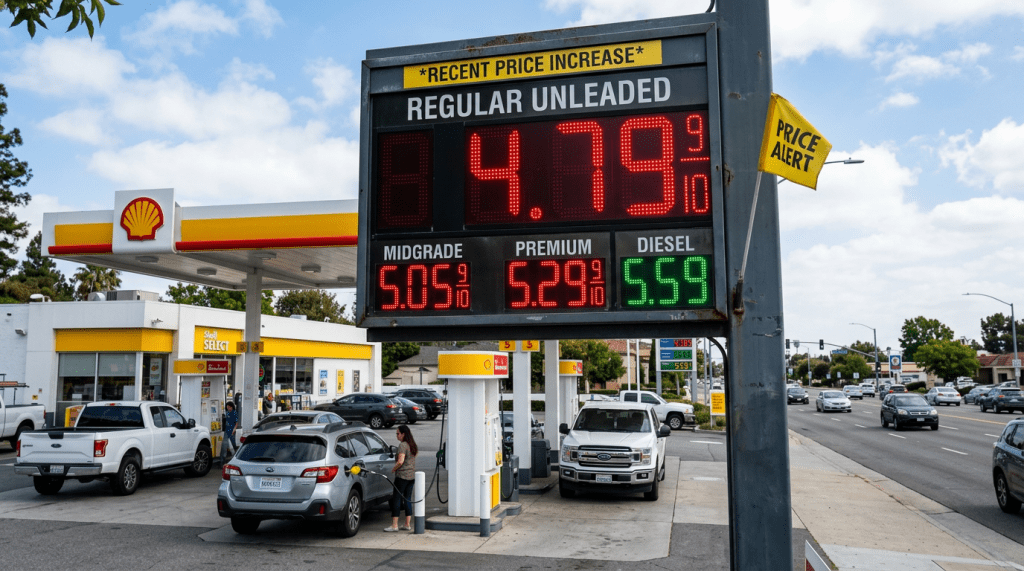
    For American households, the war’s immediate sting is appearing at the gas station. The national average for regular unleaded jumped 11 cents overnight to $3.11 per gallon, according to data from motor club AAA, with analysts warning that prices could spiral toward $4.00 if hostilities disrupt traffic through the Strait of Hormuz—the narrow maritime chokepoint through which roughly 20% of global oil shipments pass daily.

    Brent crude, the international benchmark, surged another 7.5% to $83.58 per barrel, while U.S. West Texas Intermediate climbed 7.6% to $76.64. To put this in context, Brent was trading near $70 less than a week ago—a volatility spike that signals markets pricing in sustained supply risk.

    “This isn’t just a geopolitical crisis; it’s an economic assault on working families,” said economic analysts at the Roosevelt Institute, noting that every $10 increase in oil prices historically translates to roughly 25-30 cents added to the average gallon of gasoline. The timing could scarcely be worse for the Federal Reserve, which has been attempting to guide inflation toward its 2% target after years of price instability.

    Trump’s “Forever War” Doctrine

    The market collapse accelerated late Monday after Trump took to his social media platform to declare that “wars can be fought ‘forever,’ and very successfully” given America’s munitions stockpiles—a statement that extinguished hopes for a swift diplomatic resolution and suggested a prolonged, open-ended military commitment with incalculable economic costs.

    This rhetoric marks a dangerous escalation from the administration’s initial justification for strikes against Iranian leadership. Where officials initially framed the killing of Khamenei as a precision response to specific threats, Trump’s latest comments reveal a strategic framework that could commit the United States to years of asymmetric warfare, mirroring the quagmires of Iraq and Afghanistan but with significantly higher economic stakes for domestic consumers.

    Historical context underscores the risk. During Trump’s first term, the 2020 assassination of Iranian General Qassem Soleimani triggered immediate spikes in oil prices and temporary market instability, though de-escalation followed within days. The current scenario—involving the death of Iran’s supreme leader and attacks on diplomatic facilities in Saudi Arabia—represents a qualitatively superior level of conflict that threatens regional energy infrastructure directly.

    The Fed’s Impossible Position

    The economic fallout extends beyond the pump. Treasury yields spiked Tuesday, with the 10-year note climbing to 4.09% from 4.05% as bond markets priced in “warflation”—the toxic combination of supply shock-driven price increases and stagnating growth. Higher yields translate directly to more expensive mortgages, auto loans, and business financing, potentially choking off the soft landing the Federal Reserve has been carefully engineering.

    Critically, the inflationary pressure from oil shocks severely constrains the Fed’s ability to respond to slowing economic growth. While Trump has aggressively demanded rate cuts in increasingly personal terms targeting Fed Chair Jerome Powell, traders at CME Group are now pushing expectations for monetary easing deeper into the summer, recognizing that cutting rates while energy prices surge would risk unleashing runaway inflation.

    Aviation and Industry in the Crosshairs

    The transportation sector is bearing the immediate brunt. United Airlines cratered 5%, American Airlines dropped 4.4%, and Delta shed 4% as investors recalculated profit margins against jet fuel costs that rise in lockstep with crude prices. The industry, still recovering from pandemic-era disruptions, now faces the dual threat of canceled routes through Middle Eastern airspace and structurally higher operating costs that will inevitably pass to consumers in the form of expensive tickets.

    Gold, which had briefly touched $5,300 during the initial flight to safety, retreated 4.9% to $5,053 as rising yields made the non-interest-bearing asset less attractive, while Bitcoin fell below $67,000—demonstrating that even digital “safe havens” provide little shelter when war drives dollar-denominated borrowing costs upward.

    With inflation expectations unanchoring and global supply chains facing their most severe test since 2022, the economic verdict on Trump’s Iran strategy is becoming clear: this is a war that American households cannot afford, and one that global markets will not tolerate indefinitely.

  • Trump Administration and DOJ Stall Refunds After Supreme Court Nullifies Emergency Tariffs – Businesses Rush to Court

    Donald Trump peeking through the wooden doors of Courtroom A in a brightly lit hallway.

    BLUE PRESS JOURNAL – The Supreme Court’s decisive ruling that nullified President Donald Trump’s emergency tariffs ignited a frantic legal scramble. Hundreds of companies—from a New York wine importer to shipping giant FedEx—are now filing lawsuits to reclaim duties they allege were unlawfully collected. The fight has split into two competing jurisdictional tracks, while the Trump administration and the Department of Justice (DOJ) deliberately drag their feet.

    Two Front‑Line Challengers
    VOS Selections, a New York wine and spirits importer represented by the Liberty Justice Center, is pressing the U.S. Court of Appeals for an immediate mandate so lower courts can begin processing refunds. The importer previously secured a verbal guarantee from the administration that any successful claim would be reimbursed promptly. In contrast, AGS Company Automotive Solutions of Michigan, the lead docket in a consolidated case, is demanding a hearing to lift a December‑23 judicial stay, arguing that each day of delay deepens the prejudice to plaintiffs.

    DOJ’s 90‑Day Freeze: A Stalling Tactic
    Despite early assurances, the DOJ now argues for a 90‑day freeze to let “political branches consider options,” labeling rapid refunds as “ill‑conceived.”  President Trump, meanwhile, has suggested the process could take years and has urged the Supreme Court to rehear the case—a rarity not seen in nearly seven decades (Reuters).  Such postponements appear designed to protect the administration’s political capital rather than remedy wronged businesses.

    Political Backlash and Legislative Action
    Democratic governors from Illinois, New York, Maryland and California have issued invoices demanding billions in refunds for their residents.  Senators Ed Markey, Ron Wyden and Jeanne  Shaheen have introduced legislation compelling U.S. Customs and Border Protection to issue full refunds with interest within 180 days, prioritizing small‑business owners (Politico).

    A Call for Uniform, Court‑Supervised Relief
    The Liberty Justice Center warns that a “900‑case pileup” will overwhelm the courts if each company pursues separate suits. Yet the administration’s resistance to an expedited, uniform process leaves businesses in limbo, facing mounting legal costs and uncertain timelines.

    Bottom line: The Trump administration’s deliberate delays and the DOJ’s procedural roadblocks betray a disregard for fiscal justice, forcing American businesses to fight a protracted legal battle for money they are rightfully owed.


  • Trump’s Iran Attack: Economic Fallout Threatens US Recovery and Global Trade Stability

    Gears labeled USA and IRAN over a chasm swallowing falling charts and GLOBAL MARKETS coins.

    BLUE PRESS JOURNAL – Trump’s reckless military escalation against Iran today poses an existential threat to American economic stability and global commerce. Far from projecting strength, these strikes risk catalyzing a catastrophic financial crisis that will burden working families while destabilizing international markets.

    The immediate consequence centers on energy markets. Iran’s geographic dominance over the Strait of Hormuz—a chokepoint handling roughly 20% of global oil shipments—means even limited conflict triggers catastrophic price spikes. Analysts predict Brent crude could surge past $130 per barrel, translating to $5+ gasoline for American consumers already battered by persistent inflation. This shockwave ripples through every sector, from transportation to agriculture, effectively imposing a regressive tax on households least equipped to absorb it.

    Global trade faces imminent paralysis. Military activity in the Persian Gulf threatens container shipping routes vital for Asian-European commerce, potentially replicating the supply chain disruptions that fueled 2021’s inflationary spiral. Insurance premiums for maritime freight have already spiked 40%, costs ultimately borne by American consumers through higher retail prices.

    Financial markets reflect this anxiety, with defense stocks soaring while broad indices plummet. The dollar’s safe-haven status offers minimal protection against the stagflationary pressures of simultaneous energy shortages and slowing growth. Moreover, diverting billions toward military operations steals resources from infrastructure and domestic manufacturing initiatives essential for long-term competitiveness.

    This economic warfare against American pocketbooks serves no strategic purpose beyond political theater. Diplomatic alternatives remain unexplored while the administration gambles with global recession. History demonstrates that Middle East military adventures consistently deliver economic devastation—higher deficits, volatile currencies, and diminished purchasing power—while failing to achieve sustainable security outcomes.

  • Trump’s Glyphosate Boost: A Poisonous Betrayal of Public Health and RFK Jr.’s Dubious Legacy

    Blue Press Journal – The Trump administration’s recent executive order to boost glyphosate production represents a stark, cynical betrayal of public health concerns, and a glaring indictment of political opportunism. This move particularly resonates with those drawn to Robert F. Kennedy Jr.’s (RFK Jr.) “Make America Healthy Again” (MAHA) movement. Initially fueled by RFK Jr.’s rhetoric against environmental toxins and skepticism towards mainstream health, this coalition later gravitated towards Trump after Kennedy’s withdrawal, believing their faith would be rewarded with genuine action on chemical protection.

    The expansion of a pesticide deemed “probably carcinogenic” by the WHO highlights a contradiction in the principles upheld by RFK Jr. and MAHA, showcasing the Trump administration’s preference for industrial agriculture over public health. This inconsistency forces RFK Jr. to address the disillusionment among his former supporters, reflecting how health concerns can be marginalized for political gain, ultimately alienating voters and jeopardizing health protections.

    Glyphosate: A Growing Threat to Ecosystems and Human Health

    Glyphosate, the most commonly used herbicide, poses significant environmental risks as it harms non-target plants and reduces plant diversity, which is crucial for resilient ecosystems. Additionally, it negatively affects soil microorganisms that are vital for nitrogen fixation and organic matter turnover, leading to decreased soil fertility and greater reliance on synthetic fertilizers.

    Intensive application has led to lasting residues in soil and water, which can contaminate groundwater and affect aquatic life and human health through chronic toxicity and endocrine disruption.

    For environmental and public health professionals, there is an urgent need to reassess glyphosate use and implement integrated weed management and monitoring of residue levels.