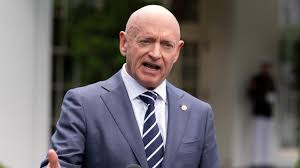
Sen. Mark Kelly’s Lawsuit Against Pentagon Marks Historic Defense of First Amendment and Legislative Independence
Blue Press Journal – In a bold move underscoring the importance of constitutional protections for lawmakers, Senator Mark Kelly (D-AZ) filed a federal civil lawsuit Monday against the Pentagon, Secretary of Defense Pete Hegseth, the U.S. Navy Department, and Navy Secretary John Phelan. The suit alleges that the Trump administration’s decision to cut Kelly’s military retirement pay—following his participation in a video message to U.S. troops—constitutes an unprecedented attack on legislative independence and the First Amendment.
Kelly’s complaint, filed in U.S. District Court in Washington, argues that the government’s actions “trample on protections the Constitution singles out as essential to legislative independence.” His legal team points out that never in American history has the Executive Branch sought to impose military sanctions on a sitting Member of Congress for engaging in political speech disfavored by those in power.
“The First Amendment forbids the government and its officials from punishing disfavored expression or retaliating against protected speech,” the lawsuit asserts. “That prohibition applies with particular force to legislators speaking on matters of public policy.”
Historical Precedent and Constitutional Stakes
Kelly’s case touches a nerve in the ongoing debate over separation of powers and free speech. The framers of the Constitution designed the Speech or Debate Clause in Article I, Section 6 to ensure legislative independence, shielding lawmakers from intimidation or retaliation by the executive branch. Past disputes—such as United States v. Johnson (1966), where the Supreme Court protected a congressman’s speeches from executive interference—have reaffirmed that principle.
Similarly, cases involving retaliation against political expression—like the landmark New York Times Co. v. United States (1971), which defended the right to publish the Pentagon Papers—reinforce that government actors cannot suppress speech simply because it is inconvenient or critical. Kelly’s lawsuit echoes these foundational rulings, framing the Pentagon’s move as not only punitive but corrosive to the core democratic values of checks and balances.
Why This Matters
Kelly, a former Navy combat pilot and astronaut, has dedicated his career to public service. His military retirement pay is not merely a personal benefit—it symbolizes the nation’s recognition of that service. Punishing him for participating in a video for troops sets a dangerous precedent, risking a chilling effect on lawmakers who speak out on military or national security issues.
At a time when political polarization threatens institutional trust, Kelly’s stand represents more than a personal legal battle—it’s a defense of constitutional freedoms that protect all Americans. If the executive branch can wield military benefits as a political weapon against sitting senators, the independence of Congress itself is at stake.
Kelly’s lawsuit is not just about his pay—it’s about preserving the voice of legislators in matters of public concern. In standing up to the Pentagon, he’s standing up for the principles that have kept American democracy resilient for over two centuries.

 Blue Press Journal