Tag: US economy

  • Trump’s Tariff Legacy: American Families Face Staggering $330 Billion Burden While Businesses Get Refunds

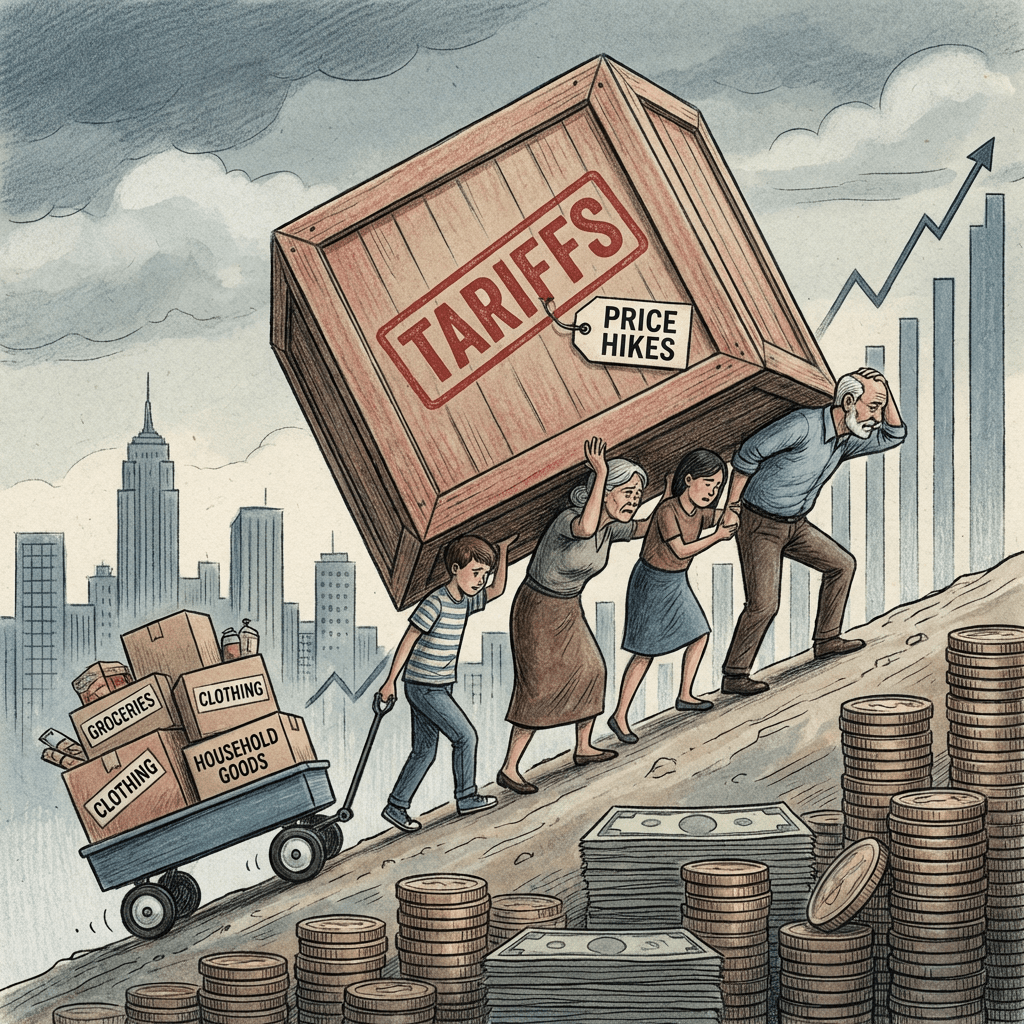
    Family carrying a heavy crate labeled TARIFFS and PRICE HIKES uphill past stacks of money.

    Blue Press Journal (DC) – American households are on track to endure an unprecedented financial hit this year, with combined costs from import duties totaling an estimated $330 billion. This colossal sum, translating to over $2,500 for the average family, underscores the severe economic strain inflicted by President Donald Trump’s aggressive trade policies. A recent report from the Democratic minority on the Joint Economic Committee (JEC) as reported by news outlets like Reuters, paints a stark picture of these escalating expenses, a considerable jump from the $1,700 Americans reportedly paid in 2025.

    Despite a Supreme Court ruling last month that invalidated Trump’s use of emergency powers for imposing widespread tariffs, the administration appears undeterred. US Treasury Secretary Scott Bessent has projected “virtually unchanged tariff revenue in 2026,” suggesting a continued reliance on these trade taxes through different legal avenues to circumvent the high court’s decision. This persistent strategy means continued pressure on consumer wallets.

    The burden of these customs charges falls disproportionately on everyday Americans. Independent analysis from the nonpartisan Congressional Budget Office (CBO) detailed in reports by organizations like the Associated Press, revealed that foreign entities bear only about 5% of tariff expenses. Domestic companies absorb roughly 30%, but a staggering 65% is ultimately shouldered by consumers through higher prices on goods and services.

    A Tale of Two Refunds: Businesses Get Relief, Families Don’t

    While American families grapple with surging costs, businesses impacted by what were deemed unlawful duties are poised for substantial relief. The US Court of International Trade (CIT) recently mandated that the Treasury Department and Customs and Border Protection must reimburse approximately 330,000 importers a staggering $166 billion for duties collected under the invalidated tariffs a development covered by outlets such as The Wall Street Journal. Customs officials indicate that a system for processing these refund requests for over 53 million entries could be operational as early as mid-April.

    However, a stark disparity remains for ordinary citizens. Senator Maggie Hassan (D-NH), a ranking member of the Joint Economic Committee, sharply criticized this imbalance. She lamented that while businesses are set to receive reimbursements with interest, “the Trump administration refuses to provide relief for families” and is instead “choosing to institute new tariffs that will push prices even higher.”

    Legislative Efforts to Aid Struggling Households

    In response to this growing economic strain, Senator Martin Heinrich (D-NM), also a committee member, has introduced a legislative proposal to directly assist those most affected. His “Working Families Refund” bill aims to provide a $600 tax rebate to individuals earning up to $90,000 annually, and to head-of-household filers making $120,000 or less. Joint filers under $180,000 would receive $1,200, with an additional $600 for each dependent child.

    Senator Heinrich emphasized the measure’s intent: “This is money that belongs to working families—not to CEOs of big corporations.” He criticized the administration’s rhetoric, stating, “The president may call the affordability crisis a ‘hoax,’ but working people feel it every time they pay for essentials. This bill will return the money lost to Trump’s tariffs back to those who paid the price.”

    Public sentiment reflects growing dissatisfaction with economic policies. An NBC News poll showed that 55% of voters believe trade taxes have harmed the economy, while only 33% view them as beneficial. With 62% disapproving of the administration’s handling of inflation and living costs, the financial strain on American families is clear. Heinrich’s bill includes a provision to prevent the president from labeling rebate checks with his name, acknowledging previous political optics around stimulus payments.
  • Trump’s New Tariffs: Another Costly Tax on American Families

    Blue Press Journal – In a move that has once again ignited concerns across the economic landscape, the Trump administration has announced a sweeping 10% tariff on goods imported to the U.S. from across the globe. This comes hot on the heels of a Supreme Court ruling on Friday, which deemed the administration’s previous use of the International Emergency Economic Powers Act (IEEPA) for issuing tariffs as unjustified. Despite this judicial setback, the President quickly pivoted, citing Section 122 of the 1974 Trade Act to impose these new levies, which are set to take effect on February 24th.

    While the administration touts these “import taxes” as a strategy to address “large and serious” trade deficits, the overwhelming consensus among economists and trade experts is clear: tariffs are not paid by foreign producers; they are a tax paid by American consumers and businesses.

    The Illusion of Protection: Who Really Pays?

    The notion that tariffs are a punitive measure exclusively against foreign nations is a dangerous misconception that has plagued Trump’s economic policy. In reality, when a tariff is imposed, it’s the American importer—a company, large or small, that brings goods into the country—who pays that tax to the U.S. Treasury. To recoup these costs, importers typically do one of two things:

    1. Raise Prices: They pass the increased cost directly onto consumers through higher retail prices.
    2. Absorb Costs: They absorb the cost, leading to reduced profits, which can translate into lower wages for employees, less investment in their businesses, or even job cuts.

    A comprehensive analysis by the National Bureau of Economic Research (NBER), for instance, found that “U.S. tariffs were almost entirely borne by U.S. domestic consumers and importers.” This sentiment is echoed by the Peterson Institute for International Economics (PIIE), which concluded that the burden of previous Trump administration tariffs fell “almost entirely on American consumers and firms.” These aren’t abstract economic theories; they are concrete realities felt in every American household.The Hidden Costs of Tariffs for American Households

    Impact CategoryDescription
    **Higher Consumer Prices**Increased costs for everyday goods, from clothing and electronics to household appliances, directly reducing purchasing power.
    **Reduced Business Investment**Companies face uncertainty and higher input costs, leading to less investment in expansion, innovation, and job creation.
    **Slower Wage Growth**As profits are squeezed, businesses have less capacity to offer competitive wages or bonuses.
    **Supply Chain Disruptions**Forced reshuffling of global supply chains can lead to inefficiencies, product shortages, and further price hikes.
    **Retaliatory Tariffs**Other countries often impose their own tariffs on U.S. exports, harming American farmers and manufacturers who rely on international markets.

    A Familiar, Flawed Playbook

    This latest round of tariffs, while excluding agricultural products, pharmaceuticals, electronics, certain vital minerals and metals, and goods from Canada and Mexico (due to a 2020 trade agreement), still casts a wide net over the global economy. It’s a return to the same protectionist policies that characterized the administration’s first term, often leading to costly “trade wars” that hurt American industries and consumers alike.

    The economic consequences of such policies are often multifaceted:

    • Inflationary Pressures: Tariffs contribute to rising prices across the board, fueling inflation and eroding the value of American wages.
    • Supply Chain Instability: Businesses struggle to plan and maintain efficient supply chains, leading to higher operational costs and potential product shortages.
    • Reduced Competitiveness: American companies that rely on imported components become less competitive globally.

    Facing Domestic Opposition

    Even within his own party, the President’s tariff strategy is facing significant pushback. Rep. Don Bacon (R-Neb.) was quick to signal that these tariffs will likely “be defeated” in Congress. As he told CNN in an interview, “It may not have a veto-proof majority, but it will have a majority that will go against that 10 percent global tariff, so I think the president is making a mistake here.”

    This confidence stems from the foundational principle that under the 16th Amendment, lawmakers hold broad authority over federal taxes, including tariffs. The legislative branch has the power to reject what many view as an economically damaging policy being unilaterally imposed.

    The True Cost of Protectionism

    The evidence is overwhelming: tariffs are a self-inflicted wound. They masquerade as a solution to trade imbalances but function as a regressive tax on hardworking American families and a burden on businesses. Instead of fostering economic growth, they invite retaliatory measures, disrupt supply chains, and ultimately make everyday life more expensive for millions.

    It’s time to move past the misleading rhetoric and embrace policies that truly strengthen the American economy through open markets, fair trade, and genuine competitiveness, rather than punishing our own citizens with higher taxes disguised as patriotism.


  • Trump’s Economic Reality Check: Self-Inflicted Wounds and False Narratives Hamper US Growth

    Economic Reality Bites: Trump’s Policies Undermine U.S. Growth Amidst Q4 Slump

    Blue Press Journal – The U.S. economy experienced a stark slowdown in the final quarter of 2025, with GDP growth reaching only 1.4%—significantly below the anticipated 3% and casting a long shadow over market optimism. This disappointing performance, coupled with a slightly higher-than-expected inflation rate (PCE up 2.9%), paints a challenging picture for American households.

    Economic analysts widely agree, including Heather Long, chief economist at Navy Federal Credit Union, that the prolonged 43-day government shutdown was a major culprit, significantly eroding year-end growth and impacting federal workers’ incomes. Leading financial publications like The Wall Street Journal and Bloomberg similarly highlighted the shutdown’s disruptive effect on economic indicators, validating the Bureau of Economic Analysis’s findings.

    Curiously, President Donald Trump took to Truth Social to declare the “Democrat Shutdown” cost the U.S. “at least two points in GDP,” while also attacking Federal Reserve Chair Powell. Such statements are not only legally problematic—federal law prohibits executive branch officials from discussing sensitive economic data pre-release—but are fundamentally false. His administration’s own political brinkmanship and demands often precipitated these very shutdowns, making his blame on Democrats a misleading deflection from policies that directly contribute to economic instability. His repeated calls for “LOWER INTEREST RATES,” while appealing, often disregard the complex factors the Federal Reserve must balance, and could exacerbate inflationary pressures.

    The economic headwinds of Q4 2025, therefore, are less an external conspiracy and more a consequence of Trump’s erratic governance and political tactics that undermine economic predictability and consumer confidence.

  • TRUMP’S BROAD TARIFFS TAKE EFFECT, EXACERBATING ECONOMIC PAIN

    Blue Press Journal: In a move that is likely to have far-reaching consequences for the US economy, President Donald Trump’s administration has begun imposing higher import taxes on dozens of countries, effective Thursday. The new tariffs, which range from 10% to 20%, will affect goods from over 60 countries, including the European Union, Japan, and South Korea.

    The tariffs, which include taxes on food items such as coffee and bananas, as well as cell phones and computers, are expected to have a significant impact on both companies and consumers. The EU, Japan, and South Korea will face a 15% tariff rate, while imports from Taiwan, Vietnam, and Bangladesh will be taxed at 20%.

    The move comes at a time when the US economy is already showing signs of strain from existing tariffs, including a 10% global tariff, a 25% levy on automobiles and auto parts, and a 50% tax on steel and aluminum imports. The Bureau of Labor Statistics recently released a weak jobs report for July, and inflation has ticked up as businesses pass on the cost of tariffs to consumers.

    Many economists warn that the risk of the tariffs is not a sudden collapse, but rather a steady erosion of the US economy. A survey by the National Foreign Trade Council found that companies are being forced to delay or reduce their product and service offerings due to rising costs and sourcing challenges.

    Heavy equipment manufacturer Caterpillar has already warned that rising tariffs could cost it $1.5 billion this year. Additionally, Trump has announced 100% tariffs on computer chips, and import taxes on pharmaceutical drugs are still pending. These moves could leave the US economy in a state of suspended animation, awaiting the full impact of the tariffs.

    As companies and consumers brace for the impact of the new taxes, there are growing concerns about the self-inflicted wounds to the US economy. The Trump administration’s trade policies have been widely criticized, with many arguing that they will ultimately harm American businesses and consumers.