Tag: writing

  • The Art of the About-Face: A Critical Look at Lindsey Graham’s Political Evolution

    American politics doesn’t usually give you a transformation as sharp, or as revealing as Lindsey Graham’s. Watching him shift in Washington has become almost surreal. The man bends with the wind, sure, but the cost of that flexibility has been his integrity.

    Just look at his record. Over the years, Graham has mostly acted like his main goal is just to hang on to his seat. He went from bashing Trump at every turn to openly praising him. If you need a case study in plain old political opportunism, this is it.

    Remember the 2016 Republican primaries? Graham didn’t pull any punches. He called Trump a “race-baiting, xenophobic, religious bigot.” He sounded like someone who actually believed what he was saying. Then, almost instantly, once Trump became the nominee, Graham dropped the act and threw in his lot with Trump. That wasn’t some sudden epiphany, it was survival mode, pure calculation.

    The shift was impossible to miss during the Brett Kavanaugh hearings in 2018. After Dr. Christine Blasey Ford’s testimony, the Senate was in chaos. Graham could have played the role of the rational adult in the room, but he didn’t. He went full throttle with a fiery defense of Kavanaugh, turning the hearings into political theater. In doing so, he shored up his spot in Trump’s camp, tossing aside the usual committee rules for a shot at the spotlight.

    Fast forward to 2020, and Graham’s credibility took another hit. After Justice Ruth Bader Ginsburg died, the same man who’d argued in 2016 that Supreme Court picks should wait until after the election did an immediate about-face. He fast-tracked Amy Coney Barrett’s nomination, just weeks before voters went to the polls. It wasn’t just a flip-flop, it was proof that his stated principles didn’t mean much when power was at stake.

    So, when does a politician stop serving the public and start just playing the angles? With Graham, it was obvious: keeping his place at the table matters more than sticking to his beliefs. He changed course whenever it suited him, and yes, it’s helped him stay in power, but at the expense of his credibility.

    Graham’s story serves as a cautionary tale. When individuals abandon their convictions to maintain relevance, they risk losing the very respect that initially earned them admiration. Politicians who remain apolitical will eventually succumb to any political pressure. Moreover, if you support someone whose principles fluctuate with the political climate, what can you truly rely on during challenging times?

    In the wake of his passing, it is customary for Washington to offer a eulogy extolling his virtues. While he was undoubtedly a remarkable individual when collaborating with John McCain, it is imperative that we draw lessons from his tenure in office. Was his primary motivation the nation and the Constitution, or was it driven by political gain and the pursuit of power?
  • Democratic Party Must Reject Darializa Avila Chevalier’s Fringe Agenda

    I’ve watched the Democratic Party stretch to build a bigger tent, always talking up diversity and inclusion, but never at the expense of democratic values or national security. Lately, though, I can’t ignore it any longer: there’s a limit to what the party can tolerate. Some statements and associations just go too far, drifting out to the fringes, even slipping into anti-American territory. After Darializa Avila Chevalier won the 2026 primary in New York’s 13th District, it’s clear she shouldn’t just slide into Congress. The party needs to act, now, before she’s elevated as a new face of the Democratic Party.

    The warnings started early. On October 8, 2023, right after Hamas attacked Israel, Avila Chevalier joined a pro-Palestinian protest in Times Square. Protest is a right, sure. But the timing and the setting sent a message that struck many as flat-out hostile toward a close U.S. ally. Critics jumped on the moment, calling it “tone-deaf,” and it’s haunted her ever since, fueling a steady campaign controversy.

    Look no further than her social media history. In 2019, Avila Chevalier posted, “I wiped my hand on an American flag instead of a napkin.” Far from a throwaway joke, this was a calculated insult to a symbol that service members have died defending. She followed that up during the 2020 election by trashing her own party’s nominee, calling Joe Biden a “rapist” and “war criminal,” and calling the U.S. a “f**king disgrace.”

    Now, she claims she has “matured” since then. But a sudden change of heart doesn’t erase the record, especially for someone in their 30s. You simply cannot publicly mock the flag and then pretend to share the values of mainstream Democrats.

    Her suggestion to unite the Dominican Republic and Haiti went over terribly. She claimed that if the island had never split, it could have been one unified nation.

    People immediately warned her to back off. Why? Because the Dominican Republic fought hard for its independence from Haiti. Bringing up a “unified island” triggers deep, historic fears for Dominican voters who are fiercely protective of their sovereignty.

    Instead of clearing the air, she completely dodged the question during a Spanish radio interview. Bailing on the conversation only made her look guilty, leaving voters more suspicious than ever.

    The issues don’t stop there. Her policies lean further left than even the most progressive lines. She calls herself a “prison abolitionist,” but when asked whether convicted murderers should go to prison, she dodged the question. She told the New York Editorial Board she’d “rather focus on fixing the systemic root causes of violence.” That isn’t leadership—it signals she’d rather excuse violent crime than enforce the law.

    Then there’s her 2022 tweet about Ukraine. She accused the United States of “bullying Russia ever since the Cold War ended,” like Russia’s full-scale invasion of another country didn’t even matter. Even after fierce criticism, her response was tepid at best barely acknowledging Ukraine’s plight, still demanding a diplomatic “solution” that would reward Russian aggression.

    The Democratic Party can’t afford to repeat the GOP’s mistake of coddling voices on the fringe until they wreck the party’s credibility. Too much is at stake now: our reputation, trust from voters, and national security. Party leadership has to show where the line is, and not seat Avila Chevalier as a Democrat. It’s time to say stop—to refuse to keep anyone who opposes the nation’s defining principles, or else risk handing our opponents a win and losing the voters we’re supposed to stand up for.

    The Democratic Party history is to support progress, inclusion, and upholding the law. Darializa Avila Chevalier’s record shows she doesn’t share those values. I’m calling on party leaders: take a stand, reject her candidacy, and keep the party rooted in the values that have always sustained American democracy.

  • The Art of the No-Deal: Inside Trump’s G7 Fatigue

    The Twilight of Trump’s Dealmaking

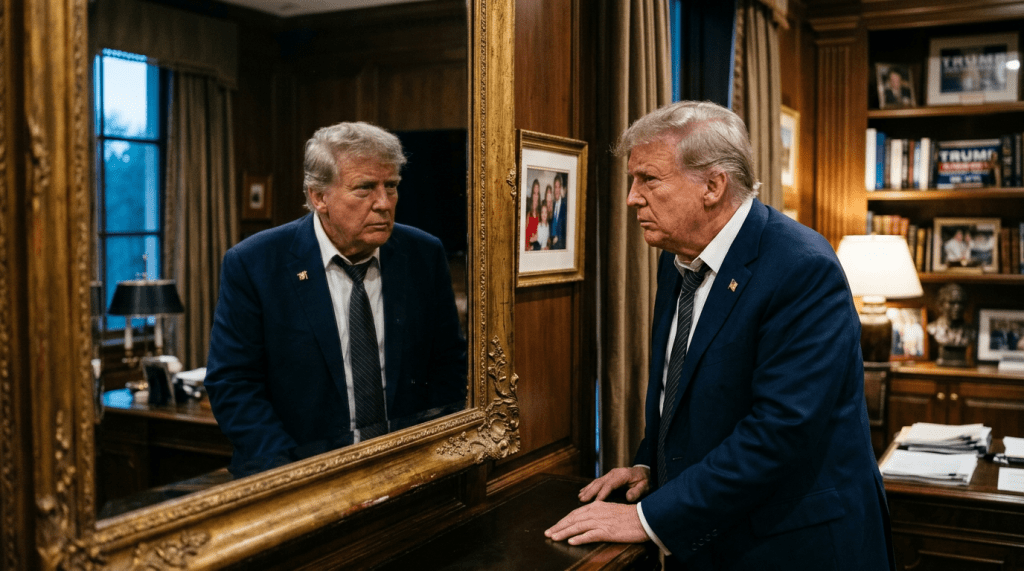
    Man in blue suit leaning on desk, looking at his reflection in an ornate mirror in an office
    .

    by Winston Wendell

    France feels different this week, quiet, maybe a bit somber. A decade of upended traditions is ending not with a bang, but a sigh. Take Donald Trump: he’s at his sixth G7, but the old swagger is gone. Back in 2017, you couldn’t miss him: loud, insistent, pulling everyone’s attention his way. Now? He looks worn down. Age hangs on him, the kind you can’t hide, no matter how much makeup you skip. At 80, the relentless drive isn’t there anymore. He seems smaller, almost faded, and it’s obvious the world isn’t watching him like it used to.

    His “big moment” in France—a supposed landmark deal with Iran—barely turned heads. Sure, there’s talk of a $300 billion economic boost for Tehran, lifting oil sanctions, and calling for a ceasefire. On paper, that sounds ambitious, a shot at lasting peace. But in reality, it just seems like an exhausted attempt to end a mess that’s sapped America’s cash and reputation. Benjamin Netanyahu already brushed it off. This isn’t bold diplomacy; it’s almost a repeat of Trump’s old routine, only without the drama.

    The contrast with Trump’s early G7 days is jarring. 2018, 2019—he showed up chomping at the bit. He demanded Russia’s return to the fold, gave NATO leaders lectures about money, even tried to turn the meetings into commercials for his hotels. That relentless energy, gone now. There’s a distant air about him. Ukraine barely comes up, and when it does, he sounds tired, going through the motions. The other G7 leaders feel the shift. They don’t count on the US for guidance the way they used to. They’re making their own plans for Kyiv, building their own safety nets.

    Everyone sees this drop in US influence. Pete Hegseth’s offhand remarks about the D-Day legacy still sting on this side of the Atlantic, and Europe’s leaders seem more focused than ever on going their own way. Waiting for Washington? Not anymore, they’re tired of the mood swings.

    Even the summit trappings fell flat. The German Chancellor handed Trump a soccer jersey. He barely cracked a smile, just mumbled thanks. At Versailles, standing in the hall of mirrors, gold everywhere, he looked a little more comfortable. Maybe it was all that gleaming reminder of power. For a second, you could almost believe he belonged.

    When it’s time to head home, Trump isn’t the “great negotiator” he set out to be. There’s no big legacy, no Nobel Prize, none of the things he once seemed sure he’d win. What’s left is an uncertain scene, with his spot in world affairs slipping away. Maybe, back in Washington, he’ll dream up another grand project—a hall of mirrors just for him. That’d fit. In these final days, it’s like he can’t look anywhere but at his own reflection. His aging reflection.

    Fediverse Reactions
  • Could we lose our First Amendment Rights?

    There has been significant concern surrounding President-elect Donald Trump’s intentions to utilize the extensive authority of the Justice Department and the FBI to pursue retaliatory prosecutions against his political adversaries. This is a troubling notion, as criminal investigations can result in individuals being incarcerated, even if they are innocent.

    At the core of every democratic society lies a fundamental principle that serves as its foundation: the right to be informed. This principle is closely tied to the First Amendment of the United States Constitution, which guarantees freedoms related to religion, expression, assembly, and the right to petition the government. 

    Democracy relies on an informed citizenry, and the First Amendment plays a crucial role in ensuring that citizens have the necessary information to actively participate in the political process.

    Democracy hinges on the belief that governance should reflect the desires of the people. However, for this reflection to be accurate, citizens must be well-informed. An informed electorate can make informed decisions, hold leaders accountable, and engage in meaningful civic discussions. Without access to information, citizens are susceptible to misinformation, propaganda, and manipulation, all of which can erode the foundations of democratic governance.

    The First Amendment guarantees the right to free speech and a free press, creating a framework for the flow of information within society. It empowers journalists to investigate, report, and share information, enabling citizens to stay informed about government actions, societal issues, and global events. The press acts as a watchdog, promoting transparency and accountability, both of which are essential for a healthy democracy.

    A free and independent press is often referred to as the Fourth Estate, serving as a critical check on governmental power. The Founding Fathers understood that without a vigilant press, the government could operate in secrecy, leading to corruption and tyranny. The ability of journalists to investigate and report on matters of public concern is not merely a privilege; it is a right that upholds the very essence of democracy.

    In recent years, there has been a rise in attacks on press freedom and attempts to undermine the credibility of journalists by Donald Trump. However, it is essential to recognize the vital role that a free press plays in upholding democracy and ensuring that citizens have access to the information they need to make informed decisions.