We aim to be a voice in the ongoing political discourse, providing both factual information and opinionated analysis, from a progressive or center-left perspective, free from the direct influence of major established Main Street Media.
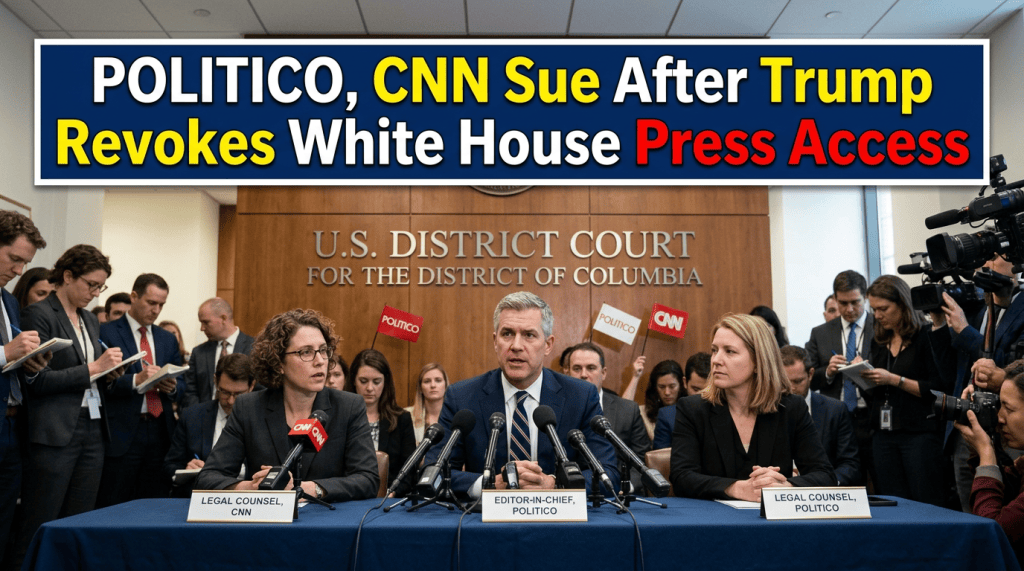
Tensions between the White House and the press corps escalated significantly on Thursday as Politico reported that one of its journalists was denied entry to the White House grounds. The incident occurred despite a federal judge’s order issued earlier that day mandating that the Trump administration restore access to several barred news organizations.
According to Politico, the unnamed reporter not only had their access blocked but also had their physical press credentials confiscated by security personnel.
The incident marks a critical flashpoint in the ongoing legal and political battle over press freedom, credentialing, and the constitutional rights of journalists covering the executive branch.
Despite a recent court ruling blocking the administration’s ban on specific news outlets, some CNN journalists are still reporting difficulties gaining access to the White House complex.
The ongoing confusion highlights a disjointed enforcement of security protocols following legal battles over press credentials for reporters from CNN, MS NOW, and Politico.
The Incident at the Gates
The challenges came to light this morning when CNN journalist Betsy Klein was blocked from entering the White House grounds. According to reports, Klein presented both her driver’s license and official press ID to U.S. Secret Service agents at the checkpoint.
Despite providing standard identification—and even showing agents a digital copy of the judge’s ruling that temporarily halted the press ban—Klein was denied entry. Agents instructed her to contact the White House press office for further clarification rather than granting her access.
The situation appeared inconsistent on the ground. Just moments after Klein was turned away, a CNN producer was permitted to enter the White House. However, the inconsistency continued when a CNN photojournalist attempting to enter shortly after was also barred, despite the producer’s successful entry.
A “Fluid” Situation Awaiting Clarification
Describing the morning’s events as “fluid,” Klein and other affected media personnel are currently awaiting formal guidance and clarification from the White House press office regarding how security personnel are operationalizing the recent court decision.
Legal experts note that while court rulings can quickly alter official policy, the operational trickle-down to frontline security staff can sometimes experience logistical delays or mixed messaging.
As this is a developing story, updates will be provided as the White House press office and legal teams respond to the ongoing access disputes.
The Trump administration wants a court order letting the executive branch decide who receives White House press credentials, and it is challenging a long-standing legal precedent that protects journalists covering the West Wing.
In a brief filed late Tuesday, the Justice Department said barring POLITICO, CNN and MS NOW from the White House complex was justified by how those outlets had reported on sensitive information.
The administration told the courts that the president believed the plaintiffs had failed basic journalistic standards by revealing classified details and national security matters.
Responding to an emergency injunction from the three media companies seeking immediate restoration of access, the government brief cited articles from each outlet about the conflict with Iran, US military reserve levels and a leak investigation into FBI Director Kash Patel. It also objected to POLITICO’s release of a Secret Service document originally given to Senate Republicans to help build a new presidential ballroom.
The DOJ brief also included copies of letters supposedly sent to the organisations that day explaining the credential revocations and setting a Friday deadline for a response.
But the documents had no signatures or letterhead and never explicitly said any cited example in the articles contained classified information. Several examples were also largely unrelated to national security; the letter to POLITICO objected to an article about internal tensions at a Texas Republican convention.
Government attorneys conceded the retroactive letters do not meet the standard set by Sherrill v. Knight, a 49-year-old D.C. Circuit ruling holding that the state cannot arbitrarily exclude specific news organisations from White House press facilities based on its perceived coverage.
Instead, the Justice Department is formally asking the courts to overturn the Sherrill precedent, dismantling the legal framework that ensures equal press access. The administration instead wants wider use of a different ruling from last year suggesting the president has discretion to restrict entry to high-security parts of the White House grounds, such as the Oval Office.
POLITICO, CNN and MS NOW sued on Monday, arguing that revoking their press passes violates the First Amendment. They have also asked for a temporary restraining order forcing the administration to restore their credentials while the case is heard.
U.S. District Judge Timothy Kelly, appointed by Trump, has set a hearing for Wednesday afternoon.
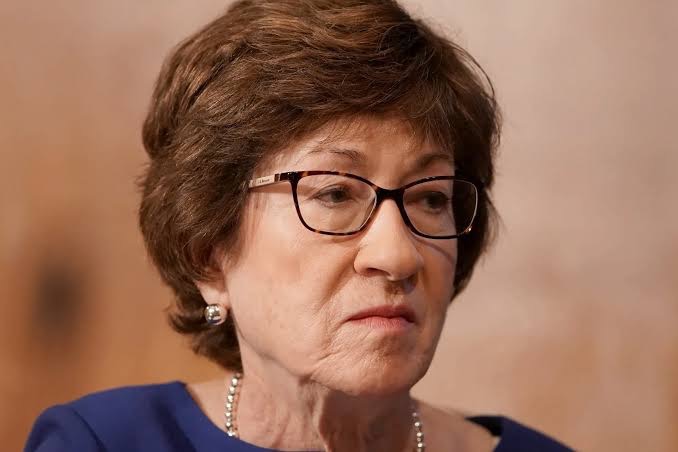
A new ProPublica report details a potentially explosive source of controversy in the re-election bid of Sen. Susan Collins (R-Maine) , shifting Democratic criticism of the senator away from her legislative voting record and towards allegations of significant political corruption.
The report follows up on an investigative trail beginning with Martin Kao, the former CEO of defense contractor Navatek, a Hawaii-based company. At the time of the 2022 campaign finance indictment, Kao was cooperating with federal authorities and met with Scott Reed, who headed a super PAC that had been associated with Collins. Kao allegedly offered to provide a $500,000 donation to the super PAC, which would have circumvented contributions from government contractors to get around bans on donations from government contractors in order to secure dozens of millions of federal naval contracts for Navatek. Reed supposedly assured Kao that the senator would be aware of where the money came from, and internal emails later suggested that Collins was committed to obtaining $32 million in contracts.
FBI agents had investigated the possibility of a bribery investigation connected to these allegations, but the probe died out after the new election cycle began, and federal law enforcement purges, particularly those orchestrated by the Trump administration, that undermined public corruption investigations. An FBI spokesperson said that the bureau ultimately found nothing implicating Collins or her campaign.
Collins’ office and campaign have strongly rebutted the allegations, describing Kao’s statements as “outlandish” and noting that the campaign was never a target of FBI investigation, cooperating fully with authorities.
Despite these denials, the report threatens to derail the final weeks of the Maine Senate race, with Collins’ Democratic rival, Troy Jackson, quickly capitalizing on the story, claiming the allegations represented “corruption of the highest order” and calling for full transparency, which is sure to be a major issue for voters ahead of election day.
In a surprising development, Belarussian President Alexander Lukashenko refuted the reports of a major potash deal between the US and Belarus. Lukashenko asserted that there were no such volumes of potash for sale to make such a deal, despite Trump’s insistence that a significant discount on Belarusian potash would benefit the American farmers.
President Trump announced the deal on his social media platform called Truth Social, claiming that the US is “working on a massive Deal with respect to the purchase of Potash from Belarus” at a price lower than the current Canadian rate. However, President Lukashenko of Belarus spoiled the deal by telling Trump that all of their available potash has already been ordered and that they do not have any for sale.
Trump’s long-running dispute between Canada and the United States has upended the potash market and has had a clear outcome: American farmers supply has decreased and costs have increased. Canada is the world’s largest producer of potash, and about 53% of its output is exported to the United States. Overall, roughly 80% of the potash used on American farms comes from Canada, while Belarus supplies only about 2%.
As the dust is settling on the Belarus potash debacle, it is hard to say with a degree of certainty whether Trump was being truthful about the purported deal or he was just engaging in some self-promotion from the outset. The American farmers are left scratching their heads in bewilderment over the actual state of affairs with respect to their fertilizers. The bottom line is Trump is solely to blame for the critical shortage!
President Donald Trump has intensified economic pressure on Iran with new sanctions and blockades, claiming it will strengthen the United States. Instead, record diesel prices are fueling backlash from farm and energy interests, pushing Republican lawmakers from rural states to consider a diesel export ban that cuts against his own policy.
Mr. Trump’s war with Iran has reduced Iranian oil exports and triggered a blockade of the Strait of Hormuz, creating a shortage in European and Asian markets. With diesel demand still high, prices have hit record levels, hammering the agricultural sector and driving up the cost of goods and services. As the 2026 midterm elections approach, Republicans risk losing farm voters who blame the President and his party for surging inflation.
Many Republicans in Congress refuse to budge because they rely on big oil money from companies like Exxon and Chevron, which profit when diesel prices soar. Their lobbying power drowns out farmers who are being squeezed by high fuel costs. This GOP loyalty to oil giants over rural voters exposes a blatant hypocrisy that could cost them crucial farm‑state electoral support.
Critics say the President’s Iran policy is less about security and more about staging a confrontation with Tehran to distract voters. They argue his hardline moves have failed to explain to voters why Iran was a looming threat, but a political tactic to distract from stubbornly high prices for everyday goods and services because of this tariffs.
For farmers and American’s, it means that prices of commodities and services are about to rise again. The President’s and Republican’s current course of action will be detrimental for the country, we need change!
Donald Trump has pursued one scandalous policy after another in his second term. One of the latest initiatives that perfectly represents the president’s disregard for the public interest in favor of big business. In essence, the policy allows big tech companies to score a decade-long billion-dollar tax break by building AI data centers on public lands.
One commentator has summarized the issue by noting that tax breaks are nothing more than a “windfall” given to big tech companies. Indeed, a separate fiscal analysis report noted that thanks to new Trump administration rules, major technology companies, including Amazon, Microsoft, and Google, would benefit enormously from being able to “accelerate the depreciation of data center equipment.”Amazon, Meta, Alphabet, Netflix, Apple, and Microsoft collectively pay an average effective tax rate of 18.8%, far below what the average American pays in taxes.
Environmentalists have pointed out that the policy is short-sighted because it will fuel the American west’s newest land-use fights. For example, ranchers, farmers, conservationists, and indigenous peoples’ representatives from a significant number of western states, including Utah, Nevada, and Montana, have raised concerns about the environmental impact of technology giants building their data centers in the region. The companies would use huge amounts of water to cool the data centers and would have to build new power lines and roads, disrupting local wildlife.
Trump’s initiative on AI is counterproductive because it fails to acknowledge the fact that cutting big tech companies’ taxes will reduce the resources for critical social programs that support the American middle class. Furthermore, the technology companies have more than enough money to research and develop innovative AI technologies without taxing the public.
The Trump administration and Donald Trump has pursued a policy that hurts the public, benefits corporations, and will destroy the environment.
The United States Supreme Court is in crisis. The institution which was designed to provide nonpartisan justice in accordance with the Constitution has become a clearly politicized body.Its decisions undermine the rights of the people and ignore the voice of the nation.
By ruling in blatant support of one party and president, the Court betrays its role as the ultimate decision-maker in the United States. The Court has repeatedly violated the constitutional rights of the people and has usurped the authority of duly elected officials.
With the overturn of Roe v. Wade in the Dobbs v. Jackson Women’s case, the Court removed a constitutional civil right that protected women for decades. Through the Trump v. United States decision, the justices granted president Trump immunity from prosecution. In addition, the Court has hampered the ability of the federal government to function properly by ruling against environmental protections, consumers, and the environment in the Chevron decision.
The Court’s reputation has been irreversibly harmed by these decisions and many more taking America backward. It is high time to reform the Court by imposing term limits or expanding it to obtain ideological balance. The unbiased administration of justice will be restored only when the members of the Court realize their role as judges in the service of the people.
Why Limiting Media Access to the White House Undermines Transparency, Fuels Misinformation, and Threatens the Future of Our Democratic Republic
by Winston Wendell
Durning Trump’s second term we have seen a concerning trend of restricted access to the White House for the press. As I see the political climate shift, I feel it is important to stand up for the freedom of the press, as it plays such an important role as the watchdog of a democratic state.
The Press as the Guardian of Accountability
I believe that the press is the primary mechanism which checks the powers of the government. Providing constant updates to the public and providing a diverse array of opinions allows the press to effectively fulfill its role as a watchdog and inform the public of what transpires in the government buildings. The press allows the American public to hold accountable their representatives and the president.
Socially Significant: Information as Power
We must recognize that the freedom of the press is a matter of profound social importance. Journalism provides the platform where people gain the information necessary to exercise their voting rights wisely. Democracy depends on the free exchange of information as political matters are public concerns.
If an individual has no desire to uphold the democratic regime, limiting the exchange of information is the most sure way to establish the autocracy of one’s ideas. If we are to remain a society of informed constituents, we must allow the freedom of the press that allows us to have an informed discussion and debate of the issues that determine our future.
The Peril of Censorship: Lessons from History
Looking at history with the lens of the past events, it’s easy to see that any attempt at censorship will lead to a divided country. By attempting to restrict the freedom of the press, one effectively promotes the spread of rumors and lies among the populace.
Division brings forth a lasting distrust between the people and the government, and, once established, is exceptionally difficult to combat. Through its limitation of the freedom of the press, a president betrays his swore constitutional duties and the country and promotes distrust between them and the government, putting the stability of the entire state at risk.
Building a Conscious Society
I contend that the freedom of the press is the cornerstone of a Democracy. This is because of the ability it grants us to process governmental happenings and to form a consistent opinion on it. A country that hides its actions from its citizens is a suspicious country, one which has much to hide.
I believe that Donald Trump’s decision to restrict the access of the press to the White House goes against the democratic ideals of transparency and accountability. We must demand that our political figures respect those ideals for the country is built on. Journalism fulfills a crucial role for it gives us a chance to become informed on the issues that determine our future. The presence of reporters in the Whitehouse briefings is a guarantee of freedom of the press.
I believe it is our collective duty to ensure that the press remains free—because, without it, the light of democracy will eventually dim.
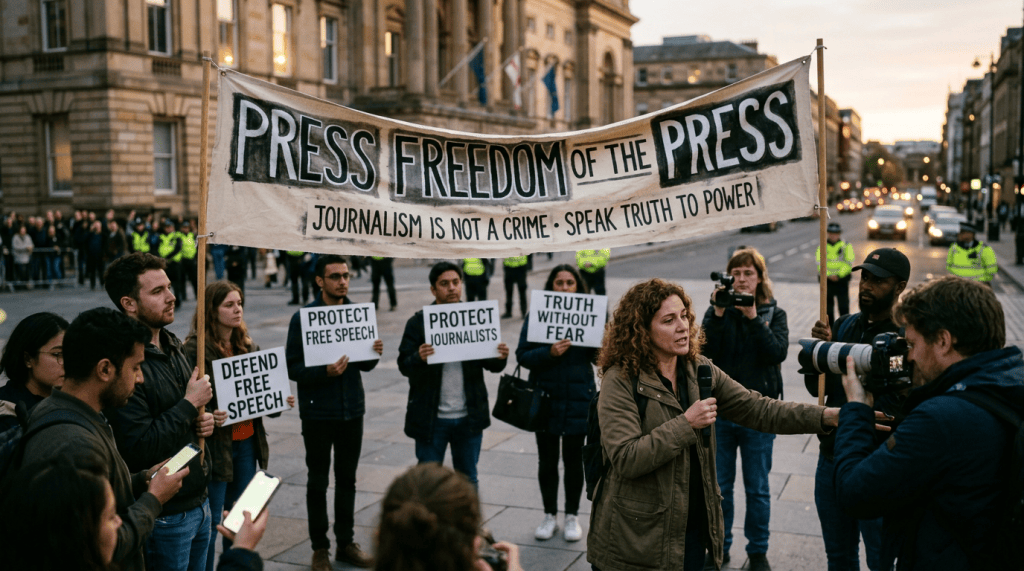
In an effort to continue his campaign of banning mainstream news sources, President Trump announced on Truth Social that he would ban CNN, MS NOW, and Politico from the White House. According to Trump, these news outlets were spreading “FAKE NEWS” for criticizing him, and he warned that more news organizations would be banned for speaking “critical” of his administration.
At his daily press conference on Friday, Trump complained about the outlets being “very one-sided” and accused them of writing negatively about him and his administration. He also claimed that they do not reflect the opinion of the American people, who, according to him, have suffered due to his military actions against Iran. However, when Reuters reminded him that freedom of the press was a protected right and that the White House could not prevent them from asking questions, Trump reacted with disdain, stating, “Oh, thank you for reminding me.” When asked whether he was trying to intimidate the press, Trump responded, “No, I don’t like dishonest press. I think you are all horrible people.”
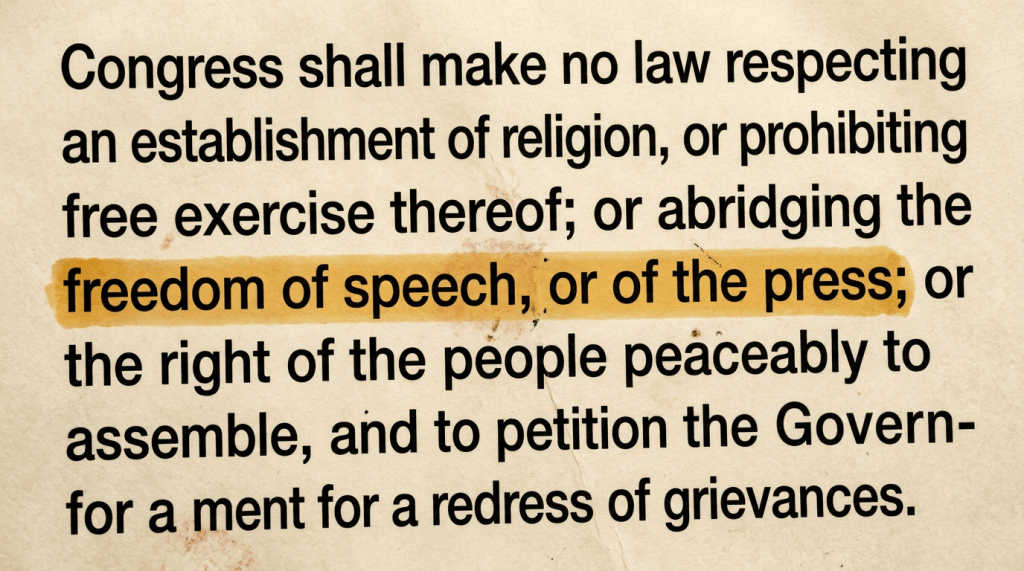
In effect, what Trump was trying to do is interfere with the right of the American people to obtain reliable information about their president and his actions, which is a direct threat to the First Amendment.
CNN strongly pushed back, claiming that “we have a right under the U.S. Constitution to do that reporting without hindrance or interference from the government.” Mark Schoeff, Jr., president of the National Press Club, expressed similar sentiments, stating that “[b]anning news organizations from the White House based on the administration’s disapproval of their coverage is a clear attempt to control which voices are allowed to witness and report on the exercise of presidential power.”
A free press is one of the pillars of any democratic society, and by threatening it, Donald Trump is threatening the very foundation of the US political system.