Tag: middle class

  • The Delusion of Democratic Socialism: A Betrayal of the American Middle Class

    by Winston Wendell

    I’ve watched the Democratic Party twist itself in knots for years, but lately, it feels like it’s finally unraveled. All of a sudden, “democratic socialists” have found their way to the center stage, and honestly, the party seems to be forgetting what most people need—folks who just want life to make sense, not another uphill battle. Democratic socialism isn’t a fresh spin on old values—it runs straight into the wall of what middle-class Americans care about.

    Anyone I know isn’t hoping for higher taxes or a government takeover in the middle of the night. They’re busy paying the mortgage, keeping the fridge stocked, checking if their kids’ schools are safe, and crossing their fingers there’s enough left over for a rainy day. Ask them about fairness, and they’ll tell you it’s about working hard and earning what you get. Nobody’s asking for the government to hand everything out or bog down the economy with wild experiments.

    Take the Green New Deal. Climate change matters—a lot. But come on, does anyone believe the middle class can foot a trillion-dollar bill and pay more for energy without breaking a sweat? We’re the ones stuck paying the price. They’re shaky ideas that pile even more pressure onto teachers, nurses, business owners, and workers—the same people already feeling squeezed by shrinking paychecks and pricier groceries.

    Party leaders keep saying there’s space for everyone, banking on far-left proposals to keep younger voters hopeful and the donation machine humming. But all this does is turn radical ideas into “normal,” and most families don’t buy it. Look at Darializa Avila Chevalier’s win in NYC’s 15th district—she ran on a 70% wealth tax and a federal jobs guarantee for everyone. Activists might celebrate, but regular folks aiming to buy a house, start a business, or pick a school for their kids look at that and think, “No thanks.” Her win doesn’t mean America wants to go far left. It’s a red flag that the party is veering toward policies that hike costs, kill investment, and stick even more power in the government’s hands—the last thing the middle class needs.

    What I wish is for the Democratic Party to stick to common sense, back up small businesses, and deliver real help: affordable childcare, decent job training, safer streets. Democratic socialism misses all that. If we’re being real, it’s just an idealistic, top-down plan that swaps practical answers for risky promises—and guts what makes the Democratic Party strong. If this direction keeps up, it’s the middle class left holding the mess. We know the Republican Party and Trump clearly not for the American middle Class. Let’s be honest: this isn’t some bold new path for Democrats. It’s just a turn away from what built and keeps the American middle class alive.
    Fediverse Reactions
  • The Cost of Trump Protectionism: Assessing the Economic Strain of 2025‑2026


    By Winston Wendell

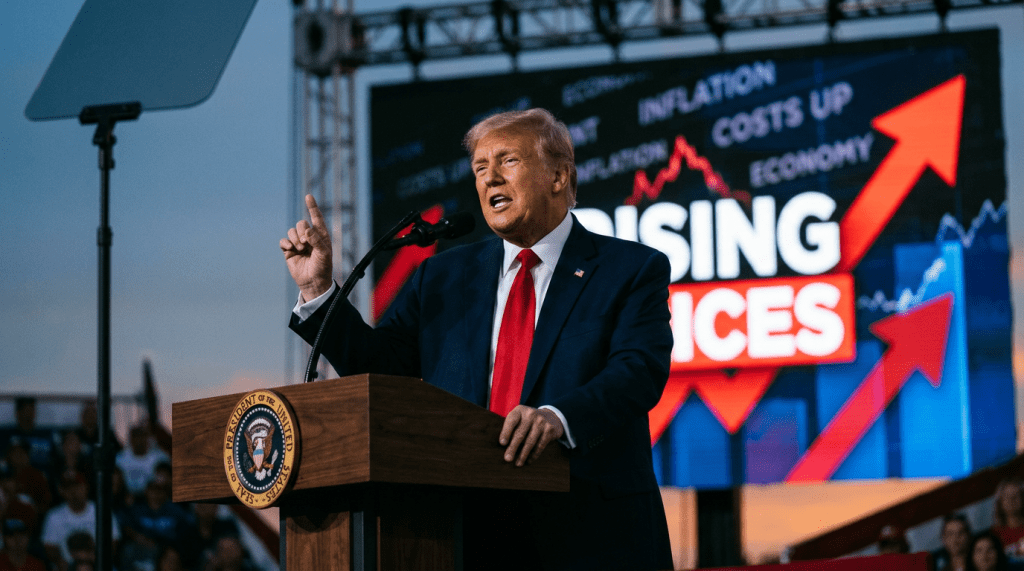
    It has been quite an eventful year – to be more precise, the economic policy of President Trump during his second term of office is turning ordinary everyday activities into a burden. Americans jokingly refer to the current situation as “Trumpflation”. However, one might wonder what is causing the increase of prices? Let us examine the causes in detail.

    Former U.S. president giving speech at podium with 'Rising Prices' and inflation graphics behind him

    Tariffs and Price Surges

    In 2025, President Trump introduced the tariffs of 10% on imports and 60% on imports from China, claiming that it will boost production in the USA. However, economists from the Peterson Institute did not hesitate in criticizing the move as a sales tax for citizens.

    By June 2026, the level of inflation in the USA reached 6.5% which is the highest one since before COVID-19.

    One of the places where this process becomes obvious is a local supermarket. America is still dependent on foreign fertilizer, chemicals, and farming equipment. As a result, any increase in the costs of importing them makes local products more expensive. A gallon of milk cost increased by almost 80% reaching $5.10. Moreover, even staple goods and food are increasing in price faster than the rate of inflation, and families making $50,000 to $150,000 a year face this problem.

    Oil Shock: The Iran War and Gasoline

    However, things get worse overseas. By the end of 2025, Trump began to attack Iran causing the start of what became known later as “The Iran War”. This led to the closure of Strait of Hormuz which accounts for 20% of global oil transportation. As a result, gasoline prices exploded.

    As a result, in early 2026, the average price of gasoline reached $5.65 a gallon. In Arizona and in the Midwest regions, the price per gallon was $6. With the yearly mileage of 12,000 miles, one will spend additional $1,200 on gasoline. Such expenses become unbearable for families with low budgets.

    Forbes reports that small businesses suffered a great deal from the situation described above – particularly those which use trucks and ships. Many business owners decided to increase their prices, but some of them simply had to fire some workers to pay for their increased costs.

    The 2025 Tax Law: The Winners and Losers

    Also, Trump passed the tax reform legislation known as “the Big Beautiful Bill”. It was said that such legislation would benefit ordinary Americans. However, the examination of the law shows that most of the profits will not reach Americans. Corporate tax breaks which were introduced in 2017 remained unchanged, but sales and excise taxes increased drastically. The Congressional Budget Office and Tax Policy Center calculated that the 1% of the richest Americans received 65% of the total benefits, and most of other people received no or little changes to their wallets.

    Such conclusion is supported by data from the Federal Reserve. Any advantage gained from tax breaks disappeared in front of rising prices. Families with middle incomes of $100,000 decreased their disposable income by 3 to 4% between 2024 and 2026.

    How Everyone Survives

    People are talking about this problem constantly. According to the Gallup poll conducted in June 2026, 68% of Americans believe that the current trend of the national economy is heading downwards. Also, according to the survey conducted by Pew, more than 75% of Americans are worried about the food and gas prices; they blame the trade war for keeping inflation.

    What Will Happen in Future?

    The Federal Reserve announced that it will continue holding interest rates at present levels to bring prices down. However, with constant tariffs and conflict with Iran, such action seems rather fruitless. Also, based on conversations with the experts, they claim that as long as the protectionism and foreign disputes remain the focus of government policy, stagflation (a combination of slow growth and high prices) is imminent.

    Such trends cannot be overlooked. It is tariffs, foreign conflicts, and tax reforms favorable to corporations which increase the cost of goods for Americans. For America’s middle class, the slogan “America First” is becoming synonymous with spending extra money on goods and gasoline.

    Fediverse Reactions
  • Trump’s Tariff Shell Game: How Republicans Tax the Middle Class and Refuse Refunds

    How Republicans and Trump Tax the Middle Class While Claiming Fiscal Purity

    Blue Press Journal – The narrative pushed by Republicans and Donald Trump often centers on opposing “tax increases,” yet their actions tell a different story, particularly concerning tariffs. Tariffs are unequivocally a tax on American consumers, directly raising prices on imported goods that businesses and middle-class families rely on. This hidden tax disproportionately burdens everyday Americans, stealthily emptying their wallets.

    Even after a Supreme Court ruling—which highlighted the impact of these levies—the Republican stance is to retain the billions collected from tariffs rather than refunding this money to the American consumers from whom it was taken. This isn’t just an oversight; it’s a deliberate choice to fund their agenda by effectively taxing the public under a different name.

    What is Donald Trump doing with our money? While ordinary Americans struggle with high costs, these tariff revenues are funneled into a system riddled with questionable priorities. Concerns have mounted over costly foreign entanglements described by critics as “uncalled for wars,” diverting critical resources. Furthermore, there have been widely reported allegations and ongoing controversies surrounding the conduct of certain federal agencies, including ICE, and calls for accountability regarding alleged abuses.

    This pattern of spending contrasts sharply with other Republican fiscal policies, such as the massive tax cuts for billionaires and millionaires in 2025, which further ballooned the national debt while offering minimal benefit to the average family. News sources consistently highlight additional instances of wasteful spending, from lavish government projects to unchecked agency expenditures. Instead of returning tariff funds to taxpayers, Trump and the Republican Congress appear intent on maintaining a flow of revenue that ultimately enables a system criticized for misplaced priorities and a disregard for fiscal responsibility towards the working and middle class.