By Winston Wendell
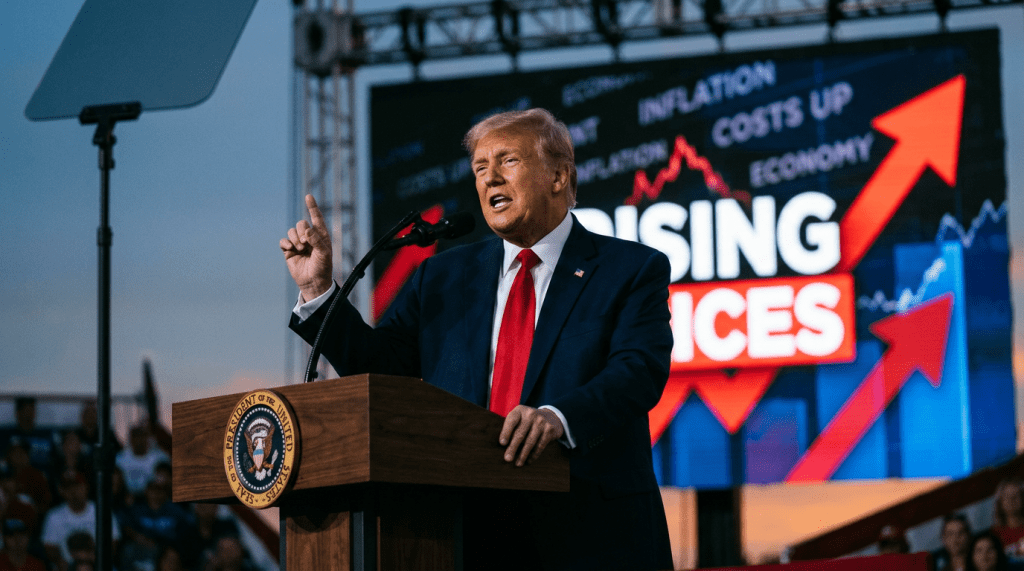
It has been quite an eventful year – to be more precise, the economic policy of President Trump during his second term of office is turning ordinary everyday activities into a burden. Americans jokingly refer to the current situation as “Trumpflation”. However, one might wonder what is causing the increase of prices? Let us examine the causes in detail.
Tariffs and Price Surges
In 2025, President Trump introduced the tariffs of 10% on imports and 60% on imports from China, claiming that it will boost production in the USA. However, economists from the Peterson Institute did not hesitate in criticizing the move as a sales tax for citizens.
By June 2026, the level of inflation in the USA reached 6.5% which is the highest one since before COVID-19.
One of the places where this process becomes obvious is a local supermarket. America is still dependent on foreign fertilizer, chemicals, and farming equipment. As a result, any increase in the costs of importing them makes local products more expensive. A gallon of milk cost increased by almost 80% reaching $5.10. Moreover, even staple goods and food are increasing in price faster than the rate of inflation, and families making $50,000 to $150,000 a year face this problem.
Oil Shock: The Iran War and Gasoline
However, things get worse overseas. By the end of 2025, Trump began to attack Iran causing the start of what became known later as “The Iran War”. This led to the closure of Strait of Hormuz which accounts for 20% of global oil transportation. As a result, gasoline prices exploded.
As a result, in early 2026, the average price of gasoline reached $5.65 a gallon. In Arizona and in the Midwest regions, the price per gallon was $6. With the yearly mileage of 12,000 miles, one will spend additional $1,200 on gasoline. Such expenses become unbearable for families with low budgets.
Forbes reports that small businesses suffered a great deal from the situation described above – particularly those which use trucks and ships. Many business owners decided to increase their prices, but some of them simply had to fire some workers to pay for their increased costs.
The 2025 Tax Law: The Winners and Losers
Also, Trump passed the tax reform legislation known as “the Big Beautiful Bill”. It was said that such legislation would benefit ordinary Americans. However, the examination of the law shows that most of the profits will not reach Americans. Corporate tax breaks which were introduced in 2017 remained unchanged, but sales and excise taxes increased drastically. The Congressional Budget Office and Tax Policy Center calculated that the 1% of the richest Americans received 65% of the total benefits, and most of other people received no or little changes to their wallets.
Such conclusion is supported by data from the Federal Reserve. Any advantage gained from tax breaks disappeared in front of rising prices. Families with middle incomes of $100,000 decreased their disposable income by 3 to 4% between 2024 and 2026.
How Everyone Survives
People are talking about this problem constantly. According to the Gallup poll conducted in June 2026, 68% of Americans believe that the current trend of the national economy is heading downwards. Also, according to the survey conducted by Pew, more than 75% of Americans are worried about the food and gas prices; they blame the trade war for keeping inflation.
What Will Happen in Future?
The Federal Reserve announced that it will continue holding interest rates at present levels to bring prices down. However, with constant tariffs and conflict with Iran, such action seems rather fruitless. Also, based on conversations with the experts, they claim that as long as the protectionism and foreign disputes remain the focus of government policy, stagflation (a combination of slow growth and high prices) is imminent.
Such trends cannot be overlooked. It is tariffs, foreign conflicts, and tax reforms favorable to corporations which increase the cost of goods for Americans. For America’s middle class, the slogan “America First” is becoming synonymous with spending extra money on goods and gasoline.


Leave a comment