Tag: donald-trump

  • Federal Appeals Court Halted Construction on Trump’s Ballroom Project

    Blue Press Journal

    WASHINGTON – A federal appeals court has paused construction on President Donald Trump’s budgeted 400 million-dollar project of the White House ballroom. The court ruled that building the ballroom should be immediately stopped from proceeding with any jobs “above ground”, including features the government claims are necessary security measures.

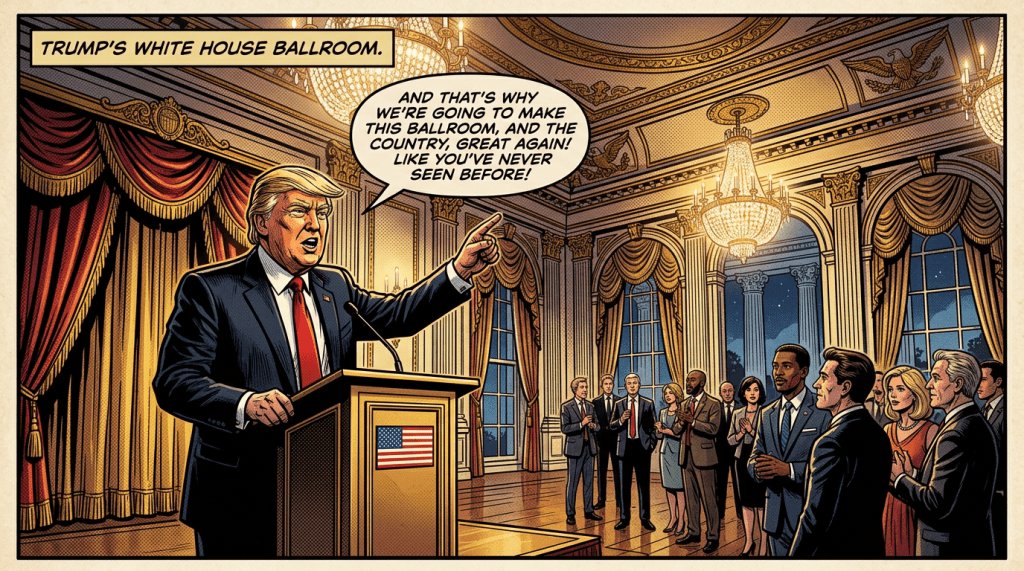
    Donald Trump speaking at a podium in the White House ballroom with an audience listening
    .

    On Friday, a 2-1 panel of the D.C. Circuit Court of Appeals ruled to uphold a preliminary injunction against the President. The National Trust for Historic Preservation, an organization that protects buildings, filed the injunction in December 2025 after the administration began demolition of the East Wing to make way for a 90,000 square foot subterranean ballroom not approved by Congress.

    Patricia Millett’s and Bradley Garcia’s opinions, in which they ruled in favor of preservation, were joined by judges who were appointed by President Barack Obama and Joe Biden. They stated that the Constitution does not permit presidential edicts to dictate the use of federal resources.

    They continued, “whether a large ballroom should be built…is a decision for Congress, not the President” due to the fact that the Constitution grants spending authority over the federal assets to lawmakers, not the executive branch, despite the security reasons cited by the administration.

    However, the decision to halt the work was only made official for two weeks in order to allow the Trump administration to appeal to the U.S. Supreme Court.

    Neomi Rao, who was nominated by President Trump, filed a dissenting opinion in response to the majority’s ruling. She stated that the injunction which stopped the work was an act of judicial activism.

    “By stepping in and taking control over something as monumental as the White House, the district court engaged in judicial activism,” she wrote. “Courts shouldn’t be running building projects”

    The administration’s original plan was to decommission the East Wing while keeping the West Wing as a separate unit. However, the White House Complex’s budget requires funding beyond the president’s official salary so the administration argued that the entire wing be demolished to make way for the expansion of the subterranean chamber.

    Furthermore, the administration claims that the ballroom project is part of larger security upgrades to the complex.

    President Trump expressed dissatisfaction with the decision in his Truth Social page. He stated that the ruling was “politically motivated and completely illegal.” He argued that not completing the ballroom project endangered future presidents, staff, diplomats, and the general public.

    The two-week pause in the construction of the ballroom project means that the future of the project depends on whether or not Trump’s emergency appeal to the Supreme Court is granted.

    Fediverse Reactions
  • The GAO Finds That DOGE Budget Reports Were Misleading

    NEWS REPORT by Winston Wendell

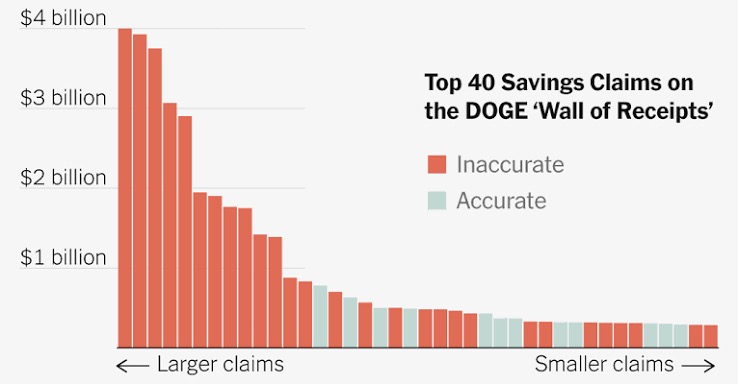
    According to a report released on Thursday, the Department of Government Efficiency, better known as DOGE, led by Elon Musk himself, was making up figures about the amount of money it was saving the country. The report was requested by Democratic senators Gary Peters of Michigan and Richard Blumenthal of Connecticut and was conducted by the Government Accountability Office.

    DOGE was found to have used “misleading practices” when it came to canceled leases and active government contracts. Additionally, the audit found that the department provided insufficient evidence for the methods used in 96 percent of the canceled grants.

    The Department of Government Efficiency was also found to have failed to follow their own formulas when it came to calculating figures for canceled leases and contracts, and in the cases where they did follow their formulas, they either missed out on the details or did not disclose them when they should have. When they did follow their own procedures, the Government Accountability Office found that they overlooked the complexities of government contracts, including liabilities and penalties that come with breaking a contract before the due date.

    “The report shows that the Trump administration’s cost-saving mission was conducted in a misleading fashion, achieving little apart from putting at risk taxpayer data and key programs,” said Senator Peters.

    “President Trump and his allies in the Senate and House have been using DOGE as a fig leaf to hide tax-cut giveaways to the wealthy and large corporations while pretending to save the deficit,” said Senator Blumenthal.

    Many people have responded to the report, including Jessica Tillipman, associate dean of the GWU School of Law, who specializes in government procurement. Tillipman cited several errors she found on the social media accounts of DOGE, one of which being a claim that the department had saved $28 million reduction in expenditures for an Air Force agreement, whereas the actual financial relief amounted to roughly $600,000 from a canceled lease. “That figure doesn’t account for the present value of future lease payments, which would reduce the supposed $3.7 million savings,” Tillipman said.

    “DOGE’s fiscal wins were mostly fictional,” write Reason editor-in-chief Eric Boehm, who covered the story for the libertarian magazine. “According to a new report from the Government Accountability Office, the Trump administration’s claims about savings from slashing federal spending were often based on faulty math.”

    “DOGE may soon start spending more taxpayer money, but at least the government watchdogs are forcing Musk’s agency to be more open about how it spends our money when it comes to cutting back federal services,” concluded Senator Blumenthal.

    Fediverse Reactions
  • The Art of the About-Face: A Critical Look at Lindsey Graham’s Political Evolution

    American politics doesn’t usually give you a transformation as sharp, or as revealing as Lindsey Graham’s. Watching him shift in Washington has become almost surreal. The man bends with the wind, sure, but the cost of that flexibility has been his integrity.

    Just look at his record. Over the years, Graham has mostly acted like his main goal is just to hang on to his seat. He went from bashing Trump at every turn to openly praising him. If you need a case study in plain old political opportunism, this is it.

    Remember the 2016 Republican primaries? Graham didn’t pull any punches. He called Trump a “race-baiting, xenophobic, religious bigot.” He sounded like someone who actually believed what he was saying. Then, almost instantly, once Trump became the nominee, Graham dropped the act and threw in his lot with Trump. That wasn’t some sudden epiphany, it was survival mode, pure calculation.

    The shift was impossible to miss during the Brett Kavanaugh hearings in 2018. After Dr. Christine Blasey Ford’s testimony, the Senate was in chaos. Graham could have played the role of the rational adult in the room, but he didn’t. He went full throttle with a fiery defense of Kavanaugh, turning the hearings into political theater. In doing so, he shored up his spot in Trump’s camp, tossing aside the usual committee rules for a shot at the spotlight.

    Fast forward to 2020, and Graham’s credibility took another hit. After Justice Ruth Bader Ginsburg died, the same man who’d argued in 2016 that Supreme Court picks should wait until after the election did an immediate about-face. He fast-tracked Amy Coney Barrett’s nomination, just weeks before voters went to the polls. It wasn’t just a flip-flop, it was proof that his stated principles didn’t mean much when power was at stake.

    So, when does a politician stop serving the public and start just playing the angles? With Graham, it was obvious: keeping his place at the table matters more than sticking to his beliefs. He changed course whenever it suited him, and yes, it’s helped him stay in power, but at the expense of his credibility.

    Graham’s story serves as a cautionary tale. When individuals abandon their convictions to maintain relevance, they risk losing the very respect that initially earned them admiration. Politicians who remain apolitical will eventually succumb to any political pressure. Moreover, if you support someone whose principles fluctuate with the political climate, what can you truly rely on during challenging times?

    In the wake of his passing, it is customary for Washington to offer a eulogy extolling his virtues. While he was undoubtedly a remarkable individual when collaborating with John McCain, it is imperative that we draw lessons from his tenure in office. Was his primary motivation the nation and the Constitution, or was it driven by political gain and the pursuit of power?

  • The Maine Meltdown: How Political Ego and Corner-Cutting Threaten the Future of the Supreme Court

    by Winston Wendell

    I’ve been watching the Maine Senate race with this weird combination of fascination and dread, and after a while, you just can’t keep quiet about the slow-motion disaster that might hand Susan Collins another term. Everybody knows that seat matters—a single Republican win could lock in their Senate majority, which means control over Supreme Court appointments for years to come. It’s no exaggeration to say this race feels like a vote on the country’s future.

    Thing is, it’s not just the big stakes—the whole race has been utter chaos. Out of nowhere, Morris Katz, this young New Yorker best known for splashy viral videos with John Fetterman, parachutes into Maine. He brings along his firm, The Fight Agency, and decides to build a “man of the people” candidate from scratch for the Democrats. That’s how Graham Platner shows up—a guy who, on the surface, seems to tick every box for working-class appeal. Thanks to Katz’s flashy campaign launch, Platner’s poll numbers shot up almost overnight.

    But they cut corners to make it happen. Instead of running the usual, thorough background checks (the stuff that keeps campaigns from blowing up), Katz just grabbed a quick-and-dirty memo from some boutique outfit and called it a day. That left them exposed. Sure enough, it didn’t take long for a stack of explicit texts and an ugly online past to surface—stuff anyone should’ve spotted. Once the scandals broke (with everything from domestic trouble to abuse claims in the mix), Platner’s team tried circling the wagons and blaming “coastal elites.” All that stonewalling just made things uglier.

    And don’t let the Democratic leadership off the hook. Chuck Schumer brought his signature top-down style—pushing Governor Janet Mills to be the party’s favorite. Then, just as Platner started getting traction, Mills backed out and left the party stuck trying to rally around a candidate who was already a liability. Now, as the general election creeps closer, the Democrats are left with a nominee who’s unraveling in front of everyone.

    It’s honestly a joke—the very consultants and leaders who were supposed to guard the party’s chances are the ones who blew it up. If Collins wins, well, the consequences for the Supreme Court are enormous. With Justices Alito and Thomas likely to retire soon, a Republican majority could stack the Court with even more hard-right judges—locking in their decisions for a generation.

    What gets under my skin is the arrogance that started all this. Katz, the Hollywood kid, treated picking a candidate like casting for a movie—another part for Manhattan insiders to play. Schumer, with all his experience, doubled down on party machinery, and it ended up backfiring. They both forgot the basics: voters actually want real people, some honesty, and accountability.

    Now, Maine Democrats are scrambling to put the pieces back together at the last possible moment. I can’t shake the feeling that the fallout is going to stick with us long after the voting wraps up. If Collins keeps her seat because of these screwups, the consequences will show up at the Supreme Court for years. That’s the warning: when you skip the unglamorous hard work and any sense of humility, even the sharpest political team can implode from its own hype.

  • The Art of the No-Deal: Inside Trump’s G7 Fatigue

    The Twilight of Trump’s Dealmaking

    Man in blue suit leaning on desk, looking at his reflection in an ornate mirror in an office
    .

    by Winston Wendell

    France feels different this week, quiet, maybe a bit somber. A decade of upended traditions is ending not with a bang, but a sigh. Take Donald Trump: he’s at his sixth G7, but the old swagger is gone. Back in 2017, you couldn’t miss him: loud, insistent, pulling everyone’s attention his way. Now? He looks worn down. Age hangs on him, the kind you can’t hide, no matter how much makeup you skip. At 80, the relentless drive isn’t there anymore. He seems smaller, almost faded, and it’s obvious the world isn’t watching him like it used to.

    His “big moment” in France—a supposed landmark deal with Iran—barely turned heads. Sure, there’s talk of a $300 billion economic boost for Tehran, lifting oil sanctions, and calling for a ceasefire. On paper, that sounds ambitious, a shot at lasting peace. But in reality, it just seems like an exhausted attempt to end a mess that’s sapped America’s cash and reputation. Benjamin Netanyahu already brushed it off. This isn’t bold diplomacy; it’s almost a repeat of Trump’s old routine, only without the drama.

    The contrast with Trump’s early G7 days is jarring. 2018, 2019—he showed up chomping at the bit. He demanded Russia’s return to the fold, gave NATO leaders lectures about money, even tried to turn the meetings into commercials for his hotels. That relentless energy, gone now. There’s a distant air about him. Ukraine barely comes up, and when it does, he sounds tired, going through the motions. The other G7 leaders feel the shift. They don’t count on the US for guidance the way they used to. They’re making their own plans for Kyiv, building their own safety nets.

    Everyone sees this drop in US influence. Pete Hegseth’s offhand remarks about the D-Day legacy still sting on this side of the Atlantic, and Europe’s leaders seem more focused than ever on going their own way. Waiting for Washington? Not anymore, they’re tired of the mood swings.

    Even the summit trappings fell flat. The German Chancellor handed Trump a soccer jersey. He barely cracked a smile, just mumbled thanks. At Versailles, standing in the hall of mirrors, gold everywhere, he looked a little more comfortable. Maybe it was all that gleaming reminder of power. For a second, you could almost believe he belonged.

    When it’s time to head home, Trump isn’t the “great negotiator” he set out to be. There’s no big legacy, no Nobel Prize, none of the things he once seemed sure he’d win. What’s left is an uncertain scene, with his spot in world affairs slipping away. Maybe, back in Washington, he’ll dream up another grand project—a hall of mirrors just for him. That’d fit. In these final days, it’s like he can’t look anywhere but at his own reflection. His aging reflection.

    Fediverse Reactions
  • The $600 Million Vanishing Act: Trump’s “Private” Ballroom Becomes a Taxpayer Burden

    Crowd in formal attire inside ornate Trump World Ballroom with chandeliers and red carpet

    by Winston Wendell

    Donald Trump always called himself the king of making deals, a real budget hawk who’d slash government waste wherever he found it. But when you start looking closely at the ballooning costs of his White House ballroom project, a whole different story starts to surface. Instead of thrift, you see broken promises, some pretty clever budget gymnastics, and a jaw-dropping bill of $300 million dumped straight onto the American people.

    At first, the ballroom was supposed to be a $200 million renovation, all paid for by private donors. That promise didn’t last. Now it’s ballooned to a bloated $600 million construction saga. Even worse, the whole idea of “private funding” just fell apart. An investigation from The Washington Post found that taxpayers are now picking up about half the tab, even though Trump kept insisting otherwise.

    Clark Construction, the company handling this massive overhaul, spelled out exactly how things got off track. This project isn’t just a fancy party room anymore, they’ve expanded it to include full demolition of part of the East Wing, plus a high-security underground bunker. Sure, presidents need security. But nobody’s been upfront about where the money’s really coming from, and that’s got critics riled up.

    Look at the numbers. Project summaries from March lay it all out: the Secret Service is kicking in $155 million; the White House Military Office, another $149 million. They’re even pulling $3 million from the Executive Residence budget. Instead of just calling this what it is, spending on a luxury ballroom, they’re labeling everything as “security upgrades.” Outlets like The New York Times keep pointing out this move; it’s classic Trump-era accounting.

    The $400 million gap between what was promised and where things stand now says a lot. This is an administration, Donald Trump, that loved grand promises, but flopped on fiscal responsibility. By burying construction costs inside military and Secret Service budgets, they’ve hidden just how expensive this ballroom actually is.

    So as the total skyrockets, everyday Americans are left utterly bewildered. How on earth did a project billed as “privately funded” morph into a public bill? For a president who claimed to be the champion of cutting government fat, this outrageous $600 million ballroom is shaping up to be the poster child for the very wastage and irresponsibility he vowed to eradicate.

  • The Perfection Standard: Why Democrats Keep Shooting Themselves in the Foot

    by Winston Wendell

    Look, I know some people won’t like hearing this, but I have to say it: The Democratic Party has a huge problem right now, and it’s not Donald Trump. The real issue is us. More specifically, it’s this weird, self-sabotaging urge to demand perfection from our candidates, while we watch Republicans pretty much celebrate, sometimes even reward their candidates’ flaws.

    When a Republican messes up, supporters shrug it off or chalk it up as part of their personality. When a Democrat falters, even a little, we’re first in line to tear them apart. This exhausting cycle really hit me during the latest Senate primary. It’s time we get honest about the double standard that’s hurting our future.

    Let’s talk about Graham Platner.

    Platner’s a veteran who went through multiple combat tours. And if you haven’t been there yourself, let me be clear: war changes you. Sometimes it leaves scars that take years to even see, much less heal.

    What I respect about Platner is that he never ran from his past. He talked, publicly, about some of the darkest stretches of his life, about drinking to cope, about struggling in his relationships after coming home. He didn’t offer excuses. He talked about recovery, and that takes guts.

    So what did we do? We basically did the opposition’s job for them. The New York Times’ dug up his history, amplified exes, obsessed over his tattoos in search of “problematic” ties. We picked apart his lowest moments and asked if he was even qualified to serve, and lost sight of the man he is now. 

    Their star witness, Lyndsey Fifield, who dated Platner for a couple of years. She previously worked for former Republican South Carolina Gov. Nikki Haley’s 2024 presidential campaign and right-wing organizations such as the Heritage Foundation, the US Chamber of Commerce, the Independent Women’s Forum, and Ladies for Kavanaugh—a group she co-founded to support the US Supreme Court nomination of Brett Kavanaughwho faced sexual misconduct allegations. Seriously, where’s the sense of proportion? Really. 

    Meanwhile, look at the Republican establishment. They put a Supreme Court justice on the bench despite credible sexual misconduct accusations. They re-elected a president who literally bragged about sexual assault on tape and seemed to treat the Constitution like a nuisance. Republican voters, for the most part, just circled the wagons, loyalty and power matter most. And here we are, Democrats, tearing into our own whenever someone shows their humanity.

    I’m not saying we should lower our standards. I’m saying we need to apply those standards with some real-world perspective, not just for show. We say we’re the party of redemption and growth, the party that leads with empathy. But when a veteran openly owns his trauma and his healing, we act like he’s not “perfect” enough to support.

    We say we’re afraid of Republican attacks, but by shredding our own candidates over old mistakes, we’re doing the right wing’s dirty work for them.

    I support Graham Platner because I believe people can change. Because he chose to serve again, putting himself out there, flaws and all. But most of all, I support him because the idea that we’d toss aside a guy with real experience and a serious commitment to recovery, for the sake of some imaginary “perfect” candidate, is just not something we can afford.

    We can keep chasing after some flawless unicorn who doesn’t exist, or we can build a party that gets what it means to grow, that values redemption, and that understands the stakes are just too high to keep sabotaging ourselves.

  • A Hole in the Ground where American History Once Stood

    by Winston Wendell

    I stood at the edge of the Ellipse this week, just staring at what used to be the East Wing of the White House. Honestly, I’ve seen a lot in Washington, but nothing quite like this—a massive hole in the ground where American history once stood, and no one really knows what’s supposed to happen next.

    That’s what you get with this administration: ambition isn’t a problem. If Trump wants a ballroom—actually, let me fix that. If Trump wants a magnificent ballroom, one so spectacular Marie Antoinette would cry into her croissants, he’ll tear down a perfectly good historic building to make it happen. You gotta give him credit for going all in, even if you’re left wondering who’s paying the bill.

    About that bill: Congress was supposed to handle it. Republicans put together a shiny $1 billion package just for what they called the “East Wing Modernization Project,” which, in D.C. speak, means, “Please Mr. President, take the cash and build your big dance hall.” But then everything just collapsed, faster than a Jenga tower during an earthquake.

    Why? Well, turns out the ballroom wasn’t the only thing up for debate. There was also this $1.8 billion slush fund hanging around to pay off the January 6 rioters—or, as the White House likes to call them, “people who were just exercise-walking through the Capitol, dressed like medieval peasants.” Suddenly, Republicans started crunching the numbers and figured maybe, just maybe, this was worth voting on.

    So they ditched the bill, stormed out of Washington all annoyed, and now we have this huge hole in the ground where someone’s grandma used to have an office. I talked to a construction worker on site, and he just shrugged. “We have the excavators,” he said. “We’re ready to pour concrete as soon as someone tells us what it’s for. Right now, I’m just digging holes and filling them up again. Great exercise, honestly.”

    The courts haven’t helped either. Some judge decided you can’t just demolish parts of the White House without Congress signing off, which sounds pretty reasonable until you remember it’s the actual White House, where the President technically lives. If I want to knock out a wall in my own place, I don’t need my neighbors’ permission, but apparently the Founders had other ideas about presidential home renovations.

    So here we are. A hole. The dream of gilded chandeliers and a dance floor big enough for 500 Americans to do the hustle. And absolutely zero way to connect the two.

    Trump could appeal. He could drag this through the courts until the judges are begging for a break. He could wait for a new Congress that might play along, if that ever happens. For now, though, the hole just sits there—a monument to ambition crashing straight into a very specific budgetary Waterloo.

    I asked a White House spokesman what he thought, and he just sighed. “Sir, we’ve got a hole to stare at.” Then he wandered over and did exactly that.

    Somewhere out there, Karl Marx is probably nodding. History repeats itself, first as tragedy, then as a $1 billion unfinished ballroom with really good chandelier potential.

  • Trump’s Iran Ceasefire: Strategic Stalemate Masquerading as Diplomatic Victory

    Man tearing a paper labeled Iran nuclear deal with conflict and political imagery in the background

    Blue Press Journal – The Trump administration’s declaration of victory following recent hostilities with Tehran rings hollow against a backdrop of unresolved crises and diplomatic retreat. What officials characterize as a successful military campaign reveals, upon closer inspection, a strategy that has left Iran’s nuclear ambitions intact and its regional influence largely undiminished.

    The fragility of the announced ceasefire became immediately apparent when Iranian parliamentary speaker Mohammad Bagher Qalibaf accused Washington of negotiating in bad faith. As Reuters reported, the agreement’s explicit exclusion of the ongoing Israeli military operations in southern Lebanon—a conflict that has claimed over 1,500 lives and displaced more than one million civilians according to United Nations estimates—undermined Tehran’s willingness to engage in further bilateral talks. White House confirmation that Lebanon remained outside the ceasefire’s scope has validated Iranian accusations of American duplicity.

    Secretary of Defense Pete Hegseth’s claims of degrading Iran’s conventional capabilities ignore the reality of asymmetric warfare that Tehran has mastered. While the administration celebrates tactical gains, Iran’s effective blockade of the Strait of Hormuz sent global oil markets spiraling, demonstrating economic leverage that military strikes cannot neutralize. Bloomberg analysis indicates this pressure directly inflated American energy costs, forcing President Trump to contemplate unprecedented “joint venture” arrangements that would effectively cede partial control of this vital artery to Tehran—far from the decisive dominance initially promised.

    The administration’s nuclear containment strategy appears equally untenable. Despite Hegseth’s assertions regarding Iran’s 970-pound stockpile of highly enriched uranium, The Washington Post notes there remains no credible mechanism compelling Tehran to voluntarily surrender its ultimate survival deterrent. The regime’s survival—cemented by the seamless succession from Ayatollah Ali Khamenei to his son Mojtaba, as documented by The New York Times—belies administration assumptions that military pressure would catalyze domestic collapse.

    Ultimately, Iran has achieved its primary strategic objective: endurance. The Islamic Republic has weathered American bombardment while retaining the capacity to destabilize regional energy flows. Rather than securing a decisive victory, the Trump administration has engineered a precarious stalemate that leaves the United States negotiating from a position of diminished leverage.

  • Trump’s Rambling Iran Address Offers No Timeline While Sparking Constitutional Crisis and NATO Withdrawal Threats

    Donald Trump speaking at a podium with the Seal of the President of the United States.

    Blue Press Journal (DC) – President Donald Trump’s recent prime-time address regarding the ongoing military conflict with Iran delivered neither a strategic roadmap nor a withdrawal timeline, instead raising serious constitutional questions about unauthorized military action and threats against NATO allies that legal scholars say lack legal merit.

    Speaking for a mere 18 minutes, the President failed to outline how tens of thousands of deployed personnel would return home or how the United States would secure the Strait of Hormuz, through which one-fifth of global petroleum flows. According to constitutional experts cited by The Washington Post, the President’s unilateral initiation of hostilities without congressional authorization as required under Article I, Section 8 of the Constitution represents a significant overreach of executive power, violating the War Powers Resolution that mandates legislative approval for sustained military engagements.

    The address also featured renewed attacks on NATO, despite the alliance’s defensive nature under Article 5 of the Washington Treaty. As Foreign Policy analysts note, NATO membership involves Senate-ratified treaty obligations that a president cannot simply terminate without legislative consent—a constitutional reality Trump’s rhetoric appears to ignore. The alliance, designed for collective defense rather than offensive wars of choice, holds no obligation to join member-initiated conflicts of aggression.

    Trump’s threats to destroy Iran’s electrical generation facilities—civilian infrastructure protected under international humanitarian law—have drawn condemnation from human rights monitors and Human Rights Watch, which classify such actions as potential war crimes. These warnings accompany reports of approximately 1,500 civilian casualties, including 175 children killed in a February 28 strike on a school.

    The President’s historical comparisons—equating one month of conflict to World War I, Vietnam, and Iraq—offered little comfort to families of 13 fallen service members or hundreds wounded. His contradictory statements regarding Iran’s nuclear program, simultaneously claiming the material is inaccessible yet monitored by satellite, suggest strategic incoherence rather than diplomacy.

    Meanwhile, Trump attributed rising domestic fuel costs to Iranian “terror attacks” rather than wartime market volatility, a deflection that Reuters economic analysts dispute given the conflict’s disruption of regional oil flows.

    As constitutional scholars underscore, the commitment to perpetual conflict demands the explicit consent of the democratic populace rather than unilateral decisions by the executive branch.

    WATCH: The White House took down this video, but we still have it. Trump: We can't take care of daycare. We're a big country. We're fighting wars. It's not possible for us to take care of daycare, Medicaid, Medicare, all these things.

    The Lincoln Project (@lincolnproject.us) 2026-04-02T15:45:28.821986468Z