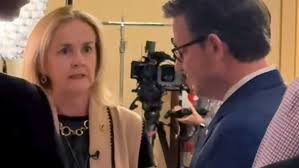
Blue Press Journal – A tense and public confrontation erupted on Capitol Hill Wednesday as Rep. Madeleine Dean (D-Pa.) directly challenged House Speaker Mike Johnson (R-La.) over President Trump’s recent inflammatory remarks to military leaders, demanding the GOP leader address the president’s stability.
Johnson, dismissing the charge, quickly fired back, “A lot of folks on your side are, too.”
The confrontation stemmed from comments the president made during an address to generals in Quantico, Va., where he suggested that Democratic-led cities be used as “training grounds” for the military. Dean pressed Johnson on the severity of such rhetoric. “That is so dangerous,” she insisted.
Citing her experience on the House Foreign Affairs and Appropriations committees, Dean warned that the president’s erratic behavior was having tangible effects on U.S. foreign policy and national security. “This is a collision of those two things,” she explained. “Our allies are looking elsewhere. Our enemies are laughing.”
Dean’s alarm was shared by other high-ranking officials. Senator Jack Reed (D-R.I.), a senior member of the Armed Services Committee, decried the Quantico event as an “expensive, dangerous dereliction of leadership by the Trump administration.”
In a statement, Reed criticized the politicization of the military gathering. “While American forces confront real threats across the globe, Mr. Hegseth and President Trump chose to pull generals and admirals away from their missions to listen to hours of political grievances,” he said.
The president’s speech was described by attendees as troubling, depicting a commander-in-chief who sounded “incoherent, exhausted, rabidly partisan, stupid, and meandering.” In this context, Trump’s proposal to use American cities for military drills raised serious concerns among Democrats about his judgment and fitness for office.
Blue Press Journal – In a high-stakes game of political brinksmanship, the Democratic Party is refusing to back down from its insistence that withholding their votes from a continuing resolution in the Senate can pressure Republicans into extending Obamacare subsidies. With health care costs for millions of Americans set to spike if the subsidies are not restored, Democrats believe they have a strong hand to play in the ongoing budget negotiations.
The Democratic ask is straightforward: extend the Obamacare subsidies that were taken out of the budget by the BBB Bill, or face the consequences of a government shutdown. As Jesse Ferguson, a veteran Democratic strategist, put it, “Republicans have backed themselves into a corner where they demand to end tax credits for health insurance costs or else they’re shutting down the government. People won’t buy it. Their ransom note reads: ‘Higher bills or closed doors — pick one.’”
The stakes are high, with the Kaiser Family Foundation estimating that out-of-pocket costs for Obamacare enrollees could increase by as much as 114% if the subsidies are not extended. This would have a devastating impact on millions of Americans who rely on the Affordable Care Act for their health care needs, many in red states. Democrats are counting on the pressure growing on Republicans as notices about premium hikes hit constituents’ inboxes, making it increasingly difficult for the GOP to maintain its hardline stance.
However, despite the Democratic Party’s confidence in its strategy, there are concerns that the law may not effectively prevent the Trump administration from enacting subsidy cuts. The administration has a history of ignoring legal norms, and the conservative U.S. Supreme Court often supports its actions. As one Democratic aide noted, “We don’t believe the law is meaningfully holding back Vought or Trump from enacting cuts. So, what has been stopping Vought before? Politics.”
This is crucial, as it suggests that the Democratic strategy involves not just the law but the politics at play. By withholding their votes on the resolution, Democrats aim to create urgency that will push Republicans to rethink their stance. They also seek to highlight the human impact of the GOP’s position, portraying it as callous and disconnected from everyday Americans’ needs.
The early polling on a shutdown supports the Democratic reading of the situation. The NPR/PBS/Marist Poll found that 38% of Americans would blame Republicans for a shutdown, while 27% would blame Democrats, and 31% would blame both parties equally. A late September survey from Blueprint, a Democratic group, found an even bigger advantage for Democrats, with 50% of registered voters blaming Republicans and 34% blaming Democrats.
These numbers suggest that the Democratic strategy is about winning public opinion, not just legislative victories. By framing the issue as a choice between higher health care costs and a government shutdown, Democrats aim to create moral urgency that resonates with voters. As Ferguson noted, “People won’t buy the Republican argument that they’re shutting down the government over a matter of principle. They’ll see it for what it is: a cynical attempt to hurt millions of Americans struggling to make ends meet.”
The Democratic insistence on withholding their votes from the continuing resolution may be seen as a brave and necessary step to protect the well-being of millions of Americans from high insurance costs. By standing firm and refusing to back down, Democrats are sending a clear message that they will not be intimidated or swayed by Republican tactics. They are also highlighting the human impact of the Republican stance, and making the case that the GOP is out of touch with the needs of ordinary Americans.
As the deadline for a government shutdown approaches, the Democratic Party is fully committed to protecting the health care needs of millions of Americans. Whether this strategy will succeed is uncertain, but the budget battle and the future of Obamacare will be a defining moment in American politics with significant consequences for the country.
Blue Press Journal – On Tuesday, President Donald Trump addressed a gathering of hundreds of senior U.S. military officials in Virginia, speaking for over an hour on a range of topics. However, what was intended to be a straightforward address to the nation’s top brass has raised more questions than answers. Critics have described the President’s delivery as “quieter and more confused” than usual, leaving many to wonder if something is amiss with the Commander-in-Chief.
During his speech, Trump touched on familiar themes, including his decision to rename the “Gulf of Mexico” to the “Gulf of America,” his strike on Iran, and criticisms of former Presidents Barack Obama and Joe Biden. While these topics are not unusual for Trump to discuss at length, the context of the remarks being given to top military officials is what makes this address so concerning.
The President’s meandering speech, coupled with his uncharacteristically subdued tone, has sparked fears that America’s military preparedness may be jeopardized. The nation’s top military officials, who are responsible for making life-or-death decisions, may be left questioning the President’s ability to provide clear and coherent leadership.
This is not a trivial matter. As historian and national security expert John Nichols noted, the issue of a President’s sanity and ability to make rational decisions is a critical one. In 1973, an Air Force nuclear-missile officer named Harold Hering posed a simple yet profound question during a training session: “How can I know that an order I receive to launch my missiles came from a sane president?” Trump’s rambling, out-of-focus speech may have inadvertently answered that question for the nation’s military leaders, and the implications are chilling.
As the world faces complex security challenges, the United States needs a Commander-in-Chief who can provide confident leadership. The military officials protecting American interests deserve this. It is crucial that the President’s behavior and decision-making are scrutinized to ensure military preparedness and security are upheld.
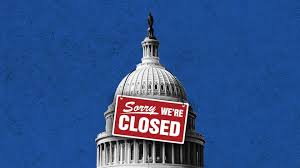
Blue Press Journal – In a reckless display of Republican partisan politics, the federal government has shut down, leaving hundreds of thousands of federal workers without pay and millions of Americans facing uncertainty over their health insurance. The shutdown, which began in the early hours of Wednesday, is a direct result of a bitter standoff between Republicans and Democrats over measures to protect health insurance for millions of Americans.
At the heart of the dispute is the refusal by Republicans to extend enhanced subsidies for health insurance through the Affordable Care Act. These tax credits, passed during the COVID-19 pandemic, are set to expire at year-end, leading to skyrocketing premiums for millions of Americans. Democrats believe they have the upper hand, as the consequences of inaction will affect many.
They tax credits for insurance were cut out of the budget by Republicans to afford huge tax cuts for billionaires and millionaires.
The shutdown highlights the dysfunction in Washington. While Democrats fight for basics like healthcare access, Republicans seem focused on political gains. Senate Minority Leader Chuck Schumer (D-N.Y.) stated, “The American people are learning how bad this health care crisis is, and they will put tremendous heat on Republicans to solve it.” Rep. Greg Casar (D-Texas) remarked, “Democrats are ready to fight for your family’s needs, unlike House Republicans who are on vacation.”
The shutdown will have far-reaching consequences, with federal agencies and operations grinding to a halt. Hundreds of thousands of federal workers will be forced to stay home without pay, while others, including active-duty troops, will have to work without compensation. The economic impact will be significant, and the human cost will be even higher.
Democrats are fighting for a basic principle: that every American deserves access to quality healthcare. It’s time for Republicans to put aside their partisan games and work towards a solution. The American people deserve better.
Blue Press Journal – As we navigate the tumultuous landscape of Trump’s second term, which began in 2025, it’s becoming increasingly clear that the administration is spiraling out of control. On a daily basis, scandals are unfolding that threaten the very fabric of American health and democracy. The latest developments are not only alarming but also have serious implications for the nation’s well-being.
One of the most disturbing trends is the Trump administration’s assault on vital medical research. The cancellation of crucial cancer and vaccine research is a stark example of the administration’s reckless disregard for the health and welfare of Americans. These programs, which have the potential to save countless lives and improve the quality of life for many, have been abruptly terminated without justification. The consequences of such actions are dire and will be felt for years to come.
Furthermore, the promotion of bogus claims and misinformation is a hallmark of this administration. The recent assertion that Tylenol causes autism is a baseless claim with no scientific backing. Not only does this misinformation have the potential to mislead vulnerable parents and caregivers, but it also undermines trust in the medical community and the FDA, which is responsible for ensuring the safety and efficacy of medications.
In addition to the health concerns, the Trump administration is also embroiled in a deepening scandal surrounding cronyism and corruption. The preferential treatment of certain individuals and companies is a clear abuse of power and a betrayal of the public’s trust. This blatant disregard for ethics and the law is a threat to the integrity of our democratic institutions.
Perhaps most egregious, however, is the administration’s weaponization of the Department of Justice (DOJ). The indictment of a former FBI director as a form of political retaliation is a stark example of the administration’s willingness to exploit the justice system for personal gain. This abuse of power not only undermines the independence of the DOJ but also erodes the public’s faith in the rule of law.
As Trump’s second term spirals out of control, Americans must remain vigilant and demand accountability from elected officials. The threats to our health and democracy are real, and we must ensure the administration upholds the highest standards of integrity. Inaction will have severe consequences, and it is our responsibility to safeguard our nation’s future.
Blue Press Journal – As the threat of a government shutdown draws near, Democrats are accusing House Speaker Mike Johnson (R-La.) of intentionally keeping the House of Representatives out of session to avoid a vote on the release of the Jeffrey Epstein files. The House had been scheduled to vote on Monday and Tuesday, but Johnson canceled the votes, citing the need to pressure Senate Democrats to accept a government funding bill passed by the House earlier this month.
However, Democrats argue that the real motive behind the delay is to prevent a vote on the Epstein files, which could potentially embarrass high-ranking government officials and politicians. The files, related to the Justice Department’s investigation into the late sex trafficker, have been the subject of intense scrutiny and speculation.
The delay in voting is also holding up the swearing-in of Rep.-elect Adelita Grijalva, a Democrat who won a special election last week to fill her late father’s Arizona seat. Grijalva’s presence in the House would provide the crucial 218th signature on a “discharge petition” that would force a vote on legislation to release the Epstein files.
Rep. Katherine Clark (Mass.), the No. 2 Democrat in the House, wrote a scathing letter to Johnson on Monday, accusing him of depriving Grijalva’s constituents of representation and questioning the motive behind the delay. “Any delay in swearing in Representative-elect Grijalva unnecessarily deprives her constituents of representation and calls into question if the motive behind the delay is to further avoid the release of the Epstein files,” Clark wrote.
In today’s political landscape, few groups are more closely watched than young voters. Their engagement, preferences, and concerns can shift the direction of elections—and in 2025, their skepticism toward Donald Trump’s economic agenda is telling. While Trump has managed to attract some younger voters with his anti-establishment appeal, new research suggests his support rests on shaky ground.
According to a spring poll from the Harvard Kennedy School’s Institute of Politics, which surveyed more than 2,000 adults aged 18 to 29, opposition among young Americans is high on core economic issues. The numbers are clear: tariffs, cost-of-living concerns, and a lack of faith in Trump’s policies are eroding his credibility with a generation already financially strained.
The Numbers Speak Loudly
Here’s a breakdown of the poll’s most eye-opening findings:
Issue
Support
Oppose
Tariffs on imports
19%
50%
Trump’s economic policies overall
18% (say it will help)
51% (say it will hurt)
These figures highlight what may become a central challenge for Trump: his economic strategy simply doesn’t align with the lived experiences of young people.
Why Young Americans Are Disenchanted
1. Rising Costs and Stagnant Wages
Young adults are deeply sensitive to cost-of-living increases. From soaring housing prices to persistent student debt and wages that have barely kept pace with inflation, this generation feels squeezed from all sides. When Trump’s policies appear to worsen these pressures—such as implementing tariffs that raise consumer prices—opposition is only natural.
2. Weak Partisan Loyalty
Unlike older generations, young voters are far less tethered to a political party. Many identify as independents or express equal frustration with both Democrats and Republicans. This makes them a swing constituency, influenced less by partisan loyalty and more by material outcomes in their daily lives.
3. A Desire for Change, Not Continuity
The attraction to Trump among some young people was never about endorsement of his policies—it was about disrupting a political system they view as broken. That disillusionment worked in Trump’s favor for a time, but it is now colliding with the reality of lived experiences.
Voices from a Generation
Quinton, a 33-year-old account manager from Georgia, expressed a frustration that resonates with many in his peer group:
“The job market is just not good at all. I have a lot of friends and family members who are struggling to find work. He made it seem like he was going to look out for the working-class people, and it’s the exact opposite.”
Quinton’s words reflect the sentiments of countless young workers who expected protection and prosperity but feel left behind.
A Fragile Coalition
Trump’s foothold with younger voters is less about ideological consensus and more about rebellion against the status quo. But rebellion without results cannot sustain a political coalition. The fact that 51% of financially struggling young adults believe Trump’s policies will actively hurt their wallets shows that his foundation with this demographic is starting to crumble.
This fragility also leaves an opening for other candidates. If Democrats can address cost-of-living concerns with concrete proposals on student debt relief, affordable housing, and wage growth, they have a real chance to win back voters disenchanted with Trump. Conversely, if they fail to connect with young people in a genuine way, the vacuum may once again be filled by anti-establishment rhetoric—this time from someone new.
The Stakes Ahead
Why does all of this matter? Because Millennials and Gen Z now comprise the largest voting bloc in America. Their economic fortunes and frustrations are poised to define not just the 2024 election, but the future of U.S. politics.
The lesson is clear: broad slogans won’t cut it. Young Americans expect direct answers to their toughest financial burdens. Tariffs that raise prices, tax policies that don’t favor workers, and vague promises about economic renewal won’t win over a generation that is already skeptical of political spin.
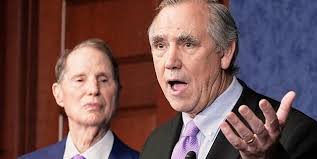
Blue Press Journal – In a move that has been met with widespread criticism, President Donald Trump announced on Saturday that he plans to send troops to Portland, Oregon, the state’s most populous city. The decision has been condemned by Democratic Oregon Sens. Jeff Merkley and Ron Wyden, who accuse the President of attempting to provoke conflict and incite violence in the city.
“Trump is launching an authoritarian takeover of Portland hoping to provoke conflict in my hometown,” Wyden wrote on social media. “I urge Oregonians to reject Trump’s attempt to incite violence in what we know is a vibrant and peaceful city.” Merkley echoed Wyden’s sentiments, stating that Trump is sending troops to Portland with the goal of “doing a number” on the city. “He wants to stoke fear and chaos and trigger violent interactions and riots to justify expanded authoritarian control,” Merkley said. “Let’s not take the bait!”
Protests have erupted at the city’s ICE facility against the Trump administration’s immigration crackdown. Many view the President’s troop deployment to Portland as an attempt to control the situation, while Merkley and Wyden argue it will escalate tensions and lead to more violence.
The Senators’ criticism of Trump’s plan is rooted in a deep-seated concern about the erosion of civil liberties and the potential for authoritarianism. By sending troops to Portland, Trump is undermining the city’s autonomy and threatening the rights of its citizens. As Merkley and Wyden point out, this move is not about maintaining law and order, but about asserting the President’s power and control over a city that has been a hub of resistance to his administration’s policies.
The decision to send troops to Portland is a dangerous move that could lead to violence. Merkley and Wyden’s criticism shows their commitment to protecting Oregonians’ rights and resisting the Trump administration’s authoritarian tendencies. It is essential for Portland’s residents and officials to remain united in their opposition to the President’s plan.
In a move that has stunned Washington and the broader defense community, U.S. Secretary of Defense Pete Hegseth has ordered roughly 800 of the nation’s top military officers—generals, admirals, and their senior enlisted partners—from around the world to return to the United States next week for an unplanned meeting. The orders, first reported by The Washington Post, require every senior officer at the one-star general or rear admiral level and above to gather at Marine Corps University in Quantico, Virginia, on Tuesday.
What makes the summons so alarming is its secrecy. No agenda has been provided, no explanation offered. Officers and analysts alike are left questioning why nearly the entire top tier of U.S. military leadership is being pulled into one room. In an era when global crises can flare at any moment, taking commanders away from their posts without a clear reason feels not just unusual, but potentially reckless.
Whispered Concerns of a Loyalty Oath
Speculation erupted almost immediately. Some worry the Secretary’s intent may have little to do with operational readiness or external adversaries. Instead, they fear this is about reshaping the loyalty of the military itself.
“July 1935 German generals were called to a surprise assembly in Berlin and informed that their previous oath to the Weimar constitution was void and that they would be required to swear a personal oath to the Führer,” wrote retired U.S. Army Lieutenant General Ben Hodges on social media. “Most generals took the new oath to keep their positions.”
The chilling historical parallel was not lost on readers. While no evidence has yet surfaced that an oath of loyalty to the President—or to Hegseth personally—will be demanded, simply invoking that possibility has raised the stakes considerably.
Critics See Recklessness and Ego
Several senior veterans were quick to voice their outrage at what appears to be, at best, a costly and distracting exercise. Fred Wellman, a West Point graduate, Harvard Kennedy School alumnus, and 22-year combat veteran, did not mince words:
“You are pathetic,” Wellman declared in response to Hegseth’s public barbs directed at retired generals. “Supposed to be leading the largest department of our government with millions of troops and civilians and you are trolling retired generals who served honorably longer and more heroically than you could. You’re not even a good squad leader.”
Marc Polymeropoulos, a retired senior officer from the CIA’s clandestine service, echoed concerns about both the practicality and optics of such a meeting. “So it’s a juvenile Rah Rah high school football speech, that cost[s] a ton of money, takes leaders out of positions in where they [are] managing crises, and puts a massive target on Quantico,” he warned. “Plus they all gonna get stuck when govt shuts down. Genius all around.”
Warrior Ethos or Political Theater?
According to The Washington Post, the meeting is expected to feature Hegseth speaking at length about his personal beliefs and vision for what the U.S. military should be—a framework he calls his “warrior ethos.” While a defense secretary is entitled to articulate philosophy and direction, doing so with the nation’s entire top brass in a single, closed-door session comes across as both unorthodox and troublingly opaque.
At a time when U.S. forces face simultaneous challenges on multiple fronts—Ukraine, Israel-Gaza, Taiwan, cyber threats—removing senior leaders from their commands for what critics are characterizing as a motivational sermon seems difficult to justify.
A Dangerous Precedent?
The principle that the U.S. military serves the Constitution, not any individual, has been one of the Republic’s most foundational guardrails. Even the appearance of undermining that norm can carry dangerous consequences, not only for civil-military relations but for international confidence in American stability.
Is this extraordinary recall a prelude to something significant, or just an ill-conceived attempt at motivational theater? Until Tuesday, the defense world—and the nation—are left with only speculation and the unsettling feeling that transparency has once again fallen victim to politics.
Blue Press Journal (DC) – In a move that has raised eyebrows and sparked concerns about the politicization of the justice system, the Justice Department indicted former FBI Director James Comey on Thursday. The indictment comes after President Donald Trump publicly demanded that Attorney General Pam Bondi bring charges against Comey, a longtime nemesis of the president.
Trump’s expectations for an indictment were made clear in a September 20 post on his Truth Social platform, in which he argued that Comey, along with other political enemies such as Senator Adam Schiff and Attorney General Letitia James of New York, are “all guilty as hell” and that the DOJ has a “GREAT CASE” against them. The president ended his post with an urgent demand: “JUSTICE MUST BE SERVED, NOW!!!”
The indictment of Comey is a significant development, but it is also a troubling one. Trump has long slammed Comey for leading a “witch hunt” against him, despite the fact that the Russia investigation, which was taken over by special counsel Robert Mueller after Trump fired Comey, determined that Russia did attempt to influence the 2016 election.
A report from the Department of Justice’s Inspector General determined that James Comey contravened agency policies by disclosing information from the memos. While these memos included classified information, the Inspector General did not uncover any evidence indicating that Comey had leaked any classified details from the documents.
Moreover, the circumstances surrounding the indictment are suspect. Trump recently forced acting U.S. Attorney for the Eastern District of Virginia Erik Siebert out of his job because he hadn’t secured indictments against Comey and another target of the president’s ire, James. Days before Siebert handed in his resignation, sources told The New York Times that he had told his superiors at the Justice Department that the cases against Comey and James were weak and unlikely to result in charges.
The indictment of Comey raises concerns about the Justice Department’s independence and the integrity of the justice system. Trump’s demands for action seem to have influenced the decision to indict, undermining impartial justice. The American people deserve assurance that the justice system is not a tool for political revenge or personal vendettas.





 Blue Press Journal