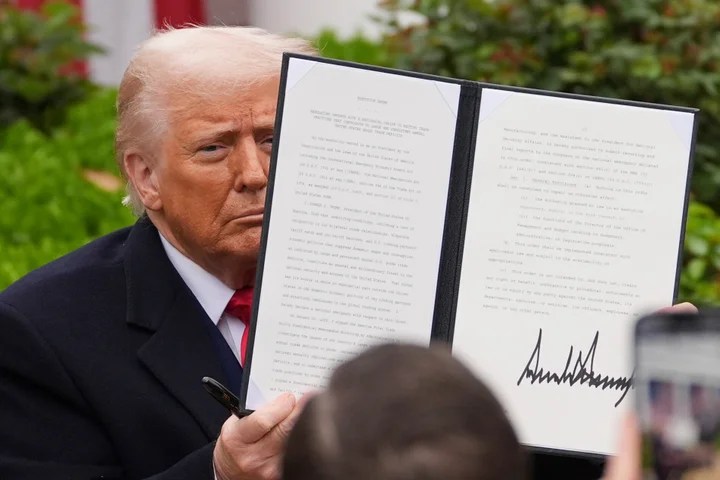
Few Republicans are willing to defend the president’s tariffs, leaving the party vulnerable for the first time in Trump’s new term. The implementation of these tariffs marks a significant shift from the global trend of decreasing trade barriers, with economists warning that Americans could face thousands of dollars in increased prices each year, while the U.S. economy is expected to slow sharply.
According to the Yale Budget Lab, the Trump administration’s tariffs could result in the average household facing an additional $3,800 in expenses this year. This includes a 10% universal tariff, higher tariffs on approximately 60 countries, as well as existing import taxes on steel, aluminum, and cars. Inflation is projected to soar to over 4%, up from the current 2.8%, with the economy facing minimal growth, as estimated by Nationwide Financial.
The repercussions of these tariffs were felt on Thursday, as the S&P 500 index plummeted by 4.8%, marking its worst day since the pandemic began. The Dow Jones Industrial Average also took a hit, dropping over 1,600 points, causing the average 401 retirement account to lose over $8,000 in just one day.
Economists predict that the average U.S. tariff could reach nearly 25% once fully implemented on April 9, surpassing levels seen in over a century and even exceeding the infamous 1930 Smoot-Hawley tariffs, which exacerbated the Great Depression.
The impact of these tariffs will be particularly harsh on Asian countries, with duties on Vietnamese imports rising to 46% and on Indonesia to 32%. Some Chinese imports could face tariffs as high as 79%, affecting major U.S. import sources for shoes like Nike, which produced half of its shoes and one-third of its clothing in Vietnam last year.
Best Buy’s stock plummeted by a staggering 17.8%, a devastating blow attributed to the global production of its electronics. United Airlines also suffered a significant loss of 15.6%, as fears of a weakening global economy deterred customers from traveling for business or leisure. Target, too, experienced a sharp decline of 10.9%, with concerns mounting over the financial strain on its customers amidst persistent inflation. The once thriving giants of the retail and travel industries now find themselves teetering on the edge of uncertainty, as the world grapples with economic turmoil.




 Blue Press Journal