Tag: tariffs

  • Trump’s Trade Agenda Under Fire: U.S. Beef Prices Spark Feud with Loyal Supporters

    In a shocking departure from his “America First” trade agenda, President Trump has ignited a fierce battle with some of his most ardent supporters over U.S. beef prices. The controversy centers on Trump’s decision to quadruple the quota for tariff-free Argentinian beef, a move that has infuriated American cattle ranchers and certain GOP lawmakers.

    Rep. Marjorie Taylor Greene (R-Ga.), a staunch Trump ally, slammed the decision on “The Tucker Carlson” show, stating, “I have no idea who is telling our great president… that this is a good idea. Because, honestly, it’s a punch in the gut to all of our American cattle ranchers, and they are furious and rightfully so.”

    Trump’s rationale for importing Argentinian beef is to reduce prices in the U.S. while providing a financial lifeline to the struggling South American nation. The president has approved billions of dollars in aid for Argentina, aiming to bolster his ally, President Javier Milei, as he faces elections amidst an economic crisis.

    However, this decision has sparked bipartisan criticism, particularly in light of the ongoing government shutdown, which has left thousands of military and federal workforce members without pay. The move has also drawn ire from American farmers and ranchers, who are already struggling with the consequences of Trump’s tariffs and immigration agenda.

    Meriwether Farms, a Wyoming-based ranch, expressed its discontent on social media platform X, stating, “We love you and support you — but your suggestion to buy beef from Argentina to stabilize beef prices would be an absolute betrayal to the American cattle rancher.”

    The American agriculture sector is facing rising material costs, including tariffs on fertilizers, and labor shortages due to Trump’s immigration policies. Trade partners have retaliated with their own taxes on American goods, worsening the challenges for U.S. farmers and ranchers.

    As Trump’s decision sparks outrage, it remains to be seen how he will reconcile his “America First” agenda with the interests of loyal supporters and the agriculture sector. The feud over U.S. beef prices has exposed a deepening rift within the Trump administration’s trade policies.
  • Ontario Premier Doug Ford Yields to Trump’s Pressure, Pulls Anti-Tariff Ad

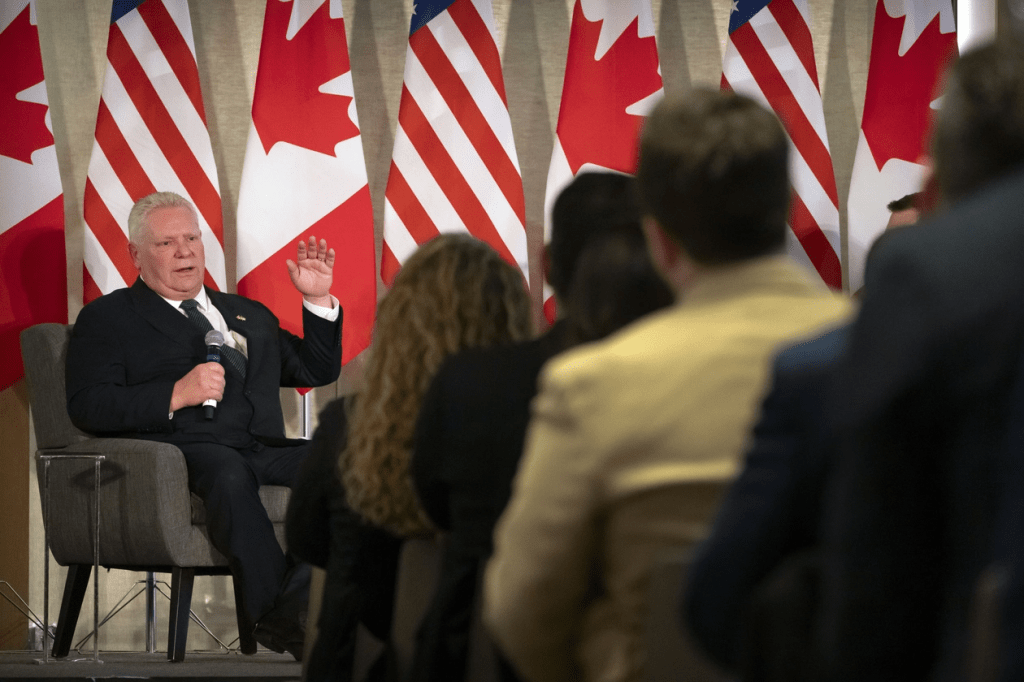
    Blue Press Journal – In a surprising move, Ontario Premier Doug Ford has announced that he will pause an anti-tariff advertising campaign featuring former US President Ronald Reagan, following a heated reaction from President Donald Trump. The campaign, which Trump dismissed as “fake,” showcased excerpts from a speech by Reagan, in which he denounced tariffs and advocated for free trade.

    The 60-second ad, which debuted on major US networks last week, was funded by Ford’s provincial government. However, after Trump halted trade negotiations with Canada, Ford has decided to pull the ad, citing a desire to resume trade talks. The ad will air a few more times during the World Series, which starts on Friday, before being taken down on Monday.

    Ford stated that the goal of the campaign was to “initiate a conversation about the kind of economy that Americans want to build and the impact of tariffs on workers and businesses.” He claimed that this goal had been achieved, as the ad had reached high levels of the US government. The decision to pull the ad was made after a discussion with the Prime Minister, with the aim of restarting trade negotiations.

    It’s evident that Donald Trump isn’t driven by facts or what’s best for America when it comes to trade decisions; instead, he operates on the whims of his own inflated ego. In short, he comes across as nothing more than a petulant man-child.

  • Trump’s Economic Policies Are Undermining America’s Financial Stability

    Blue Press Journal – Since the second half of 2025, the U.S. economy has been teetering under the weight of President Donald Trump’s aggressive trade and fiscal policies—policies that were once hailed as pillars of a booming economy but now stand as key drivers of inflation, stagnating job growth, and mounting public discontent.

    Despite repeated denials from the White House, data paints a troubling picture. Prices have risen steadily over the past several months, fueled in large part by the sweeping tariffs reimposed by the Trump administration. These tariffs, intended to protect domestic industries, have backfired—increasing the cost of imported goods and materials, which businesses are passing on to consumers. The result? A surge in inflation that is hitting American households where it hurts most.

    “Tariffs are taxes—paid by consumers,” said Dr. Elsie Peng, research economist at Goldman Sachs. “The recent wave of import restrictions has created ripple effects across supply chains, contributing directly to climbing food and energy prices—two categories that disproportionately affect lower- and middle-income families.”

    The upcoming consumer price index (CPI) report for September is expected to reflect this reality, with economists anticipating a notable uptick in inflation. Food prices alone have increased by 5.6% year-over-year, while energy costs have jumped nearly 12%, according to preliminary data from the Bureau of Labor Statistics. For many Americans, these are non-negotiable expenses, leaving families with fewer options to adjust spending and maintain financial stability.

    At the same time, the labor market is cooling at an alarming rate. Job growth, which averaged 150,000 new positions per month at the beginning of 2025, has plummeted to just 25,000 by August. Businesses, facing higher input costs and uncertain trade conditions, are scaling back hiring and freezing expansions.

    “This slowdown isn’t random—it’s policy-driven,” Peng noted. “When uncertainty rises and costs climb, companies don’t invest, and they don’t hire. The private sector is responding rationally to an increasingly unstable economic environment.”

    The consequences are tangible. Millions of Americans are now grappling with tighter budgets, stagnant wages, and shrinking opportunities. The unemployment rate, though not yet in crisis territory, has begun to climb, especially in manufacturing and export-dependent sectors.

    Public sentiment has followed the same downward trajectory. A recent Quinnipiac University poll reveals that only 38% of voters approve of President Trump’s handling of the economy—the lowest approval rating since February 2017. That marks a nearly 20-point gap between approval and disapproval, a rare low for a president who staked his legacy on delivering an “unprecedented economic boom.”

    “President Trump promised a vibrant and muscular economy,” said political analyst Maria Thompson. “But what voters are seeing now is a contraction of opportunity, not expansion. His policies are no longer delivering on their promises.”

    While tax cuts and deregulation may have boosted corporate profits in the short term, the long-term toll of protectionist trade measures and erratic fiscal policy is becoming clear. Inflation is eroding purchasing power, job creation is stalling, and confidence in economic leadership is waning.

    The American economy was once seen as resilient and adaptive. But when core economic policies prioritize political rhetoric over measurable results, the foundation cracks. Right now, that foundation is under serious strain.

    As the nation faces economic turbulence, one fact is clear: sustainable growth cannot rely on tariffs, denial, and dwindling public trust. Ignoring this truth is already affecting grocery stores, job fairs, and households nationwide.

  • New Car Prices Hit Record High: A Dire Consequence of Trump’s Economic Policies

    Blue Press Journal – The American dream of owning a new car has become increasingly elusive, particularly for modest-income buyers. According to Kelley Blue Book, the average transaction price of a new car has surpassed $50,000 for the first time in history, marking a 4% increase from the same period last year. This staggering rise is largely attributed to the Trump administration’s tariffs and economic policies, which have priced out lower-income families from the market.

    CNN analyst Matt Egan succinctly captured the gravity of the situation, stating, “Prepare yourself because it’s literally never been more expensive to buy a new car.” The demise of affordable cars, particularly those priced around $20,000, has been accelerated by the Republican economy. Egan noted, “The $20,000 cars have basically gone extinct.” Car manufacturers have shifted their focus towards producing higher-margin, more expensive vehicles, catering to affluent buyers who are still able to purchase new cars.

    The primary factor driving this trend is the demographics of car buyers. Wealthier individuals are increasing the demand for luxury vehicles, while lower-income families are compelled to opt for used cars or forgo their plans to purchase a vehicle. This disparity stems from the Trump administration’s economic policies, which have disproportionately impacted modest-income households. As Egan noted, “Lower-income families are not buying cars right now because they’re struggling to get by with the Trump and Republican economy.”

    The consequences of these policies are far-reaching, pricing many Americans out of the new car market. The lack of affordable options impacts individual consumers and the broader economy. As the wealth gap widens, it’s essential to reevaluate the economic policies behind this crisis. Record-high new car prices highlight the need for a more inclusive economic approach that prioritizes all Americans, not just the affluent few.

  • Wall Street Journal Slams Trump’s “Self-Destructive Tariff Folly”

    Blue Press Journal – In a scathing op-ed published on Sunday, the Wall Street Journal’s editorial board blasted President Trump’s tariff policy, calling it a “self-destructive tariff folly” that is harming American farmers and businesses. The editorial comes on the heels of reports that the Trump administration is planning a $10 billion bailout for America’s soybean farmers, who have been severely impacted by China’s decision to stop buying American soybeans in retaliation for Trump’s tariffs.

    The editorial board argued that the bailout is a clear indication that Trump’s tariff policy is not working as the president claims it is. “You knew it was coming,” the editors wrote. “As President Trump’s tariffs damage farmers and businesses across the U.S., the victims are besieging the Administration for relief. The long lines at the Commerce and Agriculture departments are the latest proof of self-destructive tariff folly.”

    The editorial went on to point out that the looming bailout is a refutation of Trump’s claim that tariffs are cost-free. “They aren’t if, like soybean growers, you are the target of retaliation,” the editors wrote. “Mr. Trump likes to say that tariffs are a windfall for the Treasury, but not if much of that revenue is going back out the door in subsidies to offset the tariff harm.”

    The Wall Street Journal criticized how tariffs are fostering new lobbying and special interest groups in Washington. “The farm fiasco underscores another truth about tariffs: they expand what Mr. Trump called ‘the swamp,’” the editorial stated. “Industries hit by tariffs are flocking to Washington to lobby for relief.”

    The editorial emphasized that Trump’s tariff policy is detrimental to American farmers and businesses, urging the president to rethink his trade approach. With the soybean industry affected, it’s uncertain how the Trump administration will react and if it will reconsider its tariffs. One certainty is that the Wall Street Journal’s critique signals increasing opposition to Trump’s trade policies from the business community.

  • Trump’s Deadline to Cut Drug Prices Expires as Report Reveals Hundreds of Prescription Costs Have Risen

    Blue Press Journal – As President Donald Trump’s deadline for large drugmakers to make “binding commitments” to cut prices expired on Monday, a new report from Senator Bernie Sanders has revealed that the cost of hundreds of prescriptions has risen in the United States since Trump took office in January. The report, titled “The Art of the Bad Deal: Trump’s Failure to Lower Prescription Drug Prices,” was released by Sanders, the ranking member of the Senate Health, Education, Labor, and Pensions Committee.

    According to the report, committee staffers documented price increases for 688 medications, including 310 brand-name drugs and 378 generic ones, during Trump’s second term. The median increase was 5.5%, with 25 treatments more than doubling in cost. The report also notes that 15 of the 17 companies that received a letter from President Trump on July 31, 2025, raised the price of at least one product since Trump took office. Furthermore, since Trump sent letters asking drug companies to lower prices, the prices of 87 drugs have increased.

    The report’s findings come as Trump announced that he will impose a 100% tariff on pharmaceutical products starting October 1, unless a product’s manufacturer is making or planning to make the product in the US. Insurers are already reporting that higher drug prices arising from tariffs will result in higher health insurance premiums.

    Sanders, a longtime advocate of Medicare for All, called on Trump to support his legislation ensuring Americans pay no more than others for the same prescription drug. “If President Trump is serious about making real change, he will support my legislation,” Sanders said. “Now is the time to end the greed of the pharmaceutical industry.”

    The report’s release highlights the ongoing issue of rising prescription drug prices in the US and the urgent need for reform. As the debate continues, Sanders’ report underscores the importance of holding pharmaceutical companies accountable for their pricing practices.

  • Young Voters, Fragile Support: Why Trump’s Economic Policies Are Losing Ground Among Millennials and Gen Z

    Blue Press Journal

    In today’s political landscape, few groups are more closely watched than young voters. Their engagement, preferences, and concerns can shift the direction of elections—and in 2025, their skepticism toward Donald Trump’s economic agenda is telling. While Trump has managed to attract some younger voters with his anti-establishment appeal, new research suggests his support rests on shaky ground. 

    According to a spring poll from the Harvard Kennedy School’s Institute of Politics, which surveyed more than 2,000 adults aged 18 to 29, opposition among young Americans is high on core economic issues. The numbers are clear: tariffs, cost-of-living concerns, and a lack of faith in Trump’s policies are eroding his credibility with a generation already financially strained. 


    The Numbers Speak Loudly

    Here’s a breakdown of the poll’s most eye-opening findings: 

    IssueSupportOppose
    Tariffs on imports19%50%
    Trump’s economic policies overall18% (say it will help)51% (say it will hurt)

    These figures highlight what may become a central challenge for Trump: his economic strategy simply doesn’t align with the lived experiences of young people. 


    Why Young Americans Are Disenchanted

    1. Rising Costs and Stagnant Wages

    Young adults are deeply sensitive to cost-of-living increases. From soaring housing prices to persistent student debt and wages that have barely kept pace with inflation, this generation feels squeezed from all sides. When Trump’s policies appear to worsen these pressures—such as implementing tariffs that raise consumer prices—opposition is only natural. 

    2. Weak Partisan Loyalty

    Unlike older generations, young voters are far less tethered to a political party. Many identify as independents or express equal frustration with both Democrats and Republicans. This makes them a swing constituency, influenced less by partisan loyalty and more by material outcomes in their daily lives. 

    3. A Desire for Change, Not Continuity

    The attraction to Trump among some young people was never about endorsement of his policies—it was about disrupting a political system they view as broken. That disillusionment worked in Trump’s favor for a time, but it is now colliding with the reality of lived experiences. 


    Voices from a Generation

    Quinton, a 33-year-old account manager from Georgia, expressed a frustration that resonates with many in his peer group: 

    “The job market is just not good at all. I have a lot of friends and family members who are struggling to find work. He made it seem like he was going to look out for the working-class people, and it’s the exact opposite.” 

    Quinton’s words reflect the sentiments of countless young workers who expected protection and prosperity but feel left behind. 


    A Fragile Coalition

    Trump’s foothold with younger voters is less about ideological consensus and more about rebellion against the status quo. But rebellion without results cannot sustain a political coalition. The fact that 51% of financially struggling young adults believe Trump’s policies will actively hurt their wallets shows that his foundation with this demographic is starting to crumble. 

    This fragility also leaves an opening for other candidates. If Democrats can address cost-of-living concerns with concrete proposals on student debt relief, affordable housing, and wage growth, they have a real chance to win back voters disenchanted with Trump. Conversely, if they fail to connect with young people in a genuine way, the vacuum may once again be filled by anti-establishment rhetoric—this time from someone new. 


    The Stakes Ahead

    Why does all of this matter? Because Millennials and Gen Z now comprise the largest voting bloc in America. Their economic fortunes and frustrations are poised to define not just the 2024 election, but the future of U.S. politics. 

    The lesson is clear: broad slogans won’t cut it. Young Americans expect direct answers to their toughest financial burdens. Tariffs that raise prices, tax policies that don’t favor workers, and vague promises about economic renewal won’t win over a generation that is already skeptical of political spin. 

  • Tariff Uncertainty Proves Fatal for New York North Country Chocolate Company

    Blue Press Journal Apothecary Chocolates, a specialty chocolate company based in Colton, NY, has closed its doors due to the uncertainty surrounding tariffs and their impact on the global cocoa market. The company’s owner, Shelby Connelly, cited the fear of impending tariffs as a major factor in her decision to shutter the business.

    Connelly founded Apothecary Chocolates in 2017, using European chocolate product Callebaut to create unique chocolate bars and truffles. However, the cost of Callebaut skyrocketed from $90 per 22-pound bag in 2017 to $250 per bag this spring, following President Trump’s announcement of tariffs on cocoa-bean producing countries. Despite efforts to find alternative suppliers, Connelly was unable to mitigate the price increases, which ultimately made it impossible for the business to operate.

    The price hikes were not only caused by tariffs, but also by market uncertainty and fear. Suppliers hesitated to produce and distribute cocoa beans, leading to shortages and price increases, which were too much for the small business to overcome.

    Connelly is quick to acknowledge that other factors, such as COVID-19-related price hikes and increasing packaging costs, also contributed to the company’s demise. However, the tariff-induced panic was the final nail in the coffin. The fact that the issue was not related to cocoa bean production, but rather a global trade situation, made it particularly difficult for Connelly to accept.

    The closure of Apothecary Chocolates has not only affected Connelly but also her three full-time chocolatiers, who have lost their jobs. Connelly, who also works as an acupuncturist, is particularly concerned about the impact on her former employees, who relied on the company as their sole source of income.

  • Economic Concerns Mount: Trump’s Approval Sees a Dip

    Blue Press Journal

    Recent survey data indicates a noticeable shift in public sentiment regarding President Trump’s administration, particularly concerning economic issues. A new poll reveals that more than half of Americans now believe the U.S. economy is headed in the wrong direction, contributing to a tick down in the President’s overall approval ratings.

    Conducted from September 19-21 among 1,019 Americans with a margin of error of 3 percentage points, the survey shines a spotlight on an evolving economic outlook among the populace. A significant 54 percent of respondents expressed that the nation’s economy is currently on the wrong track. This figure represents a slight increase from August’s 53 percent and a more notable rise from July’s 52 percent, suggesting a growing apprehension about the economic trajectory. The trend indicates a consistent uptick in skepticism over the past few months.

    When it comes to the President’s direct handling of economic matters, approval numbers remain relatively low. Just over a third of respondents, 35 percent, approved of President Trump’s approach to the economy. Even more telling is the public’s perception of his administration’s efforts to address the cost of living – a direct and tangible concern for many households. Less than three-in-ten Americans, specifically 28 percent, approved of President Trump’s handling of this crucial issue.

    Further complicating the economic picture is the recent fluctuation in employment figures. The unemployment rate, a key indicator of economic health, saw an increase last month, rising to 4.3 percent.

    These findings suggest a population uneasy about the nation’s economic course. The rise in those feeling the economy is on the wrong track, paired with low approval for the President’s economic management, signals potential “buyers remorse” among voters, indicating that the Trump’s administration struggles to convince most Americans of its effectiveness in managing economic challenges.

  • The Unintended Consequences of Trump’s “Golden Age” of Tariffs: Higher Prices for American Consumers

    Blue Press Journal – The Trump administration’s aggressive trade policies, particularly the imposition of high tariffs on imported goods, have been touted as a means to achieve a “golden age” of economic growth and prosperity. However, a closer examination of the data reveals that these policies have had a profoundly negative impact on American consumers, resulting in higher prices for everyday goods and services.

    According to a recent analysis of federal government statistics, the inflation rate for groceries has surged to 3.1% on an annualized basis, significantly outpacing the 1.8% increase in grocery prices during President Biden’s final year in office. The inflation rate for electricity is even more striking, with a staggering 15.7% increase over the past four months, more than four times the rate during Biden’s final year.

    CategoryInflation Rate (Annualized)
    Groceries3.1%
    Electricity15.7%
    Overall Inflation3.1%

    The overall inflation rate has also surpassed the rate during Biden’s last 12 months in office, with a current rate of 3.1% compared to 2.8%. This trend is likely to continue, as the effects of the tariffs are still being felt throughout the economy.

    Economists had warned that the imposition of tariffs would lead to higher prices, and the data is now bearing out these predictions. As University of Michigan economics professor Justin Wolfers notes, “This is what economists warned would happen. Trump promised these prices would fall. While one could quibble about the rate at which these prices are rising, there’s no question that he hasn’t delivered.”

    One of the most extreme examples of the impact of tariffs on prices is the coffee industry, which is experiencing a staggering 63% annualized inflation rate. This is largely due to the 50% import tax on coffee from Brazil, a major coffee exporter. This tax was imposed in response to Brazil’s prosecution of Trump’s friend and ally, Jair Bolsonaro.

    The consequences of these policies are likely to be felt by the very voters who supported Trump’s candidacy in the 2024 election. A recent Fox News poll found that “the cost of living” is now Trump’s worst issue, with only 32% of voters approving of his handling of the issue and 67% disapproving.

    In a news conference held at his golf course in Bedminster, New Jersey, on August 15, 2024, Trump had promised to bring prices down immediately, starting on day one. However, his actions since taking office have been diametrically opposed to this goal. The tariffs have raised costs, meddling with the Federal Reserve has undermined its ability to fight inflation, and deportations and lower immigration have reduced the workforce, particularly in the agricultural sector.

    As the data continues to show, Trump’s “golden age” of tariffs has been a disaster for American consumers. Rather than delivering on his promises of lower prices, his policies have led to higher prices and a declining standard of living. It remains to be seen how the administration will respond to these challenges, but one thing is clear: the American people deserve better than a policy of higher prices and economic uncertainty.

    The Trump administration’s trade policies have been a failure, leading to higher prices and a decline in the standard of living for American consumers. The data is clear, and the consequences are real. It is time for the administration to rethink its approach and prioritize the needs of the American people, rather than pursuing a policy of protectionism and economic nationalism.