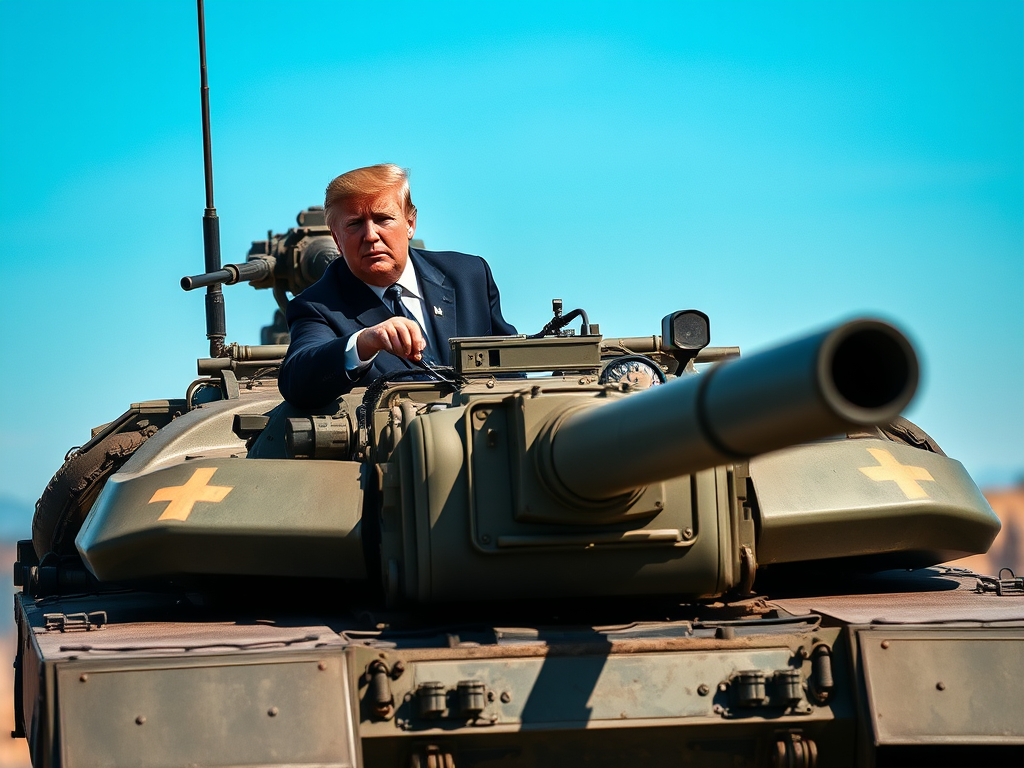
What’s 92 million dollars down the drain? Oh, just Trump’s lavish scheme for a military parade! Because what screams “patriotism” louder than a jaw-dropping spectacle of tanks and troops strutting in formation, huh? Just imagine what 92 million could do for middle-class programs—the possibilities are endless!
Trump has been drooling over the idea of a massive military spectacle for years, inspired by a parade he saw in France back in 2018. But alas, the $92 million price tag put a damper on his dreams.
It’s quite the sight to see Trump throwing himself a lavish birthday bash while claiming to be cracking down on government waste. He’s cutting budgets left and right, slashing grants, and punishing anyone who dares to disagree with him. But hey, who needs essential services when you can have tanks and fireworks, right?
Forget about kids having fewer toys for Christmas or higher food prices – the president needs his tanks and fireworks. And let’s not forget the additional millions needed to transport all that equipment and house thousands of service members for the event. Who cares about repairing roads when you can have a military parade, right?
The thought of military tanks rolling down our streets is just what we need, right? Maybe we should throw in a few more million dollars to fix the roads they’ll inevitably destroy. Because nothing says patriotism like a multimillion-dollar birthday party for Trump, all while dismantling crucial government programs and silencing dissenting voices.
Who needs to worry about a little thing like a recession when Trump is busy dreaming up extravagant ways to spend your hard-earned cash on his birthday bash? It seems like the only thing bigger than his ego is his party budget. Get ready to see your tax dollars put to good use – in the form of balloons, cake, and maybe even a golden statue of himself. Because who needs financial stability when you can have a lavish celebration fit for a king? Happy birthday, Mr. President.
President Trump has been making inaccurate claims regarding the prices of everyday items such as gas and groceries. Despite his assertions, Americans are beginning to experience surcharges on certain items due to his tariff increases.
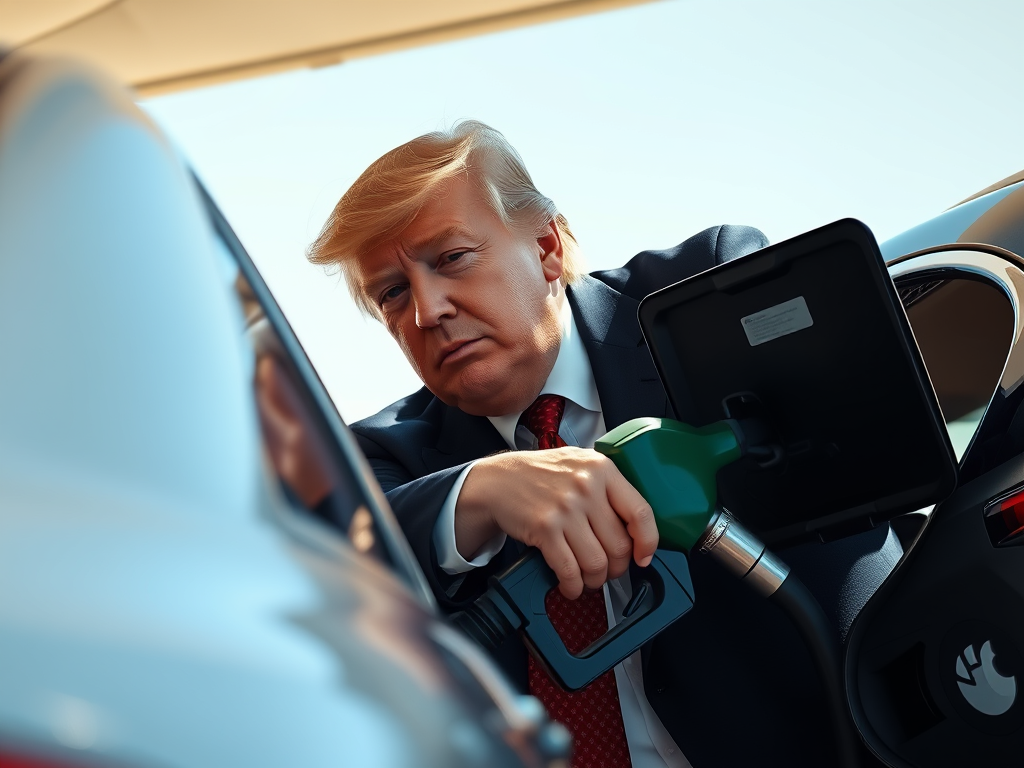
Trump has repeatedly stated that gas prices dropped to a low of $1.98 per gallon. However, GasBuddy, a company that monitors prices at over 150,000 gas stations nationwide, has not found any evidence of a gas station selling gas for that price in April. The lowest price they could confirm was $2.19 at a gas station in Texas. Additionally, Trump’s claim that gas prices are currently at their lowest level since his first term is false, as gas prices were lower during the first six months of President Biden’s term.
Regarding grocery prices, Trump has also claimed that they have decreased since he took office. However, data from the Consumer Price Index shows that the average cost of groceries in March actually increased by 0.49% from the previous month and by 2.4% compared to the previous year. Prices of beef, poultry, eggs, and nonalcoholic beverages all rose in March.
These price increases occurred before the president imposed a baseline 10% tariff on goods from most countries in early April, as well as tariffs as high as 145% on imports from China. Economists anticipate that prices of certain grocery items, such as coffee and chocolate, will rise as a result of these tariffs. Retail prices for consumers are currently at record highs, with Bureau of Labor Statistics data showing that average retail egg prices reached $6.23 per dozen in March, surpassing the previous record of $5.90 set in February.
It is evident that President Trump’s claims do not align with reality, as he appears to fabricate facts to suit his narrative.
The Trump budget proposal is a staggering $1 trillion for defense, while mercilessly slashing funding for education, foreign aid, the environment, health, and public assistance. GOP senators are raising concerns about the budget’s focus on increasing defense spending, especially when other crucial programs are facing severe cuts.
Among the agencies and programs facing the chopping block are the National Park Service, climate science research, foreign economic and disaster assistance, UN peacekeepers, education funding, the Low Income Home Energy Assistance Program, the National Institutes of Health, the Centers for Disease Control and Prevention, and rental assistance. The Internal Revenue Service is also set to lose nearly $2.5 billion in funding.
GOP Senator Collins expressed serious objections to the freeze in defense funding and the proposed cuts to vital programs like LIHEAP and TRIO. She emphasized that Congress holds the power of the purse and must carefully consider the impact of these budget decisions.
It is evident that Trump’s priorities are leading America down a path of impoverishment and vulnerability. The proposed budget paints a grim picture of a country weakened by shortsighted policies and misplaced priorities.
Trump is on a mission to become the anti-FDR, aiming to dismantle the very foundation of the country that was built during the 20th century. The repercussions of his actions are already being felt, with the U.S. economy shrinking by 0.3% in the first quarter due to the uncertainty surrounding Trump’s policies.
In his first 100 days in office, President Donald Trump has launched a relentless attack on the government, civil society, civil rights laws, desegregation efforts, foreign alliances, anti-corruption laws, and the global economy. He is tearing apart the very fabric of America’s identity, rooted in the belief that “all men are created equal.”
As Trump embarks on his second term, the U.S. economy has already taken a hit, contracting in the first three months of 2025 due to a surge in imports triggered by his reckless trade war. This marks the first quarter of negative growth since 2022, signaling a dangerous path ahead.
The 20th century was a time of unparalleled prosperity and influence for the United States, fueled by initiatives like the New Deal and the Civil Rights Movement. These efforts made America richer, more equal, more educated, and more successful than ever before. However, Trump’s administration is determined to reverse this progress, disregarding the principles of democracy and the rule of law in favor of a regressive agenda.
Trump’s ultimate goal is to dismantle the achievements of the 20th century and replace them with a society that is isolated, unequal, impoverished, uneducated, and undemocratic. The destruction of scientific research under his administration is just one example of his relentless efforts to undermine progress and knowledge.
As the country stands at a crossroads, the stakes could not be higher. Will America succumb to Trump’s destructive vision, or will it rise up to defend the values that have defined it for generations? The future of the nation hangs in the balance.
President Trump’s first 100 days in office have yielded historically low approval ratings, signaling a clear lack of support for his actions among the American populace. Republican strategists are now urging Trump to shift his focus away from the turbulence surrounding tariffs and instead concentrate on delivering on the economic promises he made during his presidential campaign but not keep.
The decline in Trump’s approval ratings can be attributed to his pursuit of restrictive trade policies and higher tariffs, which have sparked widespread concern among voters. There is growing apprehension that these policies could impact the outcome of the 2026 congressional elections, potentially resulting in a loss of the GOP majority.
When a political party loses the support of the ‘big middle’ of the electorate, swing races tend to shift away from them, and traditionally safe districts can unexpectedly become competitive. Recent polling data from Decision Desk HQ indicates that Trump’s approval rating stands at 44 percent, with 56 percent of respondents expressing disapproval of his performance. Additionally, a majority of voters (64 percent) believe that tariffs are detrimental to consumers, and a staggering 91 percent are concerned about inflation.
Many voters, disillusioned by rising costs and feeling that the country was on the wrong path under the previous administration, sought change in the last election. However, they did not anticipate nor support the changes that President Trump has implemented. It is evident that voters feel misled by Trump, as reflected in the latest polling data.
Democrats have an opportunity to capitalize on Trump’s declining approval ratings by highlighting his broken promises and misleading statements to voters. Trump’s policies, including tax breaks for the wealthy, cuts to veteran benefits, layoffs of federal workers without due process, reductions in Medicaid, and tariffs, are not resonating well with the American electorate. If these sentiments persist, voters may opt to replace Republican lawmakers with Democrats in the upcoming elections to steer the country back on course.
As we reflect on President Donald Trump’s 100th day in office, it’s abundantly clear that his reign has been nothing short of a chaotic whirlwind. With a staggering 142 executive orders under his belt, it’s no wonder the American people are feeling a bit overwhelmed.
His reckless style of governing is nothing short of chaotic, sparking a cascade of destabilization in global affairs that will inevitably wreak havoc on our homeland security and cripple our manufacturing sector, threatening countless jobs in the process.
From pardoning Capitol rioters to picking fights with our closest allies, Trump has certainly kept us on our toes. And let’s not forget his failed promise to lower grocery prices – a real nail-biter for those 2024 voters, I’m sure.
The so-called “Liberation Day,” the financial markets plummeted into chaos — and they showed no signs of recovery. Almost immediately, other nations sprang into action, declaring punitive tariffs that threw a wrench into the works. Retailers cried out about skyrocketing prices and looming supply shortages, while economists ominously warned that these tariffs would unleash a torrent of inflationary pressures.
A critical dilemma has emerged — the very foundation of the tariffs strategy is engulfed in a haze of confusion and uncertainty. His relentless back-and-forth on tariffs, one moment slapping them on, the next lifting them, has not only stalled the global supply chain but has also driven prices upward across the board, leaving American consumers to bear the brunt of this turmoil.
The crucial electoral peril in Trump’s strategy lies in its neglect of voters yearning for real solutions to pressing kitchen-table concerns—they are left feeling utterly overlooked and disheartened. A recent CBS News/YouGov poll unveiled on Sunday reveals a staggering 69 percent of Americans claiming that the Trump administration is failing to adequately address the critical issue of rising prices.
The most breathtaking moment of Trump’s foreign policy during his first 100 days unfolded on February 28, when President Trump and Vice President Vance launched an intense confrontation with Ukrainian President Volodymyr Zelensky in the Oval Office, sending ripples of shock and disbelief across the globe. With fervor, Trump and Vance insisted that Zelensky was failing to adequately convey the gratitude owed for the unwavering American support amid the harrowing Russian invasion in February 2022. Never before in our history has a President sided with one of our adversaries, Russia, against our steadfast ally, Ukraine.
Trump, who brazenly claimed he could end the war in a mere day, now teeters on the brink of forsaking the very negotiations that might achieve this lofty ambition. A recent New York Times/Siena College poll lays bare a grim truth: a mere 35 percent of registered voters endorse Trump’s war strategy in Ukraine, while an alarming 56 percent vehemently disapprove. His failure to present a viable plan is nothing short of shocking.
Federal judges in over 120 cases have tried to put a stop to Trump’s antics—judges from both sides of the aisle, including some he himself appointed—but their orders are being blatantly ignored or appealed by the regime. To add insult to injury, they’ve even gone so far as to arrest a municipal judge in Milwaukee who dared to simply attempt to hear a case involving an undocumented defendant.
Then there is Elon Musk and DOGE. His partial Track record:
Accidentally fired, and tried to rehire, employees at the National Animal Health Laboratory Network who were working on the administration’s response to bird flu.
Fired, and scrambled to rehire, people responsible for maintaining the nation’s nuclear weapons stockpile.
Fired, and then un-fired, workers at the Environmental Protection Agency.
Fired, and then rehired, people responsible for ensuring the safety of medical devices.
Fired workers at the Small Business Administration, then un-fired them, and then fired them again.
Despite his best efforts to shake things up, Trump’s approval rating is plummeting faster than a lead balloon. With only 39% of the population giving him a thumbs up, it’s safe to say he’s not exactly winning any popularity contests.
But hey, at least he’s consistent in one thing – consistently disappointing. According to a recent survey, even his own party members are starting to question his leadership. So, here’s to another 100 days of chaos and confusion.
Have we crossed the line of disregard for the rule of law? The arrest of sitting state Judge Hannah Dugan outside of her courthouse was a shocking move by the Trump administration, showing a blatant attack on the judiciary and sanctuary jurisdictions. Targeting a state judge for arrest over an alleged obstruction of detaining an undocumented migrant may not raise the same constitutional concerns as defying federal court judges, but the handling of this case is part of a larger campaign to intimidate and erode the rule of law.
FBI Director Kash Patel’s actions were highly unusual, tweeting, deleting, and reposting about the arrest, then taking it a step further by posting a photo of the arrest on social media. This behavior is not normal, appropriate, or okay.
Attorney General Pam Bondi also crossed a line by appearing on Fox News to comment extensively on the case and launch attacks on the defendant and the judiciary as a whole. These public statements about pending cases are typically prohibited by DOJ policy and legal ethics rules, but Bondi ignored them to cater to a Trump-friendly media outlet.
It is clear that the top law enforcement officials in the United States are playing politics and trying to spin a false narrative about the Judge to taint the Wisconsin judge’s case. This behavior is unacceptable and undermines the integrity of our legal system.
Why the Federal Case will Fall Apart
The allegations against Judge Dugan arise from an incident on April 18, during which federal agents sought to apprehend a defendant, Eduardo Flores-Ruiz, outside her courtroom. It is crucial to note that the agents were in possession of an “administrative warrant” issued by Immigration and Customs Enforcement (ICE), rather than a judicial warrant.
Despite the circumstances, Judge Dugan took appropriate measures to safeguard the integrity of her courtroom proceedings. She instructed the federal agents to address their concerns with the Chief Judge and ensured that the defendant’s hearing proceeded without interference from external sources.
The recent statements made by the FBI Director regarding this case are concerning, as they appear to prejudge the defendant and undermine the principles of due process. Such extrajudicial comments have the potential to bias the case, infringe upon the defendant’s rights, and erode public trust in the judicial system.
In accordance with standard procedures and in respect of judicial independence, felony charges against a member of the judiciary are typically presented to a grand jury for review. By circumventing this process and arresting Judge Dugan without following established protocols, the prosecutors have raised questions about the political motivations behind the case.
Furthermore, it is important to consider the limitations of administrative warrants, which do not authorize forced entry or detention without judicial oversight. The context in which the warrant was issued must not be overlooked in evaluating the legality of the actions taken.
The assertion that Judge Dugan should have regarded an administrative warrant as binding authority is a significant misinterpretation of the law, reflecting more on political agendas than on actual violations of federal statutes. Judge Dugan’s legal predicament is part of a larger pattern that has characterized Trump’s political career: the deliberate targeting and disparagement of strong, independent women who resist submitting to his control.
The arrest of Judge Dugan highlights a double standard that persists in the Trump era. While a local judge faces federal prosecution for actions aimed at upholding constitutional boundaries, the Trump administration itself has displayed blatant disregard for legal standards. Enforcement is applied selectively, used to punish dissenters and shield allies.
It is crucial for the public to perceive the case against Judge Dugan not as an isolated conflict, but as a cautionary tale. If the Trump administration can detain a judge for her handling of a defendant’s movements within a courthouse, what constraints remain?
Could a judge be apprehended for challenging the legitimacy of an executive order? For postponing a hearing to allow a defendant to seek legal counsel? For suppressing unlawfully obtained evidence? Each of these fundamental judicial functions could be reinterpreted as “obstruction” under the current aggressive, politically charged approach.
The nation must not become desensitized to these tactics. They signify a departure from democratic governance towards authoritarian practices where legal pretext supersedes due process.
Judge Dugan’s case calls for a thorough and transparent examination of the facts, as well as a call to action for all who believe in the primacy of the law over politics, rather than bending it to serve political interests.
The arrest was a clear message. The nation’s response will determine whether the messenger succeeds in stifling independent judgment.
With the ongoing political discourse surrounding Medicaid and the GOP’s commitment to a reduction of $880 billion from the program, it is essential to comprehend the intricacies of the program, its operational framework, and its significance to the American populace.
Medicaid is a joint federal-state program that provides health coverage to millions of low-income Americans, including children, pregnant women, elderly adults, and people with disabilities. As a critical safety net, Medicaid plays a vital role in ensuring access to healthcare services for some of the nation’s most vulnerable populations.
Understanding Medicaid
Medicaid was established in 1965 under the Social Security Act as a partnership between the federal government and individual states. The program is designed to provide healthcare services to specific groups of low-income individuals who might otherwise struggle to afford coverage. While the federal government sets minimum guidelines for eligibility, enrollment, and services, states have the flexibility to tailor their programs to meet local needs and preferences.
Medicaid’s Impact on Individuals
For millions of Americans, Medicaid is a lifeline that provides access to essential healthcare services. The program covers a broad range of services, including:
Inpatient and outpatient hospital services
Physician and nursing services
Laboratory and X-ray services
Family planning and maternity care
Mental health and substance use disorder treatment
Transportation to medical appointments
Home health services
Rehabilitative services and devices
Dental and vision care
Non-emergency medical transportation
Medicaid’s Role in Supporting Hospitals
Medicaid is not only crucial for the individuals it serves but also plays a significant role in supporting the financial stability of hospitals and healthcare systems. Medicaid reimbursements help hospitals cover the cost of care for low-income patients, ensuring that essential services remain available to all who need them.
Financial Assistance: Medicaid reimbursements help hospitals offset the costs of providing uncompensated care to uninsured or underinsured patients.
Safety Net: Medicaid serves as a safety net for hospitals, particularly those in low-income areas, by providing a stable source of funding for essential services.
Preventive Care: By covering preventive care services, Medicaid helps reduce the need for more costly interventions and hospitalizations down the line.
Rural Health: Medicaid is vital for ensuring access to healthcare services in rural areas, where hospitals often struggle to remain financially viable due to lower patient volumes and higher rates of uninsured individuals.
Medicaid is a critical safety net program that provides essential healthcare services to millions of low-income Americans. By supporting both individuals and hospitals, Medicaid plays a vital role in promoting health equity, ensuring access to care, and maintaining the financial stability of healthcare systems.
Firefighters face a constant battle against toxins and chemicals that threaten their physical and mental well-being. This struggle is only intensified by the stress and lack of sleep that come with the job. Shockingly, research from NIOSH has revealed that firefighters are 9 percent more likely to be diagnosed with cancer and 14 percent more likely to die from it compared to the general population.
Despite the vital role that NIOSH plays in ensuring the health and safety of firefighters, the program has been drastically reduced or eliminated under the direction of Health and Human Services Secretary Robert F. Kennedy Jr. in a ruthless “reduction in force” that has impacted over 10,000 employees. This devastating blow has left many fearing a significant decline in the health outcomes of firefighters.
The dedicated individuals at the Center for Firefighter Safety, Health, and Well-being, including those involved in the Fire Fighter Fatality Investigation and Prevention Program, have been unjustly let go. Similarly, the team responsible for maintaining the CDC’s National Firefighter Registry for Cancer, a crucial resource authorized by President Donald Trump in 2018, has also been disbanded.
It is a cruel irony that firefighters, who have shown unwavering support for President Trump, now find themselves betrayed and discarded in favor of tax cuts for the wealthy. The very individuals who risk their lives to protect others are now being abandoned and forgotten. How does it feel to be stabbed in the back and cast aside after all they have sacrificed? The injustice is palpable, and the consequences are dire.
Grocery prices have not budged an inch, not even a smidgen.
Picture this: Donald Trump, standing at his New Jersey golf course last summer, surrounded by a table overflowing with food items. He dramatically declared that grocery prices had “skyrocketed” and vowed to fix it ( Day One) if re-elected. Spoiler alert: he didn’t.
In his first 100 days back in office, Trump has been a busy bee. He’s managed to disrupt the lives of federal workers, condemn migrants to a life behind bars in El Salvador, and even switch sides in the Ukraine war. Oh, and let’s not forget about the trillions lost from retirement accounts and the looming trade-war-induced recession.
Not only have grocery prices been on the rise since Trump took office, but the inflation rate for groceries has hit a two-year high. So much for those promises of cheaper groceries, huh?
To all the Trump supporters who were swayed by his pledge to lower grocery prices, I hate to break it to you, but you’ve been duped. The man has a talent for spinning tall tales, especially when it comes to the most pressing issue for the average voter.
Despite Trump’s recent backtracking on tariffs, the damage has already been done. Brace yourselves for even higher grocery prices as the cost of imported food skyrockets.






 Blue Press Journal