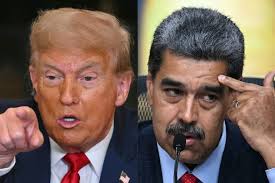
BLUE PRESS JOURNAL – Two months ago, Donald Trump’s own Chief of Staff, Susie Wiles, said something that now sounds almost prophetic. In an interview with Vanity Fair, she made it plain: if the president “were to authorize some activity on land, then it’s war, then [we’d need] Congress.”
She was right — and now, Trump has done exactly what she warned against.
Overnight, the former president ordered U.S. forces into Venezuela, capturing its embattled leader, Nicolás Maduro, without so much as a phone call to Congress. No debate. No authorization. No transparency. Just a unilateral act of war.
By the reasoning of his own chief of staff — and by the plain text of the Constitution — this was illegal. Trump broke the law. He violated the Constitution. And, in doing so, he upended one of the most fundamental checks on presidential power in American history.
This morning, standing beside Vice President J.D. Vance, Trump confirmed what many had already suspected: the operation was not merely about so-called “narco-terrorism.” It was also about oil. “We’re securing resources that rightfully belong to the free world,” he said. In other words, the U.S. military was sent into a sovereign nation, at least in part, for profit and political theater.
Democrats Call It “Lawless and Dangerous”
Democrats on Capitol Hill were quick to condemn the move. Senator Elizabeth Warren called it “a lawless and dangerous abuse of power.” Representative Alexandria Ocasio-Cortez said, “This is exactly why Congress — not one man — has the power to declare war. The framers of our Constitution saw this kind of executive overreach coming.”
Even Democratic moderates voiced alarm. Senator Chris Murphy warned, “If we let this stand, we’re saying any president can unilaterally start a war anywhere in the world. That’s not democracy — that’s monarchy.”
To Democrats, this isn’t just another Trump stunt; it’s a full-blown constitutional crisis.
Why This Is Unconstitutional — in Plain English
Here’s the simple version: the Constitution divides the power to make war between Congress and the President. Article I, Section 8 gives Congress the power to declare war. The President, under Article II, can direct the military only after Congress gives authorization — or in response to a direct attack on the United States.
Trump did neither. Venezuela did not attack the U.S., and Congress never approved military action.
The War Powers Resolution of 1973 was designed to prevent exactly this kind of unilateral decision-making. It says the president can send U.S. forces into combat only if (1) Congress has declared war, (2) Congress has given specific authorization, or (3) the U.S. is under imminent threat. Even then, the law requires the president to notify Congress within 48 hours and withdraw troops after 60 days if Congress does not approve the action.
Trump ignored all of that. He didn’t consult Congress. He didn’t meet the conditions. He simply acted — as though the law didn’t apply to him.
The Bigger Danger
By discarding both the Constitution and the War Powers Resolution, Trump has done more than violate the law — he’s set a precedent that could haunt America for decades. If the U.S. can invade a sovereign nation for oil or political gain, what moral ground do we have to criticize China for threatening Taiwan, or Russia for pushing deeper into Eastern Europe?
As one Democratic strategist put it, “We can’t claim to defend democracy abroad when we’re dismantling it at home.”
Even critics of Nicolás Maduro — and there are many — understand this. Maduro’s regime has been accused of corruption, election-rigging, and brutality. But the fact that he’s an illegitimate ruler doesn’t give the American president a blank check to break our own laws.
The Verdict
Trump’s invasion of Venezuela is not just a foreign policy blunder — it’s a direct assault on the American system of government. The framers designed a balance of powers precisely to stop one person from dragging the country into war for personal or political reasons.
By disregarding the delicate balance of power, Trump has done far more than merely deploy troops overseas; he has fundamentally destabilized the very pillars of American democracy. The actions of Congress and the courts in curbing his authority will not only shape the outcome of this military operation but could ultimately redefine the trajectory of presidential power in the United States for generations to come.
 Blue Press Journal
Leave a comment