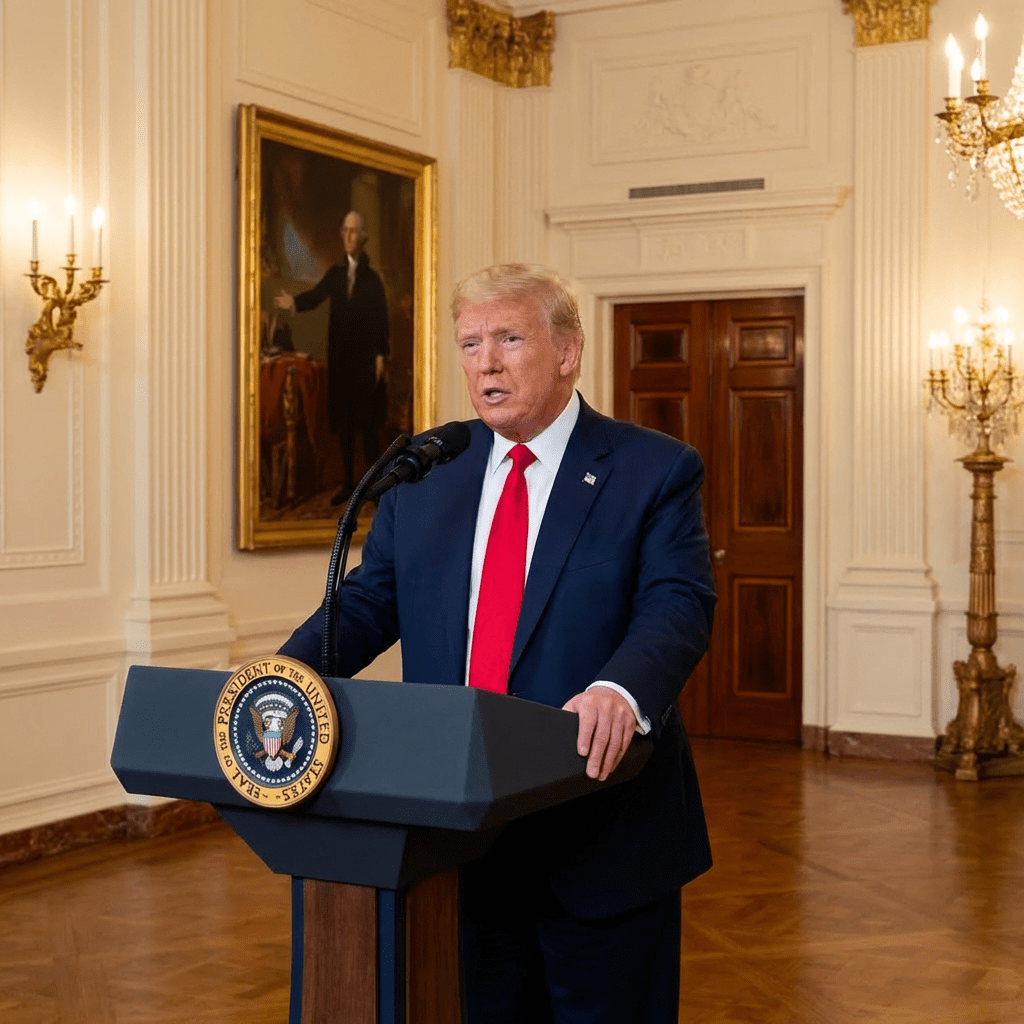
Blue Press Journal (DC) – President Donald Trump’s recent prime-time address regarding the ongoing military conflict with Iran delivered neither a strategic roadmap nor a withdrawal timeline, instead raising serious constitutional questions about unauthorized military action and threats against NATO allies that legal scholars say lack legal merit.
Speaking for a mere 18 minutes, the President failed to outline how tens of thousands of deployed personnel would return home or how the United States would secure the Strait of Hormuz, through which one-fifth of global petroleum flows. According to constitutional experts cited by The Washington Post, the President’s unilateral initiation of hostilities without congressional authorization as required under Article I, Section 8 of the Constitution represents a significant overreach of executive power, violating the War Powers Resolution that mandates legislative approval for sustained military engagements.
The address also featured renewed attacks on NATO, despite the alliance’s defensive nature under Article 5 of the Washington Treaty. As Foreign Policy analysts note, NATO membership involves Senate-ratified treaty obligations that a president cannot simply terminate without legislative consent—a constitutional reality Trump’s rhetoric appears to ignore. The alliance, designed for collective defense rather than offensive wars of choice, holds no obligation to join member-initiated conflicts of aggression.
Trump’s threats to destroy Iran’s electrical generation facilities—civilian infrastructure protected under international humanitarian law—have drawn condemnation from human rights monitors and Human Rights Watch, which classify such actions as potential war crimes. These warnings accompany reports of approximately 1,500 civilian casualties, including 175 children killed in a February 28 strike on a school.
The President’s historical comparisons—equating one month of conflict to World War I, Vietnam, and Iraq—offered little comfort to families of 13 fallen service members or hundreds wounded. His contradictory statements regarding Iran’s nuclear program, simultaneously claiming the material is inaccessible yet monitored by satellite, suggest strategic incoherence rather than diplomacy.
Meanwhile, Trump attributed rising domestic fuel costs to Iranian “terror attacks” rather than wartime market volatility, a deflection that Reuters economic analysts dispute given the conflict’s disruption of regional oil flows.
As constitutional scholars underscore, the commitment to perpetual conflict demands the explicit consent of the democratic populace rather than unilateral decisions by the executive branch.
 Blue Press Journal
Leave a comment