Tag: consumer cost of living

  • How AI Data Centers Became a Toxic Campaign Issue—And What Democrats Must Do Now

    Blue Press Journal News Desk Monday 5, 2026

    As the midterm elections near their conclusion, the advocacy organization Tech Oversight Project is urging Democratic lawmakers to exploit an issue on the rise: artificial intelligence server farms. The Republican-backed One Big Beautiful Bill Act included full expensing provisions for certain business property that critics calculate handed substantial tax breaks to large-scale data center developers.
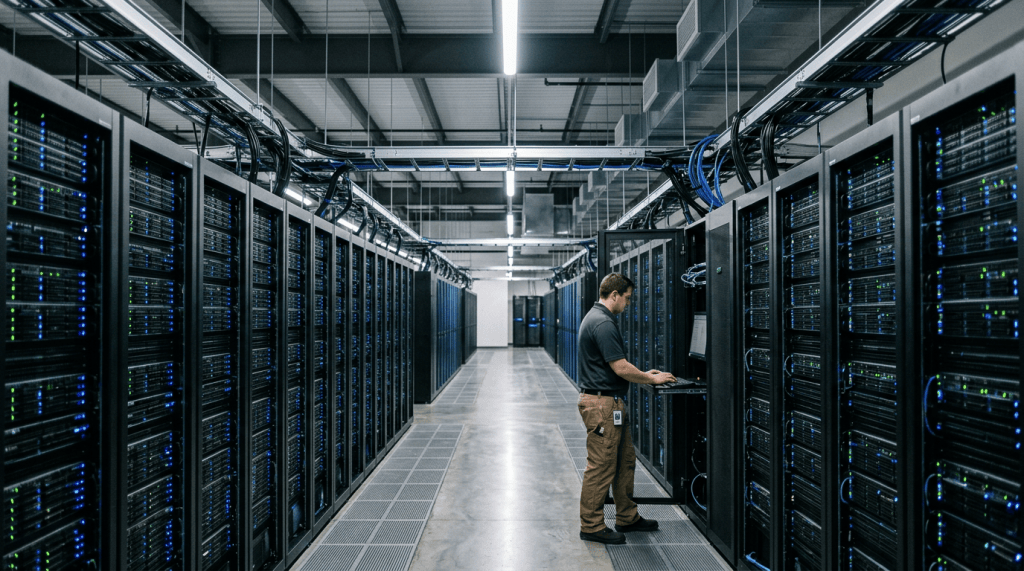
    Technician working at a server rack in a data center

    According to the group’s internal briefing, obtained by POLITICO before publication, these data centers increase the everyday costs for citizens while the companies hosting them reap government subsidies.

    “Across the country, major technology companies have captured billions in local and federal subsidies for these massively unpopular data centers, shifting the costs directly to taxpayers,” Sacha Haworth, the founder and executive director of the watchdog group, said in the briefing Monday.

    The facility boom, which has fueled the explosive growth of AI, has become a lightning rod for voters in this year’s closely watched elections.

    “There’s a lot of bipartisan unhappiness with data centers right now,” Haworth said. “The National Republican Senatorial Committee literally warned in the summer that a data center fight in Ohio was already hurting the Senate campaign of Jon Husted. It could be a warning sign to the entire country of what folks really want in an election.”

    Democrats are zeroing in on the issue as a way to score political points against Republicans, accusing them of crony capitalism and favoring tech companies at the expense of everyday Americans.

    “This line of attack will certainly exacerbate the perception of the walled-off relationships between Washington and Silicon Valley. It fails to address the real-world impact of these facilities on cash-strapped families who can’t get the relief they need from elected officials,” Haworth argued in the briefing. “Democrats should capitalize on the populist outrage being stoked around the country by pushing the message that the companies should pay for the electric loads they create, not homeowners and businesses.”

    “This approach will resonate from presidential races to municipal referendums on data center siting,” she added. That’s because “the facilities’ impacts are both local and national, where government subsidies to the facilities and the resulting local costs are completely indefensible.”

    The push appears to be working: After years of rapid expansion and little pushback, lawmakers are starting to take notice. Last month, Ohio Gov. Mike DeWine (R) blocked further tax breaks to developers of the facilities, and Gov. JB Pritzker (D) did the same in Illinois last month.

    Additionally, the Tech Oversight Project argued that the jobs promised by the data center industry are few and far between compared to the billions in tax incentives given to developers. “Companies promoting data centers often trumpet short-term construction jobs. The permanent staff needed to run a facility upon completion is often minuscule compared to the size of the subsidies given to developers,” Haworth said in the briefing. “Moreover, the companies often use these restrictive NDAs to conceal information about the facilities from the public.”

    Tech companies hoping to build new facilities or renovate old ones are rethinking their strategies as bad press mounts and costs skyrocket. More and more companies are investing in building — or, now, buying — goodwill among communities where they hope to open facilities, trying to reassure residents that they won’t hike costs or hurt the environment.

    Spreading the idea seems a tough sell: According to Pew Research Center, 60% of Americans would not want a data center in their community. “Among those who said they would not want a data center near their home, 52% said that increased electricity costs would be an important concern. 54% said that environmental damage from data centers would be an important concern,” the analysis found.
    Fediverse Reactions
  • The Cost of Trump Protectionism: Assessing the Economic Strain of 2025‑2026


    By Winston Wendell

    It has been quite an eventful year – to be more precise, the economic policy of President Trump during his second term of office is turning ordinary everyday activities into a burden. Americans jokingly refer to the current situation as “Trumpflation”. However, one might wonder what is causing the increase of prices? Let us examine the causes in detail.

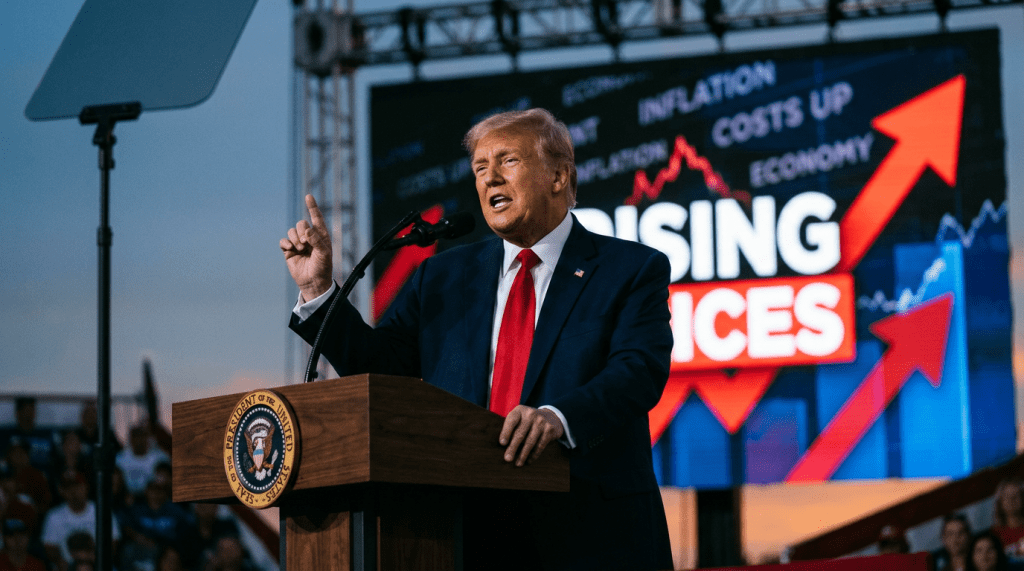
    Former U.S. president giving speech at podium with 'Rising Prices' and inflation graphics behind him

    Tariffs and Price Surges

    In 2025, President Trump introduced the tariffs of 10% on imports and 60% on imports from China, claiming that it will boost production in the USA. However, economists from the Peterson Institute did not hesitate in criticizing the move as a sales tax for citizens.

    By June 2026, the level of inflation in the USA reached 6.5% which is the highest one since before COVID-19.

    One of the places where this process becomes obvious is a local supermarket. America is still dependent on foreign fertilizer, chemicals, and farming equipment. As a result, any increase in the costs of importing them makes local products more expensive. A gallon of milk cost increased by almost 80% reaching $5.10. Moreover, even staple goods and food are increasing in price faster than the rate of inflation, and families making $50,000 to $150,000 a year face this problem.

    Oil Shock: The Iran War and Gasoline

    However, things get worse overseas. By the end of 2025, Trump began to attack Iran causing the start of what became known later as “The Iran War”. This led to the closure of Strait of Hormuz which accounts for 20% of global oil transportation. As a result, gasoline prices exploded.

    As a result, in early 2026, the average price of gasoline reached $5.65 a gallon. In Arizona and in the Midwest regions, the price per gallon was $6. With the yearly mileage of 12,000 miles, one will spend additional $1,200 on gasoline. Such expenses become unbearable for families with low budgets.

    Forbes reports that small businesses suffered a great deal from the situation described above – particularly those which use trucks and ships. Many business owners decided to increase their prices, but some of them simply had to fire some workers to pay for their increased costs.

    The 2025 Tax Law: The Winners and Losers

    Also, Trump passed the tax reform legislation known as “the Big Beautiful Bill”. It was said that such legislation would benefit ordinary Americans. However, the examination of the law shows that most of the profits will not reach Americans. Corporate tax breaks which were introduced in 2017 remained unchanged, but sales and excise taxes increased drastically. The Congressional Budget Office and Tax Policy Center calculated that the 1% of the richest Americans received 65% of the total benefits, and most of other people received no or little changes to their wallets.

    Such conclusion is supported by data from the Federal Reserve. Any advantage gained from tax breaks disappeared in front of rising prices. Families with middle incomes of $100,000 decreased their disposable income by 3 to 4% between 2024 and 2026.

    How Everyone Survives

    People are talking about this problem constantly. According to the Gallup poll conducted in June 2026, 68% of Americans believe that the current trend of the national economy is heading downwards. Also, according to the survey conducted by Pew, more than 75% of Americans are worried about the food and gas prices; they blame the trade war for keeping inflation.

    What Will Happen in Future?

    The Federal Reserve announced that it will continue holding interest rates at present levels to bring prices down. However, with constant tariffs and conflict with Iran, such action seems rather fruitless. Also, based on conversations with the experts, they claim that as long as the protectionism and foreign disputes remain the focus of government policy, stagflation (a combination of slow growth and high prices) is imminent.

    Such trends cannot be overlooked. It is tariffs, foreign conflicts, and tax reforms favorable to corporations which increase the cost of goods for Americans. For America’s middle class, the slogan “America First” is becoming synonymous with spending extra money on goods and gasoline.

    Fediverse Reactions