Blue Press Journal News Desk Monday 5, 2026
As the midterm elections near their conclusion, the advocacy organization Tech Oversight Project is urging Democratic lawmakers to exploit an issue on the rise: artificial intelligence server farms. The Republican-backed One Big Beautiful Bill Act included full expensing provisions for certain business property that critics calculate handed substantial tax breaks to large-scale data center developers.
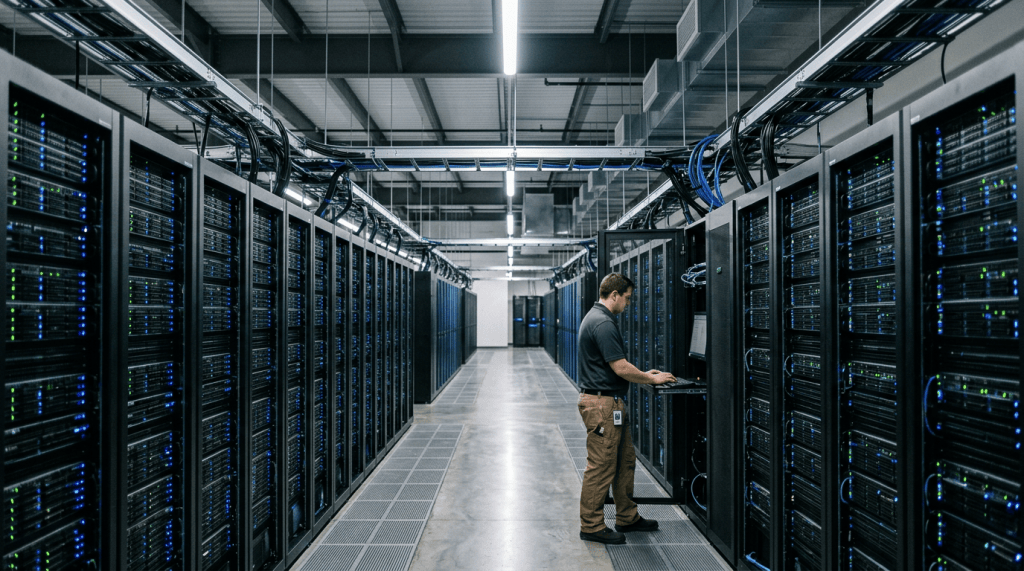
According to the group’s internal briefing, obtained by POLITICO before publication, these data centers increase the everyday costs for citizens while the companies hosting them reap government subsidies.
“Across the country, major technology companies have captured billions in local and federal subsidies for these massively unpopular data centers, shifting the costs directly to taxpayers,” Sacha Haworth, the founder and executive director of the watchdog group, said in the briefing Monday.
The facility boom, which has fueled the explosive growth of AI, has become a lightning rod for voters in this year’s closely watched elections.
“There’s a lot of bipartisan unhappiness with data centers right now,” Haworth said. “The National Republican Senatorial Committee literally warned in the summer that a data center fight in Ohio was already hurting the Senate campaign of Jon Husted. It could be a warning sign to the entire country of what folks really want in an election.”
Democrats are zeroing in on the issue as a way to score political points against Republicans, accusing them of crony capitalism and favoring tech companies at the expense of everyday Americans.
“This line of attack will certainly exacerbate the perception of the walled-off relationships between Washington and Silicon Valley. It fails to address the real-world impact of these facilities on cash-strapped families who can’t get the relief they need from elected officials,” Haworth argued in the briefing. “Democrats should capitalize on the populist outrage being stoked around the country by pushing the message that the companies should pay for the electric loads they create, not homeowners and businesses.”
“This approach will resonate from presidential races to municipal referendums on data center siting,” she added. That’s because “the facilities’ impacts are both local and national, where government subsidies to the facilities and the resulting local costs are completely indefensible.”
The push appears to be working: After years of rapid expansion and little pushback, lawmakers are starting to take notice. Last month, Ohio Gov. Mike DeWine (R) blocked further tax breaks to developers of the facilities, and Gov. JB Pritzker (D) did the same in Illinois last month.
Additionally, the Tech Oversight Project argued that the jobs promised by the data center industry are few and far between compared to the billions in tax incentives given to developers. “Companies promoting data centers often trumpet short-term construction jobs. The permanent staff needed to run a facility upon completion is often minuscule compared to the size of the subsidies given to developers,” Haworth said in the briefing. “Moreover, the companies often use these restrictive NDAs to conceal information about the facilities from the public.”
Tech companies hoping to build new facilities or renovate old ones are rethinking their strategies as bad press mounts and costs skyrocket. More and more companies are investing in building — or, now, buying — goodwill among communities where they hope to open facilities, trying to reassure residents that they won’t hike costs or hurt the environment.
Spreading the idea seems a tough sell: According to Pew Research Center, 60% of Americans would not want a data center in their community. “Among those who said they would not want a data center near their home, 52% said that increased electricity costs would be an important concern. 54% said that environmental damage from data centers would be an important concern,” the analysis found.


Leave a comment