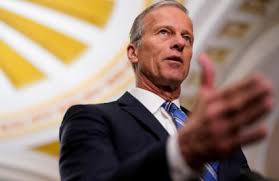
The current struggle among Senate Republicans this week to pass a budget proposal, which is unpopular, reveals a deep internal conflict, one that goes beyond typical political disagreements. According to some analysis, the core difficulty lies in a stark reality: a significant number of Republican lawmakers understand that the very people most likely to be negatively impacted by the proposed cuts are their own constituents – the Republican voters.
Under discussion is a plan described by some as potentially adding a significant $2.8 trillion to the national debt by 2035. Yet, despite this substantial increase in borrowing, the plan reportedly includes deep cuts to vital social programs like Medicaid and Obamacare. These cuts are projected to be severe enough that an estimated 11.8 million people could lose their health insurance coverage. Beyond healthcare, millions more Americans would likely lose access to other essential services upon which they rely.
Analysis indicates that these reductions would have a significant and disproportionate impact on residents of “red states,” which are integral to the Republican constituency. This consequence would predominantly affect Republican voters, a group that notably includes many individuals from the MAGA demographic.
This situation presents a peculiar political paradox. If the proposed plan simultaneously increases the national debt by trillions and inflicts significant pain on the party’s own voters, why would Republicans push for it? Specifically, if they are already willing to go $2.8 trillion deeper into debt, why wouldn’t they allocate an additional amount – say, the $930 billion mentioned in one calculation – to mitigate the damage and protect their constituents’ healthcare and services? If debt is acceptable, why not use a fraction more to shield their base from harm?
The answer, according to the perspective offered here, points towards a fundamental shift in the dynamics of the Republican Party. It suggests that the party’s actions and priorities are no longer driven purely by traditional calculations of representing constituent interests or adhering strictly to fiscal conservatism. Instead, this viewpoint posits that the party has transformed, now operating less as a conventional political organization and more as something resembling a “Trump’s cult.”
From this perspective, the audacity to harm their own supporters while recklessly escalating the national debt transcends mere policy or political maneuvering; it reveals a troubling allegiance to a non-traditional agenda dictated by the party’s powerful figurehead, Trump. This profound analysis uncovers that the ongoing budget impasse is far more than a dispute over legislative minutiae; it is a glaring symptom of a party whose very identity and motivations have undergone a dramatic transformation and no longer represents the American public. .
The polls:
A Fox News poll found that 38% of registered voters support the “One Big Beautiful Bill” based on what they know about it, while 59% oppose it.
The survey found that the legislation is unpopular across demographic, age and income groups. It is opposed 22%-73% by independents, and 43%-53% among white men without a college degree, the heart of Trump’s base.
A Quinnipiac University poll found that 27% of registered voters support the bill, while 53% oppose it. Another 20% had no opinion. Among independents, 20% said they support it and 57% said they oppose it.
A KFF poll found that 35% of adults have a favorable view when asked about the “One Big Beautiful Bill Act,” while 64% have an unfavorable view. Just 27% of independents said they hold a favorable view of it.
A survey from Pew Research Center found that 29% of adults favor the bill, while 49% oppose it. (Another 21% said they weren’t sure.) Asked what impact it would have on the country, 54% said “a mostly negative effect,” 30% said “a mostly positive effect” and 12% said “not much of an effect.”
A poll by The Washington Post and Ipsos found that 23% of adults support “the budget bill changing tax, spending and Medicaid policies,” while 42% oppose it. Another 34% had no opinion.
 Blue Press Journal
Leave a comment