Blue Press Journal – The Trump administration’s temporary lifting of Russian oil sanctions represents a stark admission that its Iran military campaign is backfiring economically. In a move rich with geopolitical irony, the White House is easing restrictions on Moscow—a direct concession to Vladimir Putin—to counteract crude price spikes triggered by the President’s own Persian Gulf escalation (The Guardian).
The decision undermines years of bipartisan measures designed to punish Russia’s Ukraine invasion while revealing acute strategic shortsightedness. According to CNN, officials failed to contingency-plan for Iran’s threatened Strait of Hormuz closure despite this scenario being “a bedrock principle of US national security policy for decades” (CNN). By treating Putin’s regime as an economic “pressure relief valve,” Trump prioritizes electoral survival over principled opposition to Russian aggression, deepening scrutiny of the administration’s crisis planning and longstanding Kremlin entanglements.
Trump’s Oil‑Price Spin Masks an Affordability Crisis and an Unnecessary Iran War
Blue Press Journal – President Donald Trump tried to portray today’s surge in gasoline prices as a boon for U.S. producers, posting on TruthSocial that “the United States is the largest oil producer, so when oil prices go up, we make a lot of money.” But the reality, reported by Reuters and CNN, is that consumers are feeling the pinch of a “fuel shock” not seen since the 1970s, deepening an already‑severe affordability crisis for middle‑class families (Reuters).
Trump’s rhetoric also drifts into dangerous territory. He claims the war with Iran is necessary to stop a nuclear threat, yet The New York Times notes that diplomatic talks were nearing a mutually acceptable agreement and no credible evidence shows Tehran is building a bomb (NYT). Energy Secretary Chris Wright’s dismissal of a $200‑per‑barrel scenario as “unlikely” ignores Tehran’s explicit warning that regional destabilization will drive prices sky‑high (CNN).
Meanwhile, the president’s ongoing effort to suppress the Epstein files diverts attention from these urgent economic issues, raising questions about his priorities. As oil prices fluctuate, the real cost falls on American drivers, not on the Trump‑aligned oil lobby.
Supreme Court’s Delay Thwarts GOP Plan to Gut Black Voting Power Ahead of 2026
Blue Press Journal – A Republican-led scheme to systematically dismantle Black-majority congressional districts across the South has been temporarily thwarted, not by a legal defense, but by the Supreme Court’s own delayed timetable, according to election law experts.
The plan hinged on the high court’s anticipated ruling in Louisiana v. Callais, a case that could severely weaken or outright strike down Section 2 of the landmark Voting Rights Act. This provision prohibits voting practices that discriminate based on race, a critical tool used to prevent the dilution of Black voting power through gerrymandering.
Had the conservative-majority Court, shaped by three justices appointed by President Donald Trump, issued a ruling gutting the VRA shortly after re-hearing the case in October, it would have greenlit a frantic redistricting process. GOP-controlled state legislatures would have been empowered to “crack” and “pack” Black voters, effectively eliminating districts currently represented by Black Democrats.
According to a stark analysis by the voting rights groupFair Fight Action, this could have targeted up to 19 House seats across nine Southern states. The move was a blatant partisan power grab, designed to permanently entrench a white conservative majority and make it “increasingly hard for Democrats to win back control of the House,” as reported by HuffPost.
However, the Court’s failure to issue a decision has now made this scenario “functionally impossible” for the 2026 elections, as primary calendars have rendered it too late for states to redraw maps.
“We’re at the point where it’s functionally impossible for most Southern states to redraw their maps, unless they do something extraordinary like move or redo primaries,” Michael Li, a redistricting expert at the Brennan Center for Justice, confirmed. States like North Carolina and Texas have already held primaries, while others face imminent deadlines to print ballots for military and overseas voters.
The GOP’s intent was clear. Louisiana’s Republican Governor, Jeff Landry, called a special legislative session on redistricting last fall, anticipating a swift ruling from the Supreme Court. This tactic aligns with the Republican project, championed by Donald Trump, to roll back voting rights protections for Democratic-leaning minority voters.
The delayed ruling is a temporary reprieve, but the case remains a loaded weapon aimed at the heart of American democracy.
How Republicans and Trump Tax the Middle Class While Claiming Fiscal Purity
Blue Press Journal – The narrative pushed by Republicans and Donald Trump often centers on opposing “tax increases,” yet their actions tell a different story, particularly concerning tariffs. Tariffs are unequivocally a tax on American consumers, directly raising prices on imported goods that businesses and middle-class families rely on. This hidden tax disproportionately burdens everyday Americans, stealthily emptying their wallets.
Even after a Supreme Court ruling—which highlighted the impact of these levies—the Republican stance is to retain the billions collected from tariffs rather than refunding this money to the American consumers from whom it was taken. This isn’t just an oversight; it’s a deliberate choice to fund their agenda by effectively taxing the public under a different name.
What is Donald Trump doing with our money? While ordinary Americans struggle with high costs, these tariff revenues are funneled into a system riddled with questionable priorities. Concerns have mounted over costly foreign entanglements described by critics as “uncalled for wars,” diverting critical resources. Furthermore, there have been widely reported allegations and ongoing controversies surrounding the conduct of certain federal agencies, including ICE, and calls for accountability regarding alleged abuses.
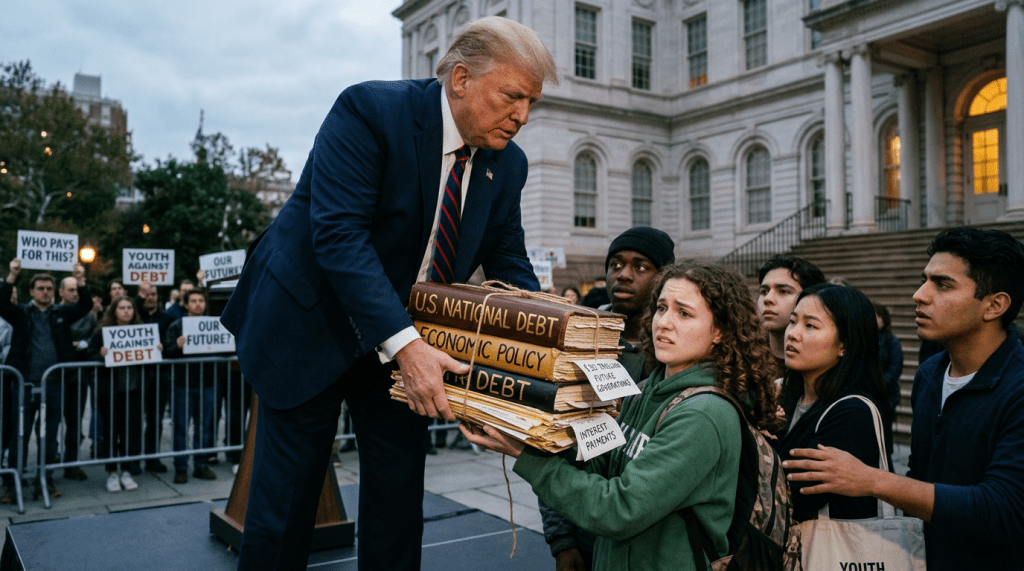
This pattern of spending contrasts sharply with other Republican fiscal policies, such as the massive tax cuts for billionaires and millionaires in 2025, which further ballooned the national debt while offering minimal benefit to the average family. News sources consistently highlight additional instances of wasteful spending, from lavish government projects to unchecked agency expenditures. Instead of returning tariff funds to taxpayers, Trump and the Republican Congress appear intent on maintaining a flow of revenue that ultimately enables a system criticized for misplaced priorities and a disregard for fiscal responsibility towards the working and middle class.
BLUE PRESS JOURNAL – The cornerstone of a functioning democracy is a free and adversarial press. However, recent events surrounding CBS and its parent company, Paramount Global, suggest that the “Fourth Estate” may be bucking under the weight of regulatory threats and corporate consolidation. When the gatekeepers of information begin to self-censor out of fear of government retribution, the democratic process itself enters a state of emergency.
The Colbert Confrontation: A Preemptive Surrender
The tension between journalistic independence and corporate interests reached a boiling point recently when Stephen Colbert, host of CBS’s The Late Show, revealed that network lawyers blocked him from airing an interview with Texas Democratic Senate candidate James Talarico.
According to Colbert, the decision was a direct response to threats from Federal Communications Commission (FCC) Chairman Brendan Carr. Carr has signaled his intent to repeal the “news exemption” for talk shows, which currently allows them to interview political candidates without being forced to provide “equal time” to every opposing candidate. While the rule has not yet changed, Colbert noted that CBS is “unilaterally enforcing it as if he had.”
This “preemptive surrender” highlights a dangerous trend: the use of regulatory “jaw-boning” to silence dissent. By threatening the licenses or the bottom lines of major broadcasters, the executive branch can effectively dictate content without ever passing a law.
Mergers, Margins, and Media Silence
The motivations behind this censorship appear to be more financial than legal. Paramount Global, recently acquired by Skydance Media—led by David Ellison and backed by Trump megadonor Larry Ellison—is currently pursuing a massive merger with Warner Bros. Discovery. Because the FCC, led by Carr, must approve such media consolidations, the network has every incentive to remain in the administration’s good graces.
Evidence of this shift is mounting. The installation of conservative figure Bari Weiss into a leadership role at CBS, despite a lack of broadcast experience, has coincided with the suppression of critical reporting. Most notably, a 60 Minutes segment exposing human rights abuses in an administration-backed El Salvadoran prison was pulled hours before airing, only to be buried later during a low-traffic time slot.
Furthermore, the abrupt cancellation of Colbert’s top-rated show—scheduled for 2026—and the resignation of veteran journalist Anderson Cooper from 60 Minutes point to a network prioritizing political alignment over editorial integrity.
The “Orbanization” of American Media
Critics argue these tactics mirror those of illiberal regimes, such as Viktor Orban’s Hungary, where the state avoids direct censorship by encouraging “regime-allied” corporations to buy up and neutralize independent outlets. When the FCC investigates programs like ABC’s The View or threatens the licenses of networks that host “uncivil” comedy, it creates a “chilling effect” where media companies become their own censors.
If the administration’s aim is to limit how critics, comedians, and opposition politicians access the airwaves, the result is a narrowed marketplace of ideas. This raises a fundamental question for the American voter: If the media is too afraid to hold power to account for fear of losing its merger approvals, who is left to protect the truth?
Sovereignty of the Script
In a defiant segment, Colbert disposed of a CBS corporate statement in a dog waste bag, asserting that the network’s lawyers approve every script in advance. His frustration underscores a grim reality: when corporate lawyers replace investigative editors as the final arbiters of truth, democracy is the first casualty.
As corporate consolidation continues to hand the keys of the media landscape to a few politically connected billionaires, the line between public discourse and state-sanctioned narrative continues to blur.
The bedrock of American democracy—free and fair elections—is under persistent assault from debunked claims of election fraud, notably propagated by Donald Trump. This ongoing narrative, termed the “big lie,” recently escalated in Fulton County, Georgia, where officials are taking extraordinary legal action against the FBI.
Fulton County Challenges FBI Over Seized Ballots
Blue Press Journal – Fulton County has requested a federal court to compel the FBI to return ballots and election documents from the 2020 election, seized during a warehouse search near Atlanta. This move responds to Trump’s “persistent demands for retribution over claims, without evidence, that fraud cost him victory in Georgia,” which have been “debunked” by numerous audits and investigations.
Fulton County’s legal filing directly challenges the FBI’s actions, asserting that the federal government breached the Fourth Amendment, which protects individuals against “unreasonable searches and seizures.” The filing argues the affidavit for the search lacked “probable cause,” instead describing “types of human errors that its own sources confirm occur in almost every election — without any intentional wrongdoing whatsoever.” As the filing succinctly states, “The Fourth Amendment demands ‘probable cause’ — not ‘possible cause.’” Fulton County Chairman Robb Pitts emphasized the gravity, stating, “This case is not only about Fulton County. This is about elections across Georgia and across the nation.”
Trump’s Rhetoric: A Threat to Democratic Norms
This incident is not isolated; it aligns with Trump’s stated desire to “take over” elections in Democratic-run areas, referencing “15 places” for targeting. Critics fear this rhetoric could lead to actions “beyond the Constitution,” a concern echoed by U.S. Sen. Mark Warner (D-Va.). Trump’s infamous 2020 call pressuring Georgia’s Secretary of State Brad Raffensperger to “find” 11,780 ballots remains a stark reminder of his willingness to undermine election results.
Despite a White House spokesperson trying to frame Trump’s remarks as supporting the SAVE Act, Trump claimed that cities like Atlanta face “horrible corruption on elections,” insisting “the federal government should not allow that.” This position directly contradicts the Constitution, which grants states authority over election administration, leading even Republican Senator Thom Tillis (R-N.C.) to state, “Nationalizing elections and picking 15 states seems a little off strategy.” The involvement of figures like Tulsi Gabbard—mentioned as Trump’s Director of National Intelligence—at the Fulton search raises concerns about the boundaries between intelligence and law enforcement.
Ultimately, the actions in Fulton County and Trump’s rhetoric embody the “big lie,” seeking to erode faith in democratic institutions and undermine elections. As Chairman Pitts said about the seized ballots, “What they’re doing with the ballots now, we don’t know, but if counted fairly, the results will be the same.” Vigilance against those undermining election integrity is crucial.
Blue Press Journal – In a sharply worded interview on ABC’s This Week, Representative Thomas Massie (R‑KY) accused President Donald Trump, senior cabinet members, and top White House officials of deliberately shielding a network of wealthy individuals tied to the late convicted sex offender Jeffrey Epstein. Massie called the effort a “systematic cover‑up” designed to protect what he labeled the “Epstein class” – a circle of billionaires who allegedly mingle with names appearing in the heavily redacted documents.
Massie reminded viewers that Trump had once promised full transparency after acknowledging social outings with Epstein‑linked guests in New York City and West Palm Beach. “He said he would be open about the issue,” Massie said, “yet he remains entrenched in the very class he vowed to expose.”
Since Epstein’s 2019 death (during Trumps first term) —officially ruled a suicide, though contested by his family—political pressure to release the remaining files has intensified. During the 2024 campaign, Trump and his allies pledged to make every Epstein‑related record public. After taking office, however, the administration stalled, dismissing the files as a “Democrat hoax” and delivering only heavily redacted versions from the Justice Department.
The limited disclosures have already raised fresh questions. According to a recent statement by Rep. Jamie Raskin (D‑MD), a search of unredacted text for “Don,” “Donald,” and “Trump” generated more than one million hits. The same files suggest deeper ties between Trump’s inner circle—Commerce Secretary Howard Lutnick, CMS Administrator Mehmet Oz, and former strategist Steve Bannon—and Epstein than previously reported.
While no direct criminal evidence against Trump or his aides has emerged, the growing web of connections fuels mounting political scrutiny. Massie seized the moment to label the current administration the “Epstein administration,” accusing it of retaliating against his push for full disclosure. In turn, Trump has publicly attacked Massie and even endorsed Massie’s primary opponent, underscoring the partisan stakes surrounding the dossier.
Blue Press Journal – The integrity of our democratic elections is a cornerstone of American society. Yet, alarming patterns of federal interference, particularly from U.S. Immigration and Customs Enforcement (ICE), threaten to undermine this fundamental right. It is unequivocally illegal for ICE or any federal agents to be present at polling sites, actively interfering with the electoral process. This isn’t just about preserving norms; it’s about upholding federal and state law against a dangerous trend of voter intimidation.
The Illegality of Federal Presence at Polling Sites
Multiple federal statutes explicitly prohibit the presence of armed federal agents at or near polling locations. The bedrock of these protections includes:
18 U.S. Code § 592 – Troops at polls: This critical federal law makes it a crime for any officer or member of the Armed Forces, or “any officer or employee of the United States,” to “bring troops or armed men to the place where a general or special election is held, unless it be necessary to repel armed enemies of the United States.” This clearly applies to federal agents like ICE, whose presence, particularly if armed or uniformed, is designed to intimidate, not to repel foreign enemies. Source: Cornell Law – 18 U.S. Code § 592
The Voting Rights Act of 1965, Section 11(b): This landmark civil rights legislation prohibits any person from intimidating, threatening, or coercing any other person for voting or attempting to vote. The presence of federal agents, especially those known for aggressive enforcement, inherently creates an intimidating environment, directly violating the spirit and letter of this act. Source: U.S. Department of Justice – The Voting Rights Act of 1965
Beyond federal statutes, numerous state laws reinforce these protections, often prohibiting armed personnel, electioneering, or interference within a specified distance of polling places. These state-level mandates underscore a bipartisan commitment to ensuring unfettered access to the ballot box, free from overt or implied coercion.
Trump’s Dangerous Playbook: Suppressing the Vote Through Fear
As leading investigative journalists have meticulously documented, Donald Trump has consistently demonstrated an unconcealed disdain for democratic elections that could undermine his pursuit of total power, his 2020 Big Lie is a prime example. Concerns about ICE’s role in this authoritarian agenda first emerged with alarming clarity in 2025. Trump launched aggressive immigration enforcement operations in major cities like Los Angeles and Chicago, then threatened to deploy National Guard troops to back them up.
Figures like California Governor Gavin Newsom and Illinois Governor J.B. Pritzker, both Democrats, immediately recognized these operations for what they were: not merely about deporting undocumented immigrants, but a preview for leveraging armed federal agents to seize control of elections and suppress dissent. Congressional Democrats have increasingly voiced alarm, especially as chaos related to these tactics escalated in communities like Minnesota. This experience shows that even absent ICE directly surrounding polls, Trump’s immigration enforcement operations spread enough fear and chaos to terrorize minority communities and significantly transform how campaigns are run.
Targeting Democracy’s Pillars
This tactic is no accident. Black, Latino, and Asian communities are major components of the Democratic Party coalition. Instilling fear and creating a climate of uncertainty within these communities serves a clear purpose: to suppress their votes and unfairly aid the Republican Party. The GOP’s historical reliance on voter suppression, whether through restrictive ID laws or purges of voter rolls, finds a new and profoundly dangerous iteration in the weaponization of federal law enforcement.
Yet, despite these brazen attempts to tear apart communities and suppress the vote, there’s a powerful counter-narrative emerging. In places like Minnesota, Trump’s actions have, ironically, spurred a rise in dispersed community networks. These grassroots efforts document ICE activities, challenge arrests, and provide mutual aid to those too afraid to leave their homes. This resilience demonstrates that while the threat to our democracy is real, so is the will of the people to protect it.
The presence of ICE at polling sites is not merely an act of intimidation; it is an assault on American democracy, a flagrant violation of federal and state laws designed to protect the sanctity of the ballot. We must remain vigilant, hold leaders accountable, and ensure that our elections remain free, fair, and accessible to every eligible voter, without fear of federal interference.
TAGS: ICE, polling sites, voter suppression, election integrity, federal law, state law, Donald Trump, GOP, democracy, civil rights, voting rights, voter intimidation, election interference, 18 U.S. Code 592, Voting Rights Act, political weaponization
Trump Tariffs Increase your Valentine’s Day Your Sweet Treat Costs
Blue Press Journal – This Valentine’s Day, many are noticing that their beloved chocolates come with a higher price tag. Beyond general inflation, a specific economic policy is playing a significant role: import tariffs on cocoa and chocolate.
During the Trump administration, the U.S. imposed substantial tariffs, impacting the global chocolate supply chain. Cocoa-producing countries faced average tariffs of 15% on their exports to the U.S., while finished chocolate products from the European Union saw duties as high as 20%. Given that the vast majority of cocoa used in American chocolate is imported, these tariffs directly escalated costs for manufacturers.
When companies pay more to import essential ingredients or ready-made chocolate, these expenses inevitably trickle down, leading to higher prices at checkout. If your Valentine’s candy budget feels strained this year, these historical trade adjustments explain the extra cost. Trump promised to lower prices day one…he lied.
Blue Press Journal – Donald Trump’s presidency has been marked by controversy, but his latest move to shutter the iconic John F. Kennedy Center for the Performing Arts for two years has many questioning the motives behind the sudden decision. Critics argue that the abrupt closure, citing the need for renovations, seems timed to coincide with the facility’s public relations woes and Trump’s own reputation crisis.
Although Trump has made efforts to spin a positive narrative around his leadership of the Kennedy Center, his actions have largely been met with negative headlines. After he hand-picked loyalists for the board who quickly elected him as chairman, ticket sales plummeted and top performers distanced themselves from the institution.
Now, in a move that has caught even some Republicans off guard, Trump is using the temporary closure as an opportunity to renovate the facility. The $257 million allocated for these renovations, as part of last year’s “Big Beautiful Bill,” has raised questions about the timing and necessity of the complete shut down. Senator Susan Collins, a Republican from Maine, expressed surprise at the unexpected closure, stating that she had understood the renovations to be already underway and progressing well.
Yet, Trump and Kennedy Center interim President Richard Grenell may need to be reminded that they cannot shut down an institution simply to avoid negative publicity. A letter signed by 70 Democratic lawmakers, including Representative Jamie Raskin of Maryland, argues that the closure likely violates federal law and raises serious legal and policy questions that must be addressed before any irreversible actions are taken.
The letter also critiques Trump’s handling of the Kennedy Center board, accusing him of purging independent trustees, altering the board’s bylaws to concentrate power in his appointees, and even defacing the national memorial to President Kennedy by adding his own name. This is a radical departure from the center’s traditionally bipartisan governance.
While Trump has promised to preserve some elements of the White House’s East Wing during his own renovation plans, the Kennedy Center’s sudden closure and renovation could be an attempt to manage public perception and distract from the facility’s mismanagement of resources under his leadership.
The fate of the Kennedy Center, a beloved American institution, now hangs in the balance as questions about Trump’s motives and legality swirl. As the country waits to see what comes next, one thing is clear: the truth behind the center’s abrupt closure and renovation will be crucial to understanding the true intentions behind this high-profile move.